
The Year the Indian Office Rewrote Its Own Rulebook
Key Takeaways
- The defining workplace trends in India in 2026 were enforced office attendance, multi-site flex portfolios, the four Labour Codes and the DPDP Rules.
- Hybrid is now office-first: in CBRE’s 2025 India survey, 94% of occupiers wanted staff in at least three days a week.
- India’s flex stock tripled from 2020 to 2025, reaching 110–114 million sq ft, so one company’s office now often spans several buildings.
- The DPDP Act’s core duties apply from May 2027, and visitor registers, badge swipes and attendance records all fall within scope.
- The Labour Codes allow women to work night shifts with consent and mandatory safety measures, making after-hours access something offices must verify and record.
- Fuller offices have not meant more engaged teams: Gallup put Indian engagement at 23% in 2025, with South Asian manager engagement falling fastest.
- Once attendance affects pay and visitor data carries legal duties, entry logs become systems of record that must be accurate, explainable and lawful.
Within a single week in November 2025, the Government of India rewrote two rulebooks that every office in the country runs on. On 14 November, it notified the Digital Personal Data Protection Rules, 2025, starting the clock on India’s first comprehensive privacy regime. On 21 November, the four Labour Codes took effect, consolidating 29 separate labour laws.
Neither announcement mentioned reception desks, meeting rooms or badge readers. Both ended up there.
Through 2026, companies wrote rules of their own. India’s largest IT services firms turned office attendance from an expectation into a tracked requirement, in one case tied to variable pay. Enterprises spread their footprint across headquarters, managed campuses and flexible centres. Visitor logs, attendance records and room bookings picked up legal and financial consequences they never used to carry.
That is the real story behind the workplace trends in India this year. The office did not return to 2019, and it did not go remote. It moved from being governed by habit and goodwill (who usually sits where, which room is usually free, whose name is in the register) to being governed by explicit rules. This piece looks at what changed, why it changed, and what the new rulebook asks of the people who run offices.
How Indian Offices Ran Before 2020: An Unwritten Rulebook
Before 2020, most Indian offices ran on assumptions nobody needed to write down. Everyone came in, so attendance was visible rather than measured. Each employee had a desk. A company had one address per city, often one building. Visitors signed a bound register at reception, which then sat open for the next visitor to read.
Meeting rooms worked on an honour system: book it on the calendar, and it was yours, whether you turned up or not. Complaints went into a box on the wall or a manager’s inbox. None of these processes generated much data, and nobody needed them to.
The arrangement held because behaviour was predictable. When behaviour stopped being predictable, every unwritten rule became something a person had to manage by hand.
Four Forces That Reshaped Indian Workplaces In 2026
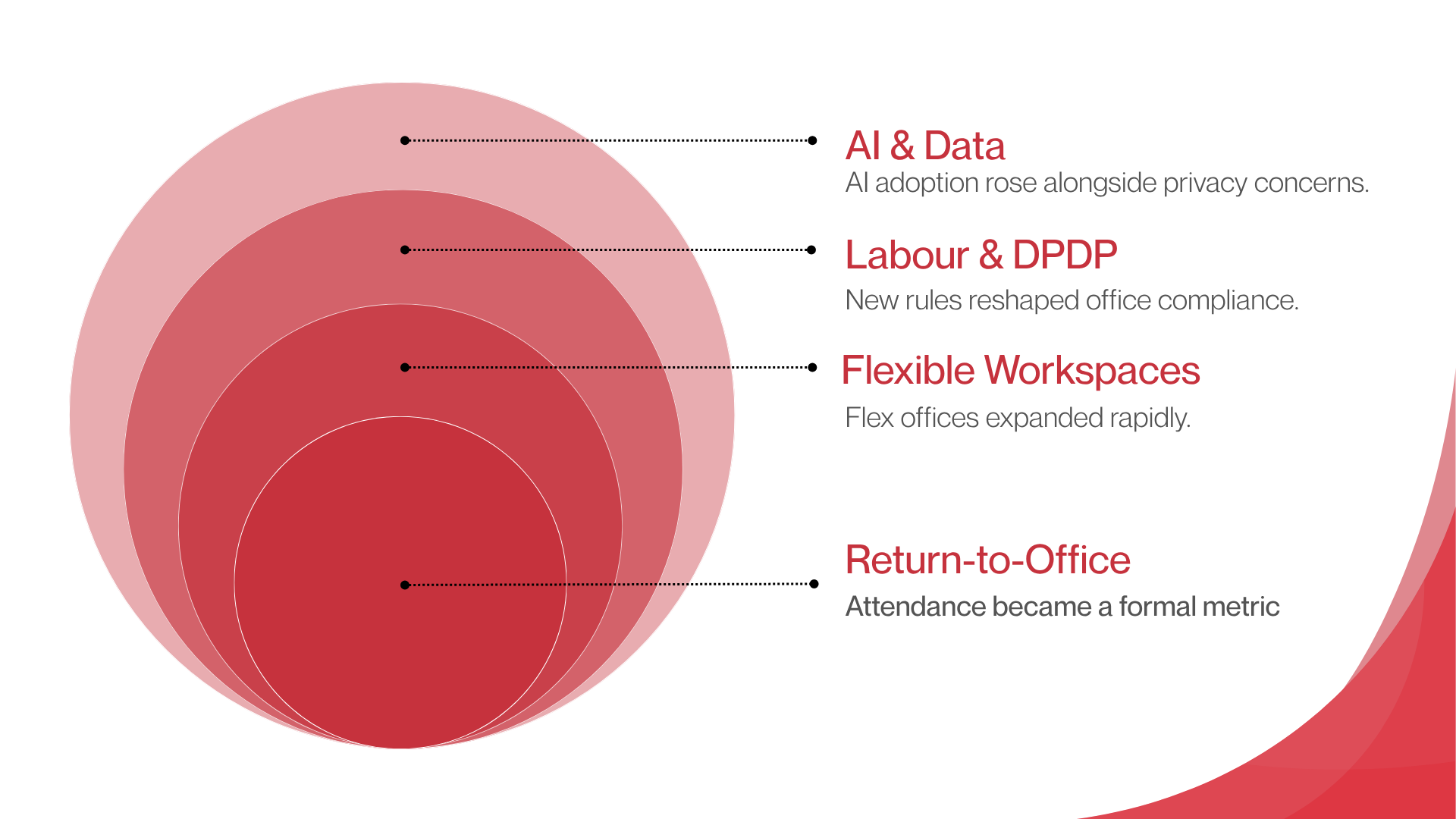
1. Return-to-office policies turned attendance into a metric
Hybrid work did not end in 2026. It got formalised. Tata Consultancy Services mandated five office days and linked variable pay to compliance. Wipro moved to three days a week with a minimum of six hours on site from the start of the year. In March, Infosys extended a four-day expectation to employees at job level 6 and above, reminded staff of a 10-day monthly minimum, and reportedly had HR review monthly return-to-office data.
The IT majors are the visible edge of a broader shift. In CBRE’s 2025 India Office Occupier Survey of more than 100 C-suite executives, 94% said they prefer staff in the office at least three days a week, and 55% reported average utilisation above 75%. In India, hybrid increasingly means office-first hybrid.
India is in step with the rest of the world here. JLL’s 2026 Global Occupancy Planning Benchmark found that 62% of organisations globally now require a fixed number of office days, up from 49% a year earlier, and that 55% of employees attend three to four days a week.
The evidence for flexibility has not gone away, though. The strongest study available, a six-month randomised trial of 1,612 employees at Trip.com published in Nature in 2024, found that two home days a week cut quit rates by a third, with no measurable effect on performance grades over the following two years of reviews. The retention gains were concentrated among non-managers, women and employees with long commutes. The trial ran in Shanghai, so it is not evidence about Indian teams specifically. Still, anyone who has done a peak-hour commute into Bengaluru’s Outer Ring Road or Gurugram’s Cyber City will understand why the commute finding travels.
That is the first tension in the new rulebook. Employers want predictable presence; the best evidence says flexibility is what keeps people. Most large Indian employers resolved it in favour of presence in 2026. Managing the cost of that choice is the job for 2027.
2. Flexible workspace turned the office into a portfolio
While attendance rules tightened, office portfolios loosened. India’s flexible workspace stock tripled between 2020 and 2025 to 110–114 million sq ft, growing 23–25% a year, according to the CBRE-FICCI “Flex-plosion” report released in March 2026. More than 500 operators now run around 2,600 centres. Bengaluru is the largest market, and Pune has the highest flex penetration in the country, at 14–16% (ANI).
Flex is no longer a startup story. The same report found that 55% of occupiers already hold flexible space and 65% expect to by 2027. Colliers projects enterprise seat uptake of around 200,000 seats a year in 2026 and 2027, roughly 25% above the 2024–25 level.
The conventional market is busy too, although consultancies disagree about how busy. CBRE recorded an all-time quarterly high of about 24.6 million sq ft of gross leasing in April–June 2026, with Global Capability Centres (GCCs) taking 42% and flex operators 27%. JLL’s count for the same quarter, using its own methodology, was 16.45 million sq ft, a nine-quarter low, though its first-half total was still the second-highest on record. The two firms agree on the driver: GCCs, which JLL puts at 41.7% of first-half leasing.
Operationally, a single company’s “office” in a city may now be a headquarters, a managed floor in a tech park and a block of flex seats across town, and one employee can use all three in a week. Any process built around one building and one reception desk breaks the moment the portfolio does.
3. The Labour Codes and DPDP Rules rewrote the legal rulebook
The Labour Codes and the DPDP Rules regulate different things, but both land inside the office building.
Three Labour Code provisions matter most for how offices run:
- Appointment letters are now mandatory for all workers.
- Night shifts are permitted for women in all establishments, subject to their consent and mandatory safety measures.
- Grievance redressal committees must include women’s representation.
For facilities and security teams, “mandatory safety measures” is concrete: it covers who can enter after hours, how that is recorded, and how people get home. Draft central rules were published at the end of December 2025 (KPMG), so details may still change, and state requirements continue to apply.
The DPDP framework is phased over 18 months, and the phasing is easy to get wrong. Here is how the Rules commence (Shardul Amarchand Mangaldas):
Phase | When | What takes effect |
One | November 2025, on notification | Data Protection Board of India constituted; its procedural rules apply |
Two | November 2026, after 12 months | Consent Manager framework and registration |
Three | May 2027, after 18 months | Notice, consent, security safeguards, breach reporting, retention and erasure, and data principal rights |
The stakes are real. According to the government’s own summary, failing to maintain reasonable security safeguards can draw a penalty of up to ₹250 crore, and failing to report a breach can draw a penalty of up to ₹200 crore. MeitY also discussed compressing the 18-month window to 12 months in January 2026 (Business Standard), but no amending notification had been located as of early September 2026 (DPDP Rules tracker).
Readiness is thin. In an EY India survey of around 150 professionals across sectors, about 71% reported limited understanding of the Act and Rules, and gap assessments, the most common first step, had been started by 48% of organisations. The sample is small, so read it as a signal rather than a census. The bigger risk is scoping: DPDP programmes tend to start with customer databases, while a large share of an office’s personal data is collected at the front door, often on paper, by staff who have never been told it is regulated.
4. AI adoption outpaced trust in workplace data
Indian enterprises are ahead of global peers on AI use. In Deloitte’s State of AI in the Enterprise 2026, based on a survey of 3,235 senior leaders across 24 countries in August and September 2025, nearly 40% of Indian respondents reported significant or full AI use, against a global average of 28%. Scaled use is highest in product development, strategy and operations, and marketing and sales; HR and finance trail.
The same research found that more than 70% of Indian respondents rated data security and privacy as a high or very high concern, and security and compliance controls were the top investment priority for 68% (CIO&Leader). For workplace teams, the takeaway is practical. Any tool that feeds occupancy, attendance or visitor data into analytics or AI inherits every DPDP question above: whose data it is, what purpose was stated when it was collected, and how long it can be kept.
Fuller Offices, Flatter Teams: Why Engagement Fell
If attendance mandates were meant to rebuild connection, the data has not shown it yet. Gallup’s State of the Global Workplace 2026 found global engagement fell to 20% in 2025. South Asia, primarily India, recorded the steepest regional drop in manager engagement, eight points, while the share of employees who are managers also fell. Gallup reads that as organisational flattening: fewer managers running larger teams. India’s overall engagement fell to 23%, its lowest in four years (Allwork.Space, reporting Gallup data).
Put that beside the attendance data, and a pattern appears. More people are coming in more often, managed by fewer and more stretched managers. JLL’s benchmark makes a related point from the real estate side: structured attendance without the support to make office days worthwhile tends to deliver compliance rather than engagement.
What employees reasonably expect from an office-first policy is modest. If the company requires them to come in, the day should work: a desk when they arrive, a room when they need one, a guest who gets through reception without three phone calls. When those basics fail on the very days everyone is required to attend, the mandate starts to look arbitrary. At that point, facilities operations stop being a back-office matter and become an engagement problem.
Why Workplace Behaviour Outran Workplace Systems
Indian offices did not lack policies in 2026. Their policies changed faster than the operational systems underneath them, and each new rule quietly assumed a capability the office did not have.
What changed | What it breaks day to day | What the system now has to do |
Attendance quotas tied to pay or leave | Entry records become HR evidence, and errors become disputes | Produce accurate, auditable presence data with a stated purpose and retention period |
Mid-week clustering around set office days | Desks and rooms run short Tuesday to Thursday and sit idle on Monday and Friday | Show live availability and release space nobody claimed |
Multi-site and flex portfolios | Each building has its own register, rules and security team | Give one view across locations, with site-level controls |
DPDP obligations from May 2027 | Open paper registers expose every earlier visitor’s details | Show a notice, record consent, collect only what the visit needs, delete on schedule |
Night-shift safety requirements | After-hours entry is informal and poorly logged | Verify who is on site after hours and keep a reliable record |
Contractors, vendors and candidates at volume | Reception becomes a queue and a security gap | Pre-register, verify and alert hosts without manual calls |
Read left to right, the table describes one chain: behaviour → operations → technology. A behaviour change (fixed office days) creates an operational problem (the Wednesday crush), which creates a system requirement (verified bookings with automatic release). Skip the middle step, and organisations buy tools that solve the wrong problem. Skip the last one and facilities teams absorb the problem by hand, which is what many did this year.
There is a second-order effect worth naming. Once an attendance record can cost someone part of a bonus, it stops being an admin log. It becomes a system of record that has to be accurate, explainable to the employee, and lawful under the DPDP Act. Visitor logs went through the same change once a privacy law applied to them. Workplace data became far more consequential in 2026, and most workplaces did not notice.
What The New Office Rulebook Looks Like In Practice
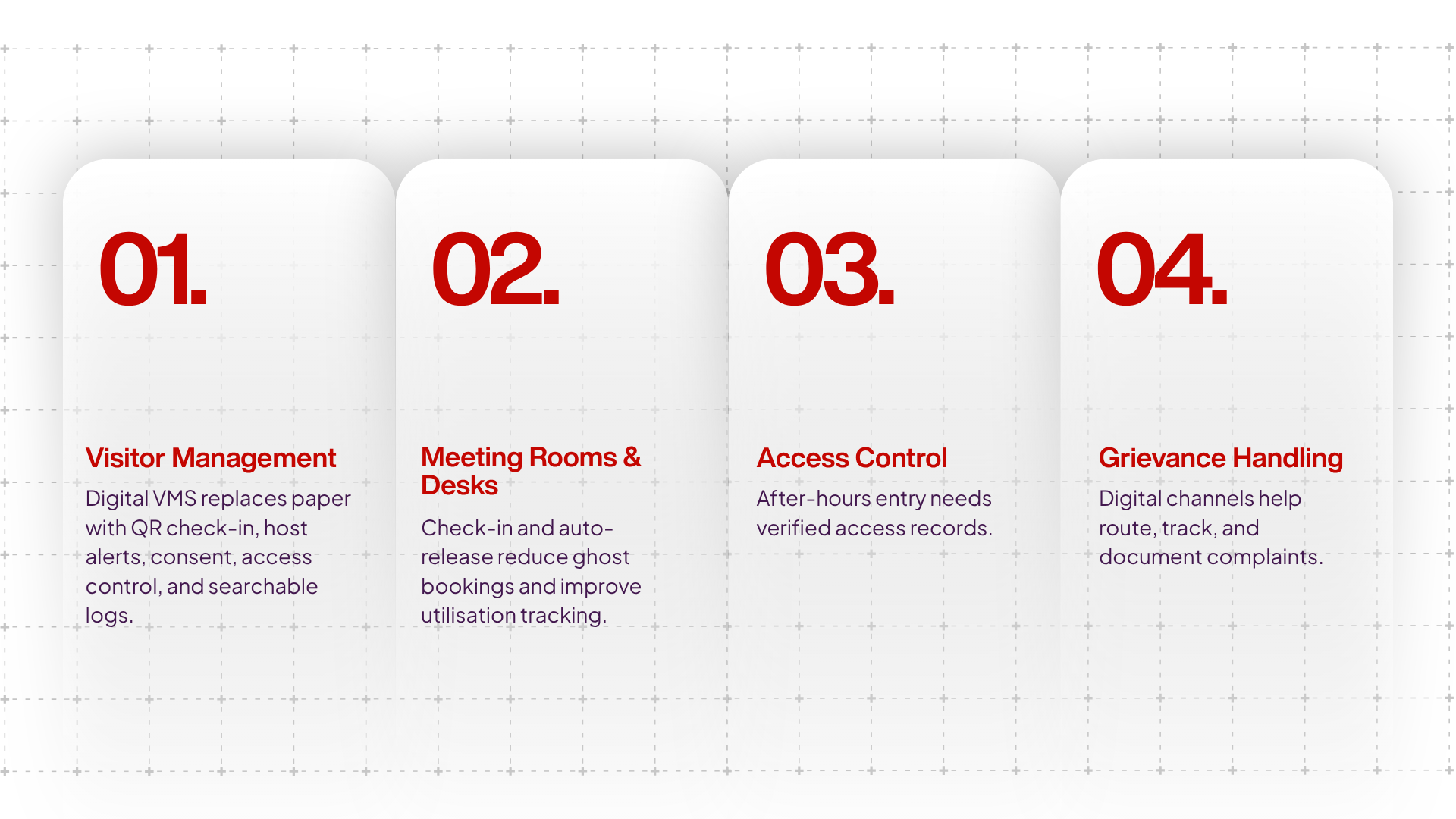
Visitor management: the front desk becomes a compliance point
Reception changed more than any other part of the office in 2026, because it is where security, privacy and first impressions meet. A digital visitor management system (VMS) replaces the paper register with a flow that captures visitor details, alerts the host, issues a pass, and keeps a searchable log. Qudify’s guide to managing office visitors digitally walks through that flow step by step.
Paper register | Digital, QR-based VMS | |
Who can read past entries | Anyone standing at the desk | Authorised staff only |
Host notification | Phone call or someone walks over | Instant alert, often on WhatsApp |
Notice and consent | Rarely captured | Shown and recorded before data is collected |
Retention | Indefinite, in a cupboard | Defined period, then deletion |
Multiple sites | Separate books, no shared view | One dashboard across locations |
Evacuation roll call | Depends on legible handwriting | Live list of who is on site |
India’s version of this technology differs from the global default in one practical way. Instead of kiosks, badge printers and dedicated apps, many Indian platforms build check-in around a QR code and WhatsApp, which has more than 500 million users in India. Visitors use their own phones and have nothing to download.
Convenience cuts both ways. Self-service check-in is only as secure as the verification behind it: host approval, pre-registration for expected guests and, on larger sites, integration with access control so that a pass decides which doors open. Under the DPDP Act, the organisation is the data fiduciary, not the software vendor, so the legal duties stay with the office whatever tool it uses. That is why a written visitor management policy matters as much as the software, and why it helps to know which legal frameworks now govern the front desk.
Paper deserves a separate line. A printed register wastes paper, but in 2026 the stronger case against it became legal: it has no access control, no retention limit, and no deletion schedule. Organisations moving off paper at reception are usually fixing a privacy problem and a sustainability problem with one change.
Meeting rooms and desks: from honour system to verified use
Mid-week clustering exposed a problem that had existed for years: the room booked on the calendar and the room actually in use are often different. Hybrid schedules made demand spiky across the week, and ghost bookings make the peaks worse. Occupancy-sensor vendor Density reported that at one Fortune 500 customer, more than a quarter of 783 booked meetings across two sites were ghosted, with nobody turning up. That is a single vendor’s case study rather than an industry benchmark, but few facilities managers will find it surprising.
The fix is to make a booking prove itself. People check in at the door, usually by scanning a QR code, and the room is released automatically if nobody does within a set window. The same logic applies to shared desks. Confirmed check-ins also produce something a calendar cannot: real utilisation data showing which rooms are too big, too small, or unused. In a flex portfolio, where every surplus seat is rent, that data pays for itself.
Access control: after-hours entry needs a record
Night-shift provisions under the Labour Codes, GCC floors working global hours and multi-tenant towers all push in one direction. Who is in the building after hours now has to be known and written down. Linking visitor and employee entry to access control closes the gap between “checked in at reception” and “authorised to be on this floor at 11 pm”.
Grievance handling: channels that show a process was followed
The Labour Codes require women’s representation on grievance redressal committees, and the POSH Act already requires an internal committee for harassment complaints. A locked box on a wall satisfies the spirit of neither: it offers no acknowledgement, no routing, and no way to spot patterns across sites. Channels that allow anonymous submission, send each issue to the right owner, and track it to closure are becoming standard for the same reason digital visitor logs are. The organisation needs to show that a process exists and was followed.
Where Qudify fits in India's new office rulebook
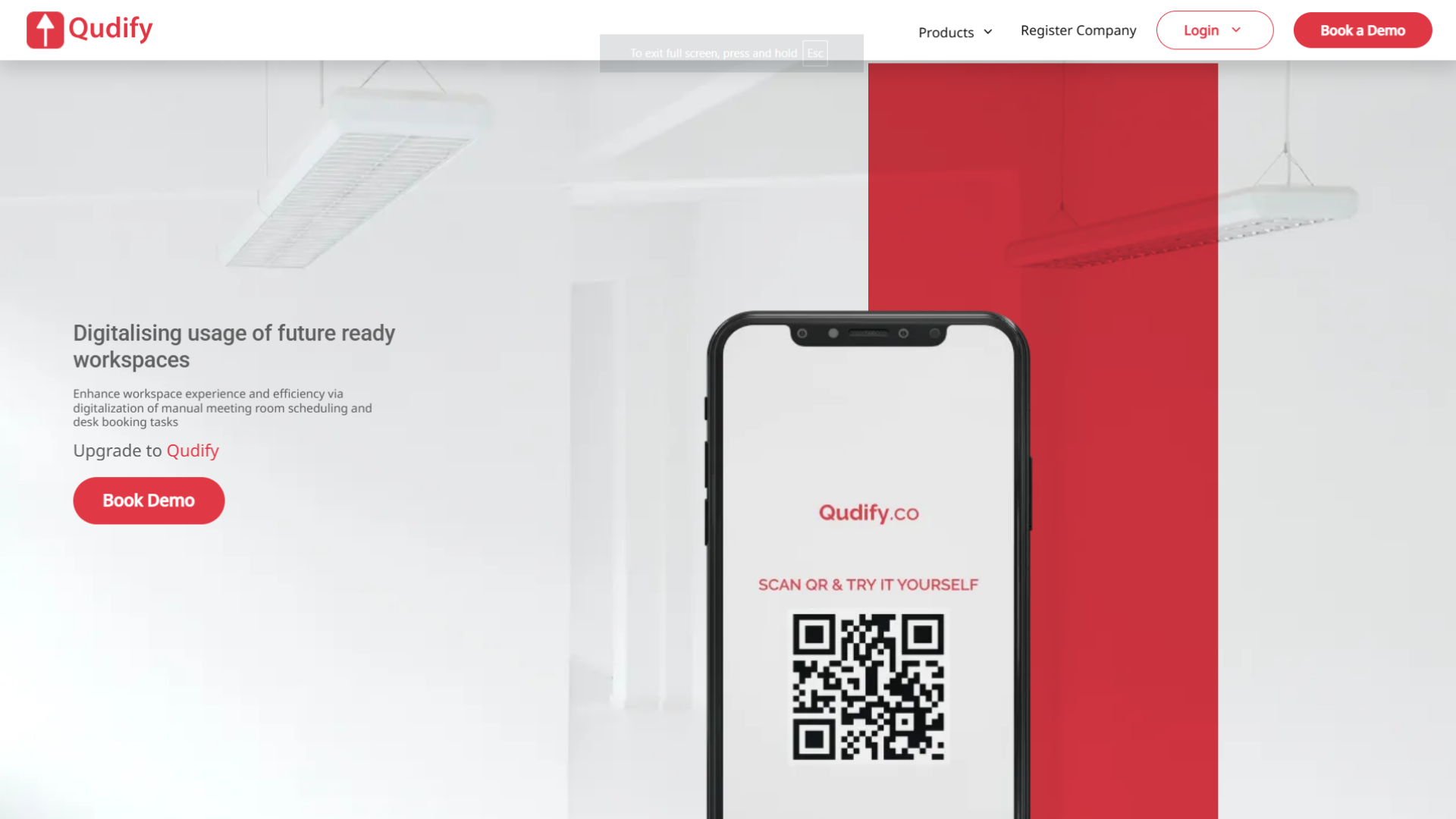
Every rule described above depends on the same thing: a reliable record of who came in, which space they used, and what they reported. Qudify, built by Gurugram-based Qdesq Realtech and launched in 2022, keeps those records on one QR-first platform covering visitor management, meeting room and desk booking and a digital feedback and complaint box.
Why Qudify stands out for Indian workplaces:
- Check-in built around how India uses its phones: Visitors scan a QR code with their own phone, and hosts approve on WhatsApp. There is no kiosk, badge printer, or app to install.
- One platform instead of three tools: Visitors, rooms, desks, and complaints share one dashboard, so facilities teams can read front-desk traffic, room use, and open issues together.
- Made for multi-site portfolios: Office-wise admin permissions let each site see its own data while leadership sees the whole portfolio, across headquarters, managed floors and flex centres.
- Bookings that prove themselves: Employees book a room or desk by scanning a QR code in the browser. Confirmations and calendar invites go out automatically, and an optional tablet display shows each room’s live status at the door.
- Configurable to your own visitor policy: Custom forms for each visitor type, digital NDAs and policies, and branded workflows let you show the right notice and collect only what a visit needs.
- Connected to the systems you already run: Qudify integrates with Google, Microsoft, Slack, and access control systems, and works with HROne HRMS and Sentinels Security.
- Rooted in India’s flex market: Qdesq Realtech also works in flexible office space, the same shift that turned Indian offices into multi-site portfolios.
- Light to roll out: It runs in the cloud and the browser, with no local installation and no device to buy for each entrance.
As with any vendor, DPDP compliance still depends on how the organisation configures notice, consent, retention, and access. During a demo, confirm retention and deletion settings, where data is hosted, and the vendor’s security certifications.
What Indian Workplaces Should Fix Before May 2027
The steps below are our recommendations, drawn from the analysis above.
- Map the personal data the building collects: Visitor registers, contractor passes, CCTV, attendance logs, and complaint forms all count, and most DPDP programmes miss them.
- Write down the purpose and retention period for every entry record: If attendance data informs pay, the employee notice should say so.
- Plan capacity for peak days: With attendance clustered mid-week, average utilisation hides the real constraint.
- Make bookings verifiable: Check-in with automatic release turns the calendar into data you can plan space with.
- Run the portfolio as one site: Headquarters, managed floors and flex seats need the same rules and a single view.
- Watch the manager layer: Attendance data shows who came in. It does not show whether teams are working well.
Three developments look likely in 2027, though none is certain. Unless MeitY compresses the timeline, May 2027 will bring visitor and attendance data into DPDP audits for the first time. Flex should keep expanding as GCC demand continues, if the CBRE-FICCI and Colliers forecasts hold. And the organisations that tightened attendance rules in 2026 will face pressure to show that office days produce something beyond compliance.
The New Indian Office Rulebook, In Five Lines
The Indian office rewrote its rulebook in 2026 along lines the office-versus-remote debate never anticipated. Neither side of that argument won. What changed instead is that unwritten rules became written ones, and written rules need evidence.
Condensed, the new rulebook reads something like this:
- Presence is policy. How often people come in is set, tracked, and sometimes tied to pay.
- The office is a portfolio. One company, several buildings, one set of rules.
- Every entry is personal data. Reception is a compliance point with a deadline.
- Bookings have to prove themselves. Calendars record intent; check-ins record use.
- Rules need receipts. For a visitor, a night-shift entry, or a grievance, the organisation must be able to show what happened.
None of these rules is about technology, yet none can be followed at scale without it. The organisations that handled 2026 best were those whose systems could tell them, accurately and lawfully, who was in the building, where they sat and why. For offices still running on registers and honour systems, May 2027 is a sensible deadline to catch up.
Frequently Asked Questions
Is hybrid work ending in India?
No, but it is becoming office-first. Large employers now set fixed office days, and most occupiers in CBRE’s 2025 India survey want staff in for at least three days a week. Flexibility survives, but inside a structure the employer defines.
How is hybrid work changing office management?
It moves the pressure from total capacity to peak-day capacity. With attendance clustered mid-week, offices need live desk and room availability, check-in with automatic release, and a single view across every site they use.
When does the DPDP Act apply to office visitor data?
The main obligations, including notice, consent, security safeguards, breach reporting, and retention, apply from May 2027. A visitor’s name, phone number, photo or ID collected at reception is personal data covered by the Act.
Who is responsible for visitor data: the office or the software vendor?
The office. Under the DPDP Act, the organisation that decides why and how data is collected is the data fiduciary and carries the legal duties. A visitor management vendor processes the data on its behalf.
Why are companies replacing paper visitor registers?
An open register exposes earlier visitors’ details, has no retention limit, and is hard to audit, which conflicts with DPDP duties. Digital systems also alert hosts faster and give one view across multiple sites.
What is a ghost booking?
A meeting room reserved on the calendar that nobody uses. It blocks space on busy days and distorts utilisation data. Check-in with automatic release is the usual fix.
Do the Labour Codes affect office facilities?
Yes. They allow women to work night shifts with consent and mandatory safety measures, which affects after-hours access, logging and transport. They also require women’s representation on grievance redressal committees.