
Key Takeaways
- Hardware-free, WhatsApp-first: Qudify and (app-based) Lobbytrack avoid kiosk and printer costs; Qudify is built around smartphone QR check-in with WhatsApp approvals.
- Best value for SMBs: Vizitor offers transparent INR pricing; piLOBI starts at roughly $10/month.
- Enterprise depth: Veris (India-built) and Envoy (global) lead on customisation, integrations, and SLA-backed support.
- Industrial and campus needs: piLOBI and Onfra track contractors, vehicles, and materials, not just office visitors.
- Compliance reality check: India’s DPDP Rules were notified on 14 November 2025, with the main compliance deadline on 13–14 May 2027. No “DPDPA-certified” label exists yet, so judge vendors on data-residency, consent capture, retention controls, and audit logs, not certification badges.
A modern visitor management system replaces the paper register at your front desk with a digital check-in flow that captures visitor details, alerts the host, issues a digital or printed pass, and keeps an audit-ready log of everyone who entered. In 2026, the best Indian platforms do this with no hardware, instant WhatsApp host alerts, and data handling built for the country’s new privacy law. This guide compares seven leading options and tells you which fits which kind of organisation.
Disclosure: This comparison is published by Qudify (a Qdesq Realtech product). We’ve tried to keep the evaluation fair and have fact-checked pricing, compliance, and market claims against public sources. Where a figure couldn’t be verified, we say so and tell you to confirm it directly with the vendor.
Quick Answer: Which Visitor Management System Should You Choose?
The best hardware-free, QR-based visitor management system for Indian SMEs and enterprises is Qudify: visitors check in by scanning a QR code on their own phone, hosts approve over WhatsApp, and there’s no kiosk, badge printer, or app to install. For India-headquartered large enterprises with complex security needs, Veris is the strongest India-built option; for global MNCs standardising across countries, Envoy; for budget-conscious mid-sized firms, Vizitor; and for industrial or high-volume campuses tracking contractors and vehicles, piLOBI or Onfra. If your front desk runs on mixed iOS/Android/Windows hardware, Lobbytrack fits.
In short: most Indian offices that want a fast, modern, low-overhead front desk should start with Qudify and step up to an enterprise platform only when on-premises storage or deep IT stack integration becomes a hard requirement.
Why the Paper Register Is Quietly Costing You
A client arrives for an important meeting and is met by a worn logbook, a half-dry pen, and a guard squinting at yesterday’s handwriting before phoning to confirm the appointment. By the time the guest reaches the room, the first impression is already dented. Multiply that by every walk-in, courier, contractor, and interview candidate, and the paper register stops being a quaint formality and starts being an operational and security liability: illegible records, no real audit trail, and personal data sitting in an open book on the desk.
That last point now carries legal weight, which is why the shift to digital has accelerated.
What Is a Visitor Management System?
A visitor management system (VMS) is software that automates how an organisation registers, tracks, and manages everyone who enters its premises. It replaces the paper logbook with a digital workflow that captures visitor details, records consent, notifies the host, issues a pass, and stores a secure, searchable record of every entry and exit.
What a Visitor Management System Does
At its core, a capable VMS handles five jobs: it captures visitor information at check-in, verifies identity, notifies and gets approval from the host, controls or logs entry, and maintains an audit-ready record. The better platforms layer on pre-registration, blacklists and watchlists, NDA signing, analytics, and integration with your access-control and HR systems.
How a Visitor Management System Works (Step by Step)
- Pre-registration or walk-in: a host invites a guest in advance, or the visitor arrives and starts a self-check-in.
- Check-in and data capture: the visitor scans a QR code, uses a kiosk, or opens an app; the system records their details and captures consent to process that data.
- Host notification and approval: the host is alerted instantly (over WhatsApp, SMS, email, or app) and approves the visit.
- Pass issued: a digital or printed pass is generated, often with a photo and validity window.
- Entry: the pass is verified at the door, optionally tied to access-control hardware.
- Check-out: the visitor signs out (or scans out), so the on-site log stays accurate in real time.
- Record retention: entries are stored for audits and compliance, then deleted per the retention policy.
Types of Visitor Management Systems
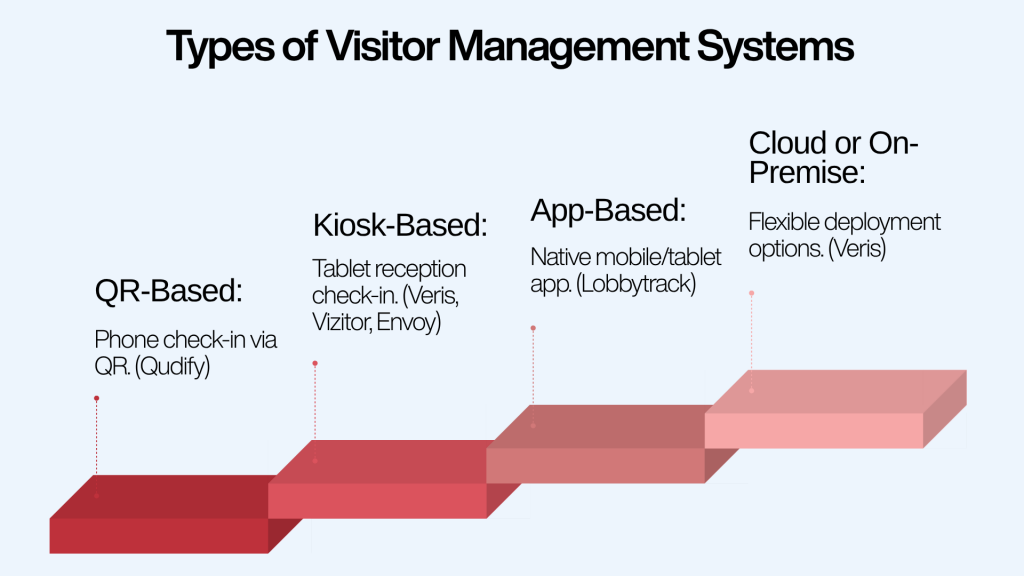
- Smartphone / QR-based (bring-your-own-device): Visitors use their own phones to scan a QR code no kiosk, printer, or app download. Lowest hardware cost and fastest to deploy. Example: Qudify.
- Kiosk / tablet-based: A dedicated iPad or tablet at reception, often paired with a badge printer. Polished but hardware-dependent. Examples: Veris, Vizitor, Envoy.
- Dedicated app-based / cross-platform: A native app running on iOS, Android, or Windows tablets, useful for mixed hardware fleets. Example: Lobbytrack.
- Deployment model: Most platforms are cloud-based (centralised, multi-site); some enterprise and high-security setups also offer on-premise storage for data-residency control. On-premise example: Veris.
What to Look For in a 2026 VMS
Beyond the basics, the leading platforms now offer:
- QR-based or touchless check-in, ideally with no app download
- Pre-registration and digital invites so visitors arrive pre-cleared
- WhatsApp and SMS host notifications instead of phone calls or buried emails
- Multi-location management from one dashboard
- DPDPA-ready data handling (consent, retention, audit logs)
- Analytics on visitor traffic and patterns
- Access-control integration with your physical security stack
The Indian Visitor Management Market in 2026
How Big Is the Market, Really?
Estimates of the global visitor management market vary widely depending on which research firm you read, so it’s worth being precise. Market Research Future pegs the market at roughly $2.03 billion in 2024, projecting growth to about USD 3,434.56 million by 2035 at a ~6.96% CAGR. Other firms put 2024 anywhere from $1.4 billion to over $6 billion, a reminder that any single “market size” figure is one analyst’s model, not gospel. What the estimates agree on is direction: steady double-digit growth, with Asia-Pacific (including India) as the fastest-growing region, and cloud-based, contactless systems leading adoption.
DPDP and Visitor Data: What Changed, and When
India’s first comprehensive data-protection regime is now operational. The Digital Personal Data Protection (DPDP) Act, 2023 was given effect through the DPDP Rules, 2025, notified on 14 November 2025. The Rules introduce an 18-month phased compliance window, putting the main enforcement deadline at 13–14 May 2027. A Consent Manager framework and the Data Protection Board’s active supervision phase fall in between.
For any organisation that collects visitor data which is virtually every organisation this means consent capture, defined retention limits, secure storage, and audit logs need to be designed in, not bolted on later. There is no government “DPDPA-compliant” certification to buy, so when a vendor claims compliance, ask how: where is data stored, how is consent recorded, how long is it retained, and can you export an audit log on demand?
DPDPA Compliance Checklist for VMS Buyers
Use this checklist when evaluating any platform’s data handling:
- Consent at check-in: Does the system show a clear notice and capture explicit consent before collecting visitor data?
- Defined retention: Can you set a retention period and have records auto-deleted afterwards?
- Data residency: Where are servers located, and can the vendor confirm Indian data-residency or equivalent safeguards?
- Exportable audit logs: Can you produce a complete record of who entered, when, and who approved them?
- Data-principal requests: Can the platform help you action access or erasure requests from individuals?
- Access controls: Is visitor data restricted by role, rather than visible to anyone with a login?
- Breach readiness: Does the vendor support the notification timelines the Rules expect?
How We Compared The Top 7 Visitor Management Systems in India
This comparison was researched first and written second. Before ranking a single platform, we verified the claims behind each one against primary and independent sources vendor pricing and product pages, third-party software directories (Capterra, GetApp, SoftwareSuggest, and similar), and official records and discarded or flagged anything we couldn’t confirm. Every platform was then assessed against five practical dimensions:
- Core features and check-in experience: what the actual visitor flow looks like in practice (QR vs. kiosk vs. app), pre-registration, host notifications, badge/pass handling, and audit logging, not just a feature checklist.
- Pricing transparency: whether real, published pricing exists and how it scales. We treated vendor figures as a starting point, cross-checked them against independent listings, and noted where a price was unverified or quoted only on request.
- Quality and locality of support: responsiveness, support channels, and whether the team understands Indian workplace, language, and compliance realities or operates at a global distance.
- Suitability across Indian business sizes and industries fit for everything from a single-office startup to a multi-site enterprise, manufacturing campus, hospital, or co-working operator, rather than a one-size-fits-all verdict.
- Readiness for India’s data-protection regime: practical DPDP Act alignment (consent capture, data residency, retention controls, exportable audit logs), judged on capability rather than on marketing labels, since no “DPDPA-certified” scheme exists yet.
A note on figures: market statistics are attributed to their source (and we flag where analysts disagree), and prices reflect publicly available information at the time of writing. Vendor pricing changes often, so treat every specific number here as a verified starting point, then confirm the current figure directly with the vendor before you buy.
The 7 Best Visitor Management Systems in India (2026)
Here are the seven platforms doing this well in India right now, with who each one genuinely fits.
1. Qudify: Best for Hardware-Free, QR-First, WhatsApp-Native Check-In
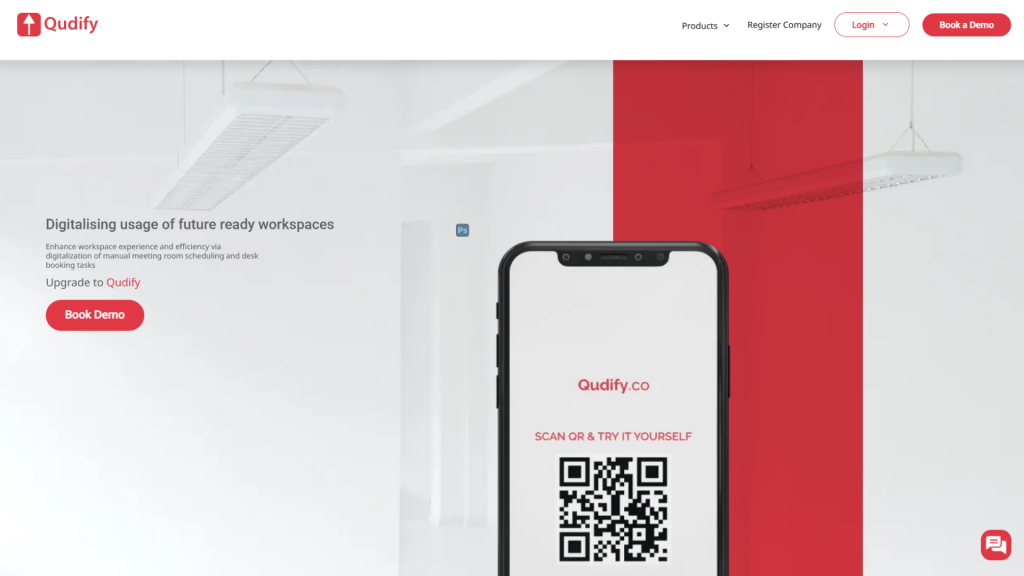
Qudify is a QR-based workplace SaaS platform developed by Qdesq Realtech Pvt Ltd and headquartered in Gurgaon, Haryana. Qdesq has shipped workspace SaaS (starting with a meeting-room and desk-booking tool) since 2022, and Qudify extends that into visitor management with a deliberate “zero hardware” philosophy: visitors check in and out by scanning a QR code on their own phone no kiosk, no badge printer, no app download.
What it does: QR check-in/out, digital pass generation and verification, pre-invites, WhatsApp-based approvals and instant host alerts, plus a wider suite (meeting-room booking, digital complaint management) and office-wise admin controls for multi-location setups. It integrates with HROne HRMS and Sentinels Security.
Best for: SMEs and mid-sized enterprises that want a polished front desk without buying tablets or printers, and ESG-minded organisations that value cutting paper and hardware waste.
Pricing and support: Scalable SaaS pricing tailored to the Indian market; contact Qudify directly via qudify.co for a quote and demo. Being India-based, support understands local workplace norms, vernacular contexts, and DPDPA obligations.
Verdict: For a genuinely hardware-free, WhatsApp-native, QR-first visitor management system built around Indian workplace realities, Qudify is the standout practical choice in 2026, especially for SMEs and multi-location offices that want a modern front desk live in a day, not a hardware rollout.
2. Veris: Best for Large Corporates, Multi-Tenant Buildings, and High-Security Sites
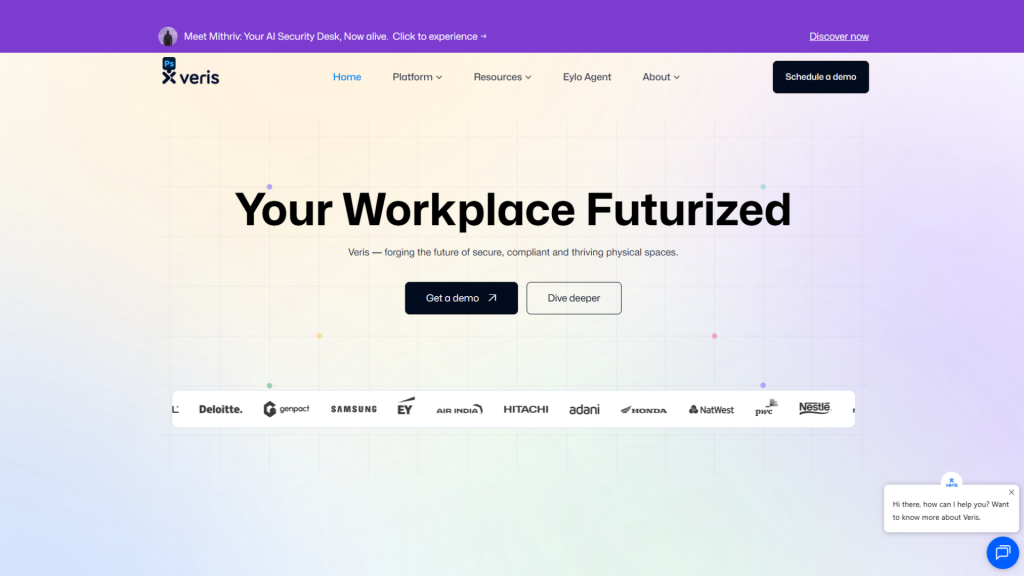
Veris is an India-born, enterprise-grade visitor platform built for complex, security-conscious environments: large corporate offices, commercial real estate, co-working operators, and high-security R&D or manufacturing sites. (Veris publishes a roster of enterprise clients on its website; verify specific logos there if you need them for an internal business case.)
What it does: self-service kiosks with image capture and badge printing; pre-registration, bulk CSV invites, and calendar invites; a drag-and-drop flow builder to customise data capture; GDPR/DPDPA-oriented workflows, digital NDAs, blacklisting, and role-based access; dedicated security-desk management; and tailored check-in flows for VIPs, contractors, candidates, and deliveries. Both cloud and on-premise deployment are available.
Best for: MNCs needing strict security and NDA handling, multi-tenant landlords needing centralised control across tenants, and facilities that require on-premise data storage.
Pricing and support: enterprise pricing on request, varying by deployment model, volume, and features; 24/7 support.
Verdict: The most battle-tested India-built VMS for large corporates, commercial real estate, and high-security facilities, with deep customisation and on-premise options most competitors don’t match.
3. Vizitor: Best for Mid-Sized, Multi-Industry Businesses on a Budget
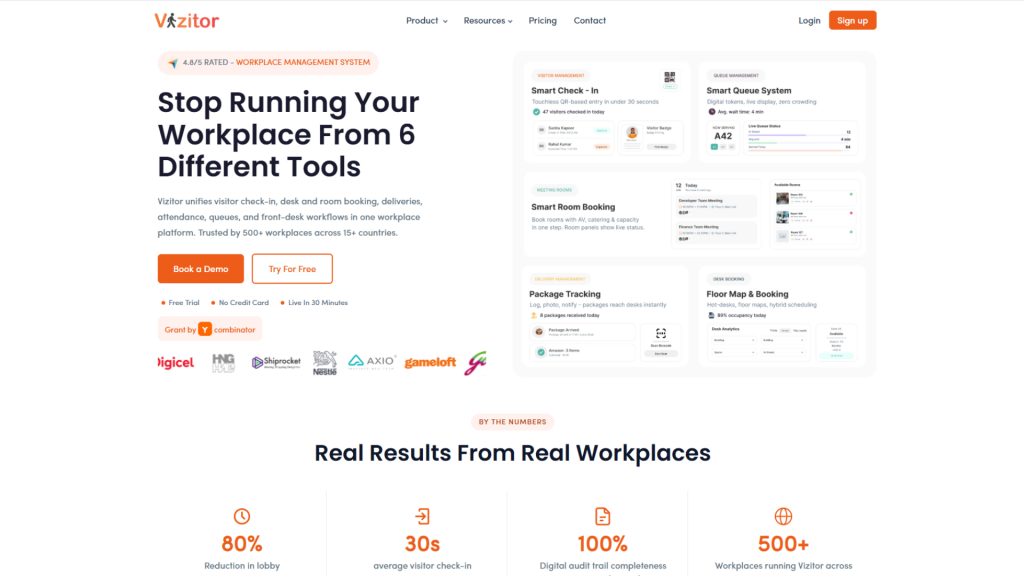
Vizitor is an all-in-one workplace platform headquartered in Mohali, Punjab. It consolidates visitor sign-in, queue management, employee attendance, desk and meeting-room booking, and delivery tracking, and is deployed across a notably wide range of Indian industries: IT offices, hospitals, universities, hotels, and salons.
What it does: self-service check-in on tablets/iPads, real-time host notifications (SMS/email/push), email invites, badge printing, digital signatures, blacklisting, overstay alerts, real-time logs, Google Directory integration, reusable validity passes for regular visitors, and multi-language support.
Best for: small-to-mid-sized businesses and diverse service industries wanting a feature-rich digital front desk without enterprise complexity.
Pricing and support: Vizitor is INR-priced, which is a real advantage for Indian buyers.Starts at ₹1,600/month/location to Enterprise pricing
Verdict: A strong pick for small-to-mid-sized Indian businesses that want depth without enterprise cost, with the rare bonus of transparent INR pricing.
4. Envoy: Best for MNCs and Global Enterprises With India Offices
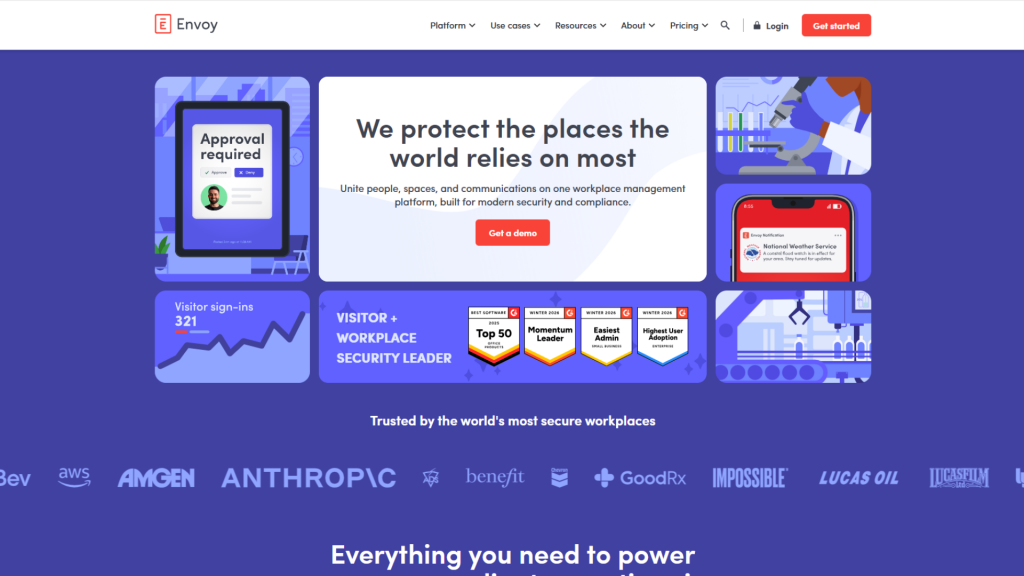
Envoy began as a pure visitor-management tool and has grown into a broader workplace-experience platform (it now also handles desk booking and delivery tracking). For global companies that want a consistent front desk across worldwide offices, Envoy is often the default.
What it does: visitor sign-in, tracking, pre-registration and screening; digital NDA signing and badge printing; host notifications by email, SMS, or app; package tracking and contact tracing; reporting dashboards; and deep integrations with Outlook, Google Workspace, Slack, Microsoft Teams, Active Directory, and common access-control and IT systems. Envoy publishes a range of compliance attestations (including SOC and GDPR); confirm the specific certifications relevant to your industry on Envoy’s trust page.
Best for: global MNCs needing one standardised system across regions, and firms heavily invested in enterprise IT stacks that demand out-of-the-box integrations.
Pricing and support: USD-denominated and billed per location. There’s a free Basic tier with limited features; Premium is about $362/location/month, with custom Enterprise pricing.
Verdict: The right call if you’re an MNC that needs seamless alignment with a global IT and security stack. For India-focused organisations, currency and per-location costs make local options more attractive.
5. piLOBI: Best for High Volume, Industrial, and High-Security Sites
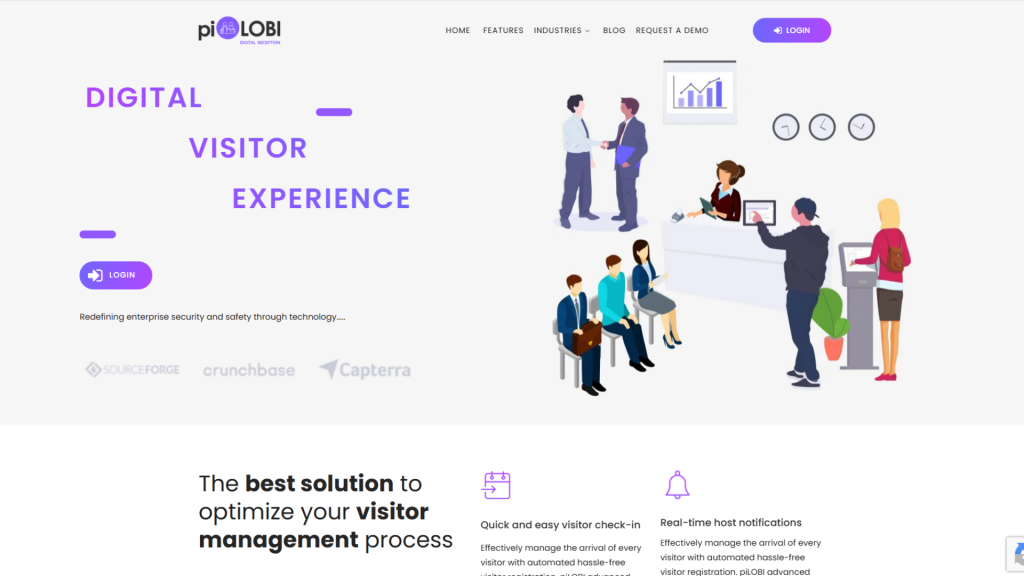
piLOBI is a cloud-based platform based in Hyderabad, with a strong reputation in industrial, manufacturing, and high-security settings where contractors, vendors, candidates, and delivery staff create large, varied visitor flows.
What it does: automated self-check-in kiosks (no receptionist needed), digital signatures, facial capture, real-time email/SMS host alerts, approval-based entry, reusable QR codes/ID proofs for frequent contractors, badge printing, watchlists/blacklisting, a live analytics dashboard, and an emergency-evacuation feature that logs exactly who is on-site during a crisis.
Best for: manufacturing and industrial campuses managing hundreds of daily contractors, and security-conscious facilities needing facial capture and evacuation accountability.
Pricing and support: an accessible entry point from about $9.99 Per Month, with custom plans for multi-location or enterprise deployments. Support is reviewed as responsive and flexible.
Verdict: Punches above its price for complex, high-volume environments; the QR reuse, facial capture, and evacuation logging suit manufacturing and facilities-heavy organisations especially well.
6. Onfra: Best for Integrated Workplace and Facility Management
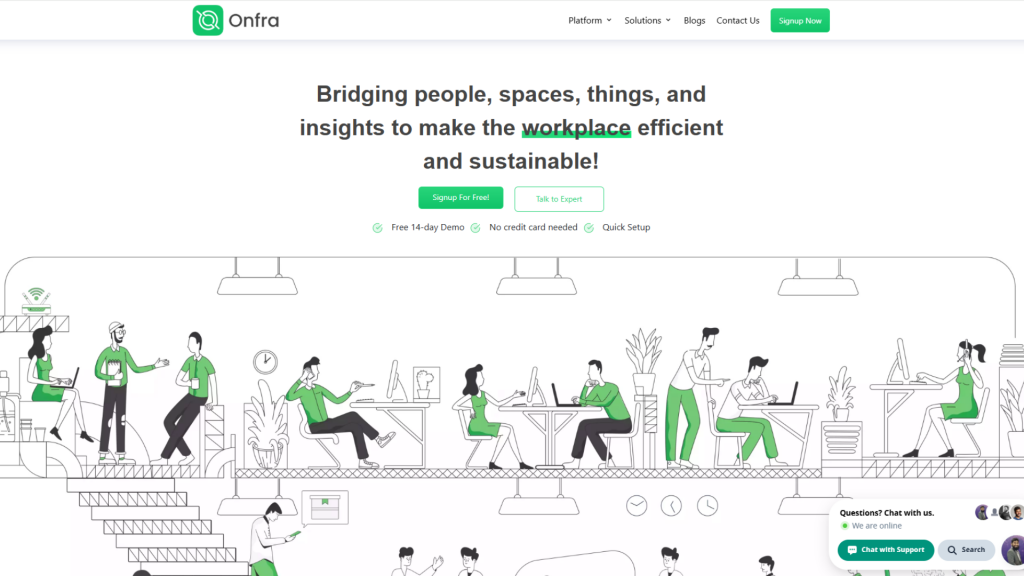
Onfra is an India-based platform that treats visitor management as one piece of a larger facility-operations picture. Alongside entry and access control, it tracks employees, visitors, contractors, vehicles, and materials, and adds space utilisation, desk and meeting-room booking, asset tracking, digital checklists, and maintenance ticketing.
What it does: the Onfra Pad self-service kiosk app, automated guest registration, badge printing, host notifications, expanded tracking of contractors/vehicles/materials, facility-ops tools (checklists, ticketing, delivery logging), and a real-time utilisation dashboard.
Best for: manufacturing and logistics sites that need to track people, vehicles and materials, and large campuses that want one platform for desks, rooms, visitors, and maintenance instead of several point tools.
Pricing and support: tailored quotes based on scale, features, and hardware (biometric scanners, kiosk tablets).
Verdict: Worth serious consideration if visitor management is just one part of a broader workplace-operations problem you’d rather solve in a single platform.
7. Lobbytrack: Best for Contactless, Multi-Platform Deployments
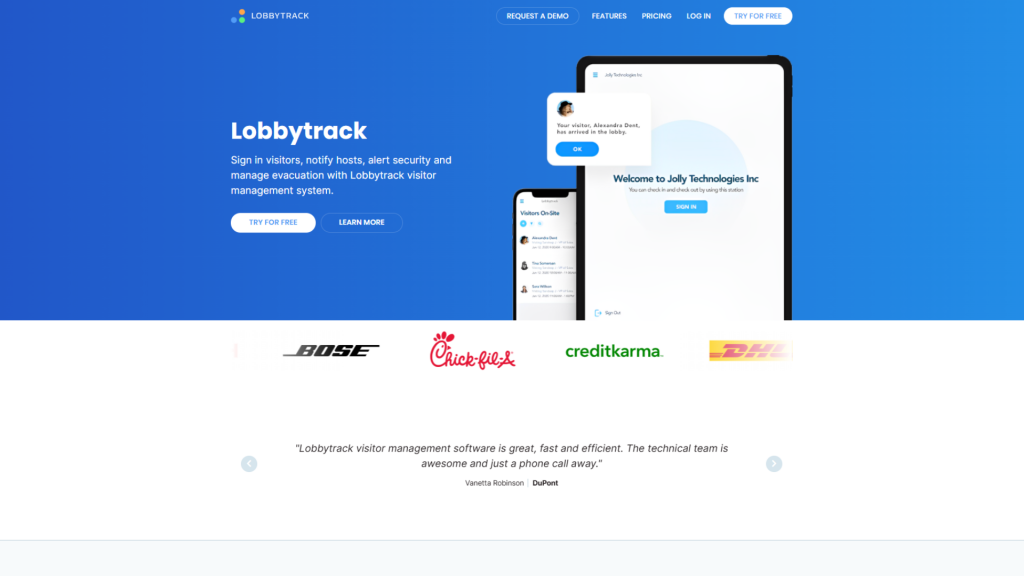
Lobbytrack is a cross-platform visitor management system known for contactless sign-in/out via mobile and tablet apps that run natively on iOS, Android, and Windows tablets. That heterogeneous-hardware support is its defining strength for businesses with mixed or legacy device fleets across locations.
What it does: a native check-in app for quick contactless sign-in/out, visitor screening and photo capture, digital NDA signing, badge printing, automatic syncing of pre-registered visitor data and access permissions across locations, and full visibility of who’s on-site.
Best for: mixed-hardware environments and fast-growing enterprises that don’t want to standardise on a single device platform and need cloud-synced records across branches.
Pricing and support: tiered plans scaling by visitor volume, locations, and features (a limited free tier has been offered; confirm current availability). Support is email/chat-based with strong self-service documentation.
Verdict: A reliable, no-fuss choice for contactless visitor management across diverse hardware, especially for businesses expanding into new sites.
Side-by-Side Comparison
| Platform | Best for | Starting price | Hardware-free? | WhatsApp alerts | India-based? | DPDPA-ready design |
| Qudify | SMEs/enterprises, sustainability-focused | Contact for quote | Yes | Yes | Yes | Yes |
| Veris | Large corporates, commercial real estate | On request | No (kiosk option) | Yes | Yes | Yes |
| Vizitor | Mid-size, multi-industry | ~₹1,250–₹1,600/mo (confirm) | Partial | Yes | Yes | Yes |
| Envoy | MNCs, global enterprises | ~$109–$395/location/mo | Partial | No (email/SMS/app) | No | GDPR + SOC; verify scope |
| piLOBI | Industrial, high-security, high-volume | From ~$10/mo | Partial | Yes | Yes | Yes |
| Onfra | Workplace + facility management | Custom quote | No (Pad app) | Yes | Yes | Yes |
| Lobbytrack | Multi-platform, contactless | Tiered (free tier may apply) | Yes (app-based) | No (app-based) | No | Verify scope |
Pricing and feature details change frequently; verify with each vendor before purchasing.
How to Choose the Right VMS for Your Organisation
Startups and Small Businesses (Under 100 Employees)
Prioritise affordable, hardware-free systems you can deploy in a day. Qudify and Vizitor’s entry plans fit this without upfront spend on tablets or printers.
Mid-Sized Companies (100–1,000 Employees) With Multiple Offices
Multi-location dashboards and centralised control matter most. Vizitor, piLOBI, and Qudify offer this at a fraction of enterprise-platform cost.
Large Enterprises and MNCs
Integration depth, compliance scope, and SLA-backed support dominate. Veris and Envoy lead, with Veris having the edge for India-headquartered enterprises and Envoy for those standardising on a global IT stack.
Industrial Facilities, Manufacturing, and Campuses
piLOBI and Onfra stand out because they track contractors, vehicles, and materials and add safety features like evacuation logging and delivery tracking.
Organisations Prioritising DPDP Act Readiness
With the 13–14 May 2027 deadline approaching, insist on clear consent capture, retention controls, and exportable audit logs. India-native platforms designed around local data handling have a practical advantage over tools built primarily for GDPR.
What a Visitor Management System Costs in India
The subscription is only part of the bill. A realistic total cost of ownership includes the software plus the hardware and overhead around it.
Subscription, Hardware, and Hidden Costs
- Software subscription: monthly/annual, often per location or per check-in tier
- Hardware: kiosks/tablets (₹8,000–₹25,000+ each), badge printers, ID scanners, cameras (only if the platform isn’t smartphone-based)
- Setup and customisation: branding, custom flows, integrations
- Ongoing: support tiers, add-ons, and per-location fees as you scale
A platform that looks cheap monthly can balloon once hardware and per-location fees are added. This is precisely where smartphone-QR, hardware-free models change the maths.
Common Mistakes to Avoid When Buying a VMS in India
- Optimising for features over adoption. The most advanced system is worthless if guards and visitors find it confusing. Prioritise intuitive, mobile-first flows.
- Ignoring total cost of ownership. Add hardware, maintenance, and per-location fees before signing.
- Underestimating WhatsApp. In India, WhatsApp is the default professional channel; host alerts there clear visitors far faster than buried emails.
- Buying global when local fits better. Western-built tools often lack regional language support, WhatsApp alerts, INR pricing, and native DPDPA handling. Evaluate India-built platforms on merit.
- Treating compliance as an afterthought. With enforcement approaching, build consent, storage, and deletion controls into your selection criteria from day one.
The Bottom Line
India’s VMS market is maturing fast, and the strongest platforms are increasingly India-native, mobile-first, and built with local compliance in mind. Touchless, pre-registered entry is becoming the standard.
- For a paperless, hardware-free approach: Qudify is one of the more thoughtfully designed domestic options.
- For large enterprises: Veris remains the most capable India-built platform for complex, multi-site, high-security operations.
- For the mid-market: Vizitor offers strong feature depth with transparent INR pricing.
The right choice depends on your size, industry, security needs, and compliance priorities, but the era of the paper register is over.
Ready to see a modern check-in flow? Book a free demo at qudify.co.
One Response