
Hybrid Workplace Management in 2026: Tools, Data and Best Practices
Key Takeaways
- Structured hybrid is the corporate default, not a perk. 96% of organisations now run a defined in-office policy, and “at least three days a week” is the single most common standard at 66%, up from 53% a year earlier (CBRE, 2026).
- Attendance is lumpy by design. Roughly 73% of organisations report Tuesday as their busiest day, while Monday and Friday sit near-empty. Peak-day demand, not average headcount, is what you have to plan around.
- Desk sharing is now the design assumption. No surveyed organisation still targets one desk per employee; the average occupancy ratio has hit an all-time high of 111%, meaning more people are assigned to a building than there are seats.
- The financial case is measurable. 79% of flexible businesses report cost savings and 72% report higher productivity (IWG, 2025); companies moving to hybrid save an estimated 10–50% on office-space costs (CBRE).
- There is a real tooling gap. 93% of employers and 90% of employees call collaboration tools essential to hybrid work, yet only about one in three companies actually invests in them (Cisco, 2025).
- Lightweight, QR-based, hardware-free tools are the mid-market answer. They let Indian enterprises and MSMEs adopt hybrid-grade coordination without the kiosks, badge printers and IT overhead that legacy platforms assume the exact category Qudify was built for.
Somewhere between the all-remote scramble of 2020 and the five-day mandates a handful of companies have tried to reimpose, most organisations have settled on something quieter and more durable: structured hybrid work, coordinated with whatever mix of spreadsheets, chat polls and half-used badge readers happened to be in the building when the doors reopened. That improvisation phase is over. In 2026, hybrid work is no longer a policy debate it is an operations problem, with its own software category, its own benchmarks, and its own failure modes.
This guide is a from-scratch rebuild of what that means in practice. It covers what the tooling actually has to do, what the latest primary-source data says about how hybrid offices behave, how the picture looks specifically for Indian enterprises and MSMEs, and how to build a management approach that doesn’t fall apart the moment everyone shows up on a Tuesday. Where the internet is awash in recycled statistics, we have traced each number back to its origin the workplace benchmarking programmes at CBRE and JLL, the Cisco Global Hybrid Work Study, peer-reviewed research, and India’s own regulatory record.
What Is Hybrid Workplace Management?
Hybrid workplace management is the set of systems and practices an organisation uses to coordinate people, space and schedules when employees split their time between home and the office rather than working from one fixed location full-time. In day-to-day terms, it spans desk and meeting-room booking, attendance visibility, space-utilisation analytics and increasingly visitor management. It is all the coordination work that used to be implicit when everyone simply turned up five days a week.
The reason this has hardened into its own software category, rather than a feature bolted onto existing office tools, comes down to one word: variance. A fixed office with fixed seating doesn’t need booking software. A fluctuating one where attendance can swing from 30% to 80% of capacity inside a single week genuinely cannot be run from memory or a shared spreadsheet once headcount passes a few dozen people. Purpose-built coordination software has moved from optional to core infrastructure precisely because hybrid attendance manufactures unpredictable peaks and lulls.
The market has grown to match. The global hybrid-workplace technology market was valued at roughly US$4.9 billion in 2023 and is projected to reach US$21.1 billion by 2032, a compound annual growth rate of about 18.3%, according to Market.us. (Estimates vary by analyst; IMARC Group, for instance, models a more conservative ~15.6% CAGR but every credible forecast points the same direction: sustained double-digit growth.) Tellingly for this discussion, small and mid-sized enterprises already account for around 72% of that market, per Market.us, a reminder that hybrid tooling is no longer an enterprise-only purchase.
The State of Hybrid Work in 2026: What the Data Actually Shows
Before the tools, the terrain. The popular narrative of a slow, chaotic drift back to offices is wrong on the specifics. The data describes something far more structured.
Structured Hybrid, not "Come in Whenever," is the Standard.
The loose flexibility of 2022 has given way to defined policy. CBRE’s 2026 Global Workplace & Occupancy Insights, drawing on client portfolios covering roughly 303 million square feet, finds that 96% of organisations now have a targeted in-office policy, and the most common arrangement, “mostly in the office three or more days a week,” has climbed to 66%, up from 53% in 2024 and 49% in 2023. Fully in-office (5%) and fully remote (0%) are both increasingly rare, and even a straight 50/50 split has fallen from 33% to 23%.
JLL’s Global Occupancy Planning Benchmark Report 2026, based on 84 organisations representing 716 million square feet, tells the same story from a different sample: 62% of organisations now require fixed in-office days, up from 49% a year earlier, and around 70% of employees attend three to five days a week. Fully remote work has shrunk to roughly 10% of the workforce, down from 18%.
The takeaway for anyone buying tools: you are not planning for chaos. You are planning for a predictable “3-2” rhythm: three office days, two remote with sharp, recurring peaks.
Attendance Clusters Midweek: the "Tuesday Effect"
Those peaks land on the same day almost everywhere. CBRE finds that about 73% of organisations report Tuesday as their highest-attendance day, far ahead of Wednesday (23%) and Thursday (3%), while Monday (0%) and Friday (1%) are consistently the quietest. This isn’t a quirk; it’s a planning constraint. Sizing desks and rooms to average weekly headcount guarantees a shortage every single Tuesday, which is exactly the experience that pushes people back home (“I commuted in and there was nowhere to sit”). We’ll return to what to do about this in the planning section.
Offices are Fuller than they've been in Years but still Below Target.
Utilisation has recovered meaningfully. CBRE reports global average building utilisation reached 53% in 2025, its highest since before March 2020, up from 38% in 2024 and 35% in 2023, with average peak utilisation now around 80%. JLL’s benchmark puts global utilisation slightly higher at 56%, against a target of 74% and, importantly, notes the gap between actual and target utilisation narrowed for the first time since the pandemic, from 25 percentage points to 18. Different studies, different samples, same signal: offices are being used far more deliberately than in 2021, but there is still meaningful slack between how full companies want their buildings and how full they actually are.
Desk Sharing is the Default Design Assumption.
This is perhaps the single biggest structural shift, and it changes what “an office” even means. Per CBRE, no surveyed organisation now targets one desk per employee. The global occupancy ratio has reached an all-time high of 111% more people assigned to a building than there are physical seats, up from 101% a year earlier. Desk sharing is mainstream: 69% of organisations report that more than 40% of their workforce shares desks, and the most common target is now a moderate 1.01 to 1.49 people per seat (chosen by 48% of respondents, up sharply from 21% in 2024). Aggressive ratios above 1.5:1 have actually fallen out of favour. In other words, companies have committed to sharing, but they’re doing it with more discipline and more data.
The Financial Case is Real, and it's Why Footprints are Shrinking.
The economics are the engine behind all of this. Research from IWG finds that 79% of flexible businesses report cost savings, 72% report improved productivity, and 71% say flexibility strengthens their ability to attract and retain talent. Global Workplace Analytics estimates employers save up to roughly US$11,000 per year for each employee who works remotely two to three days a week, and CBRE data suggests companies shifting to hybrid save between 10% and 50% on office-space costs.
Those savings are showing up in real-estate decisions: CBRE finds 57% of organisations expect to contract their office footprint over the next three years, up from 48%, and 67% of those say the primary reason is simply that less space is needed under hybrid work. This is why utilisation data has stopped being a facilities curiosity and become a board-level input.
The Technology Adoption Gap is the Crack Most Companies Fall into
Here is the tension at the centre of this entire topic. A large majority of both employers (93%) and employees (90%) say collaboration and coordination tools are essential to making hybrid work, according to the Cisco Global Hybrid Work Study 2025, yet only about one in three companies is actually investing in them, and more than 75% of employers admit they’re still working out the right balance. Everyone agrees the tools matter. Most haven’t bought them. That gap not the choice of any single platform is the most common reason hybrid coordination stays painful.
A quick benchmark reference, all figures from the primary sources above:
Metric (2026) | Figure | Source |
Organisations with a defined in-office policy | 96% | CBRE |
Most common policy: 3+ office days/week | 66% | CBRE |
Busiest day is Tuesday | ~73% of orgs | CBRE |
Global average building utilisation | 53% | CBRE |
Global utilisation vs target | 56% vs 74% | JLL |
Occupancy ratio (people per seat) | 111% | CBRE |
Organisations planning to shrink footprint (3 yrs) | 57% | CBRE |
Employers reporting cost savings from hybrid | 79% | IWG |
Say collaboration tools are essential (employers/employees) | 93% / 90% | Cisco |
Companies actually investing in those tools | ~1 in 3 | Cisco |
Hybrid Work in India: A Distinct Market With Distinct Needs
Most global hybrid-work coverage is written for the North American enterprise. India’s reality is different enough that copying that playbook wholesale is a mistake, and this is the context that matters most for organisations reading a guide like this one.
Adoption is deep, especially in technology. NASSCOM reports that nearly 70% of organisations in India’s technology industry have adopted a hybrid model. Employee demand is strong across the board: NASSCOM–Deloitte research indicates about 74% of Indian employees now prefer hybrid over fully remote or fully in-office arrangements, and a PwC India survey found 52% of Gen Z employees would reject a job that didn’t offer hybrid flexibility. Employers know it: Cisco found that 88% of Indian employers say flexible work is important for retention, the second-highest rate of any market surveyed globally, well above the 83% average.
But the Indian picture has a sharper edge on retention risk. Analysis by AceNgage suggests attrition risk is roughly 2.3x higher in Indian organisations that impose rigid in-office mandates after employees have already adapted to hybrid, a costly outcome in a market where skilled-talent competition is fierce. At the same time, engagement is fragile: Gallup’s State of the Global Workplace 2026 estimates that disengagement costs India’s economy around US$351 billion, close to 9% of GDP, with employee engagement at a four-year low. The lesson is not “avoid the office”; it’s that in India, badly designed hybrid policy carries an unusually steep retention and engagement penalty.
There is also a structural point that shapes tooling. Much of India’s economy runs through mid-sized enterprises and MSMEs, not thousand-desk corporate campuses. These organisations face the same coordination problems as global enterprises the Tuesday crush, desk sharing, visitor flow but without the capital budgets, dedicated IT teams, or appetite for multi-month deployments that legacy platforms assume. That mismatch, more than anything, is why lightweight, smartphone-native tools have found traction here. Qudify frames its own mission around exactly this population: bringing the digital experience of a Grade-A building to the roughly 1.48 million Indian enterprises and MSMEs that would otherwise never afford one.
The Core Tools Every Hybrid Workplace Needs
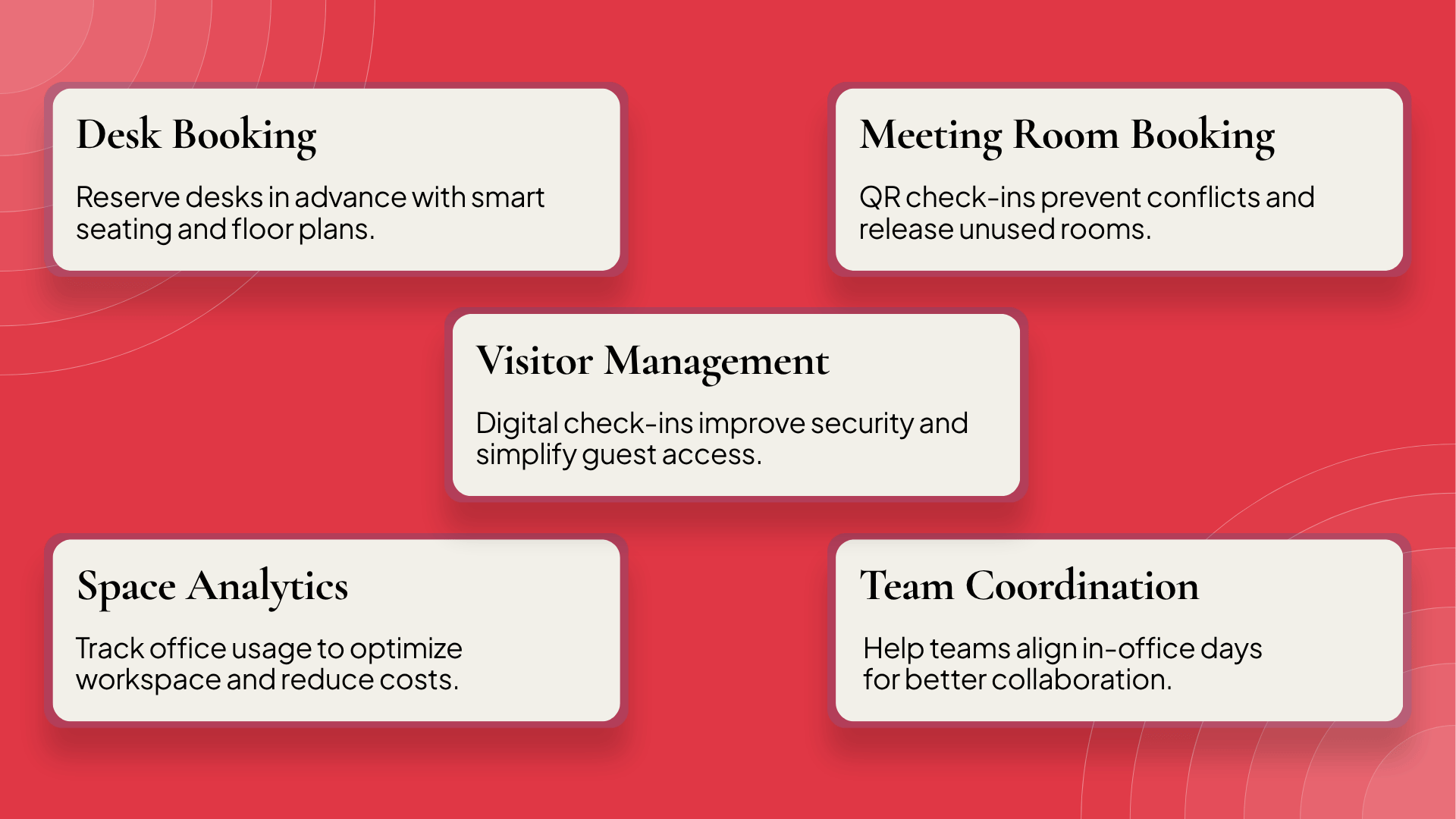
Five tool categories show up consistently across functioning hybrid setups. Each solves a distinct coordination problem; together they close the adoption gap described above.
1. Desk and Hot-Desking Booking
With desk sharing now the norm rather than the exception, a system that lets employees reserve a seat before they leave home has moved from convenience to necessity. It kills the morning scramble and prevents the overcrowding that peak days otherwise guarantee. The strongest systems add filtering by amenity (dual monitors, standing desk, quiet zone), interactive floor plans so people can pick where they sit, and recurring bookings for anchor days. Done well, desk booking is also your cleanest source of demand data; every reservation is a signal about how much space you actually need.
2. Meeting Room Scheduling and QR-Based Check-in
Room conflicts remain one of the most persistent daily frictions in any hybrid office: a room booked on a calendar but occupied by someone else, or reserved and never used (the “ghost booking” problem). QR-based check-in solves this cleanly: each room carries a unique code, and a quick scan confirms occupancy in real time, automatically releasing no-shows back into the pool.
This is Qudify’s home turf. The platform was built around QR-based internal meeting-room booking that lets an employee scan a code, reserve a room instantly, and see live occupancy status on a tablet display outside each room without a dedicated app download or additional hardware beyond the phone already in everyone’s pocket. For a mid-sized office, that “no app, no kiosk” model removes most of the adoption friction that kills room-booking rollouts.
3. Visitor Management
As offices fill back up, the front desk becomes a hybrid-adjacent problem in its own right. When the host is working remotely, they still need to know the moment a guest arrives, and paper registers create both a security gap and an unnecessary environmental cost. Hardware-free, WhatsApp-first approaches, which avoid kiosk and printer costs entirely, are increasingly the preferred route for Indian offices, as Qudify’s own comparison of visitor management systems in India for 2026 lays out in detail. Crucially, visitor data is also where a new compliance obligation now bites more on that in the DPDP section below.
4. Space Utilisation Analytics
None of the booking data above is useful sitting in isolation. Its real value comes from aggregation, turning individual reservations into utilisation patterns that inform real-estate decisions. With 57% of organisations planning footprint reductions, and utilisation now the single most-tracked metric in corporate real estate per CBRE, those decisions need months of actual occupancy data behind them, not a single snapshot or a manager’s gut feel.
5. Employee Coordination and "Team-day" Tools
A booking system alone doesn’t answer the question people actually care about: who from my team is in on Tuesday? Solving that requires visibility into team schedules so colleagues can deliberately coordinate in-person days rather than each showing up to an empty floor. This is a distinct problem from facilities booking, and the best hybrid stacks address both because an office that’s technically full but socially empty defeats the entire purpose of coming in.
Why QR-Based, Hardware-Free Tools Are Gaining Ground
Running underneath the enterprise conversation is a quieter shift: lightweight, QR-based platforms are emerging as a genuine alternative to hardware-heavy legacy systems, not just a budget compromise.
The core insight is that most workplace software historically assumed large enterprise budgets, dedicated kiosks, badge printers, tablet installations at every door, and IT teams to maintain all of it. That model works fine for a handful of Grade-A corporate campuses. It locks out the far larger population of mid-sized offices that need the same coordination problems solved without the same capital outlay. QR-first tools invert the hardware assumption: if the only device you truly need is a smartphone everyone already carries, you can stand up desk booking, room scheduling and visitor check-in in a day rather than a quarter.
Qudify was built explicitly to close that gap, describing itself as India’s first “DIY” (do-it-yourself) SaaS in this category, with new-office onboarding completed in a maximum of about 20 minutes regardless of how many locations are involved, and centralised, cloud-based monitoring across multiple offices while keeping physical touch points to a minimum.
There’s also a sustainability angle that’s easy to overlook in a category usually discussed in desk counts and occupancy percentages. Replacing paper visitor registers, printed room schedules and physical sign-in sheets with QR workflows removes a recurring source of waste. Qudify positions this decarbonisation benefit as central rather than incidental, noting that even a single sheet of office paper carries a lifecycle footprint of roughly 4.64g of CO₂-equivalent, which compounds quickly across millions of visitor entries and meeting logs. For organisations with ESG reporting obligations, that turns a convenience feature into a measurable line item.
Ask for the API documentation before you sign anything. If it cannot be produced within a week, that is your answer.
DPDP and the New Compliance Reality for Workplace and Visitor Data
Anyone evaluating hybrid tools in India in 2026 has a new box to tick that didn’t exist eighteen months ago, and it deserves its own section because it’s routinely missed.
India’s Digital Personal Data Protection (DPDP) Rules were notified in November 2025, operationalising the DPDP Act, 2023. The rollout is phased over roughly 18 months, with full compliance required by 13 May 2027, and the Consent Manager framework coming into force around November 2026, per legal analyses from firms including Fisher Phillips. This makes 2026 a “build year” the window in which organisations are expected to redesign consent, notice and data-handling workflows before enforcement.
Why does this land on workplace software specifically? Because a visitor management system is, functionally, a personal-data collection engine. Every check-in captures a name, a phone number, often a photo and a company affiliation precisely the kind of personal data the Rules govern. Under DPDP, organisations acting as Data Fiduciaries are responsible for obtaining valid consent, providing clear notice of purpose, honouring erasure once the purpose is served, and reporting breaches on tight timelines, with penalties running to hundreds of crores. That responsibility rests with the organisation collecting the data even when a third-party processor is involved.
The practical implication for tool selection: front-desk and visitor data can no longer be treated as a throwaway paper log. When you evaluate a visitor or workplace platform now, DPDP-readiness is a genuine criterion, not a nice-to-have. Look specifically for:
- Consent capture at the point of check-in, with a clear, plain-language notice of why data is being collected and how long it’s kept.
- Data-residency clarity where visitor and employee data is stored, given the Rules’ provisions around localisation for certain categories.
- Retention and erasure controls, so records are deleted once their purpose (e.g., a completed visit) has passed rather than accumulating indefinitely.
- India-based support that understands local compliance nuance, which matters more than it sounds when an obligation is this new.
This is an area where India-built, India-hosted platforms have a structural advantage, and it’s part of why Qudify’s visitor management comparison treats DPDP alignment as a first-class evaluation factor rather than a footnote.
How to Size and Plan a Hybrid Office
Software can’t rescue a badly sized floor plan. Before you buy anything, get the capacity maths right, and the maths is counterintuitive.
Plan for the peak, treat quiet days as the buffer. Because attendance clusters so heavily on Tuesdays (and to a lesser extent Wednesdays), the average across a week is a misleading number to size against. CBRE’s benchmarking illustrates the swing precisely: a large majority of organisations report peak-day occupancy running effectively at capacity, while the same organisations report typical-day utilisation well below 60%. Size fixed seating to that average and your busy days become a scramble for desks; size everything to the absolute peak, and you spend four days a week heating and cleaning a near-empty building.
The resolution most high-performing offices land on is a hybrid of the two: size a base of fixed seating to steady demand, then cover peak-day surges with shared, bookable space, hot desks and bookable rooms that are meant to swing between full and empty. That’s what a 1.01–1.49 sharing ratio actually operationalises. And it only works if you have booking data to see the peaks coming, which closes the loop back to why the tools matter. Put simply: the desk-booking system isn’t just a convenience for employees; it’s the instrument that tells you how much building you need to pay for.
Measure these before you integrate, or you will have no way to prove the project worked.
Best Practices for Managing a Hybrid Workplace in 2026
The tools are only as good as the practices they sit on top of. A handful of principles separate hybrid setups that run smoothly from ones that generate constant friction.
Design for peak days, not average attendance: As covered above, the Tuesday cluster is near-universal. Build capacity around the busiest expected day and treat the quieter days as slack, not the baseline.
Let teams co-design their in-office schedule: This is the most under-used lever available. Gallup data finds only about 11% of employees say their team had any input in setting its hybrid policy, even though teams that reach agreement together report the fairest, most collaborative outcomes. A policy handed down without consultation produces exactly the disengagement the broader data keeps surfacing. Anchor days chosen with a team stick; anchor days imposed on a team get quietly ignored.
Treat booking data as a real-estate input, not just a convenience feature: With more than half of organisations actively weighing footprint reductions, the utilisation data your desk and room bookings generate should feed directly into that decision, not sit unread in a dashboard nobody opens until the annual lease review.
Match the tool’s weight to the company’s actual scale: A large share of hybrid-tooling friction comes from mid-sized companies adopting enterprise-grade platforms built for thousand-desk campuses. Matching complexity to genuine need a lightweight, QR-based system for a smaller office rather than a full enterprise suite tends to produce faster adoption, which is the whole game. Software nobody uses solves nothing.
Pair mandates with change management, or expect them to fail quietly: This is where the research is bluntest. JLL notes that even as structured policies have tightened, the share of organisations running formal change-management programmes has fallen, from 40% to 31%. CBRE finds a parallel gap: only 15% of organisations provide substantial hybrid-management training for managers, even while manager discretion drives 67% of hybrid arrangements. The result is compliance without engagement, attendance on paper, and resentment underneath. Communicating a policy is not the same as supporting it.
Close the technology gap deliberately: Given that 90% of employees say they need effective coordination technology but only about a third of companies invest in it, closing the gap is less about finding one perfect platform and more about treating hybrid tooling as core operating infrastructure rather than a discretionary purchase revisited only when complaints pile up.
Common Hybrid Workplace Management Mistakes
Most missteps here are variations on a single error: treating a structural, ongoing coordination problem as a one-time policy announcement.
Announcing a policy without the infrastructure to support it: Mandating three office days before ensuring there are enough desks, rooms and visibility tools to make that mandate livable is the most common failure point. The mandate becomes the reason people resent the office rather than return to it.
Ignoring the midweek skew when planning space: Building capacity around average headcount rather than peak-day demand is a near-guaranteed way to have employees commute in only to find no desks available the single fastest way to erode trust in a return-to-office policy.
Treating visitor management as separate from workplace management: Front-desk flow and internal desk/room booking are often bought as entirely separate systems from separate vendors, creating two disconnected data sets and two compliance surfaces. A unified approach gives facilities and security teams one clear picture instead of two partial ones.
Underestimating the retention cost of rigid mandates: The evidence here is unusually strong. A University of Pittsburgh study of S&P 500 firms (Ding and Ma, SSRN) found that strict return-to-office mandates tended to follow stock-price declines, produced no measurable improvement in firm value or financial performance, and significantly lowered job satisfaction. A large-scale Stanford randomised controlled trial of 1,612 employees, published in Nature, found hybrid workers performed just as well as fully in-office peers on every measure while resignations fell by about a third. In India specifically, AceNgage puts the attrition risk of rigid mandates at roughly 2.3x. Rigidity has a price, and it usually shows up as your most senior, most skilled people leaving first.
Buying enterprise-grade complexity for a mid-market problem: As covered throughout, this mismatch is expensive twice over in direct software cost, and in the slower adoption that comes from asking employees to learn an over-engineered system for a comparatively simple coordination task.
Choosing Hybrid Tools by Company Size
Not every organisation needs the same category of tool. Matching the choice to your profile avoids both under- and over-investment.
Organisation profile | What matters most | Best-fit tooling |
Small / mid-sized offices (~20–300 desks) | Fast, DIY setup; no kiosk or badge-printer cost; minimal IT | Lightweight, hardware-free, QR-based systems deployable in under an hour, the profile Qudify targets |
Multi-floor, multi-department enterprises | Wayfinding, team clustering, deeper customisation | Room-and-desk platforms with floor-plan and neighbourhood features on top of basic booking |
Organisations with active ESG / sustainability reporting | Measurable environmental impact | Platforms that explicitly track the carbon/paper footprint of workplace operations, not just occupancy |
Offices juggling both visitor flow and internal booking | One connected data set; single compliance surface | A unified platform covering visitor management and desk/room booking rather than stitched-together tools |
The through-line: for the coordination problems most mid-sized offices actually face desk booking, room scheduling and visitor check-in a well-built QR-based system solves the same core problems as a full kiosk-based enterprise suite, with faster deployment and a fraction of the hardware. The genuine trade-off is depth of customisation for very large or highly complex campuses, which most mid-market organisations will never use anyway.
Conclusion
Hybrid work in 2026 is not the improvised, figure-it-out-as-you-go arrangement it was a few years ago. It’s a structured, data-driven operating model with predictable patterns: Tuesday-heavy attendance, desk sharing as the default design assumption, a measurable financial case, and a stubborn gap between how much organisations say they value coordination technology and how much they actually invest in it.
Closing that gap doesn’t require the heaviest platform on the market. For a large share of Indian enterprises and MSMEs, it requires a tool that matches the real scale of the problem fast to deploy, hardware-free, DPDP-aware, and built around how offices in this segment actually operate. Get the capacity maths right, involve teams in the schedule, treat your booking data as a real-estate and compliance asset, and choose tooling sized to your organisation rather than to a thousand-desk campus you don’t have. That’s the difference between a hybrid office that runs itself and one that generates a fresh complaint every Tuesday morning, and it’s the specific space Qudify has built its QR-based, hardware-free approach around.
Frequently Asked Questions
Is hybrid work still the dominant model in 2026, or are companies moving back to full-time office mandates?
Hybrid remains clearly dominant. Fewer than a third of organisations require fully in-person work five days a week, and while more companies are enforcing attendance than in prior years, structured hybrid most commonly three office days and two remote is the standard arrangement. CBRE puts formal in-office policies at 96% of organisations, with the “3+ days” pattern the single most common at 66%.
What is the busiest day in a hybrid office?
Tuesday, by a wide margin. Around 73% of organisations report Tuesday as their highest-attendance day, with Monday and Friday consistently the quietest (CBRE, 2026). This is why capacity should be planned around peak-day demand rather than average headcount.
How many desks does a hybrid office actually need per employee?
There’s no longer an industry expectation of one desk per employee. The typical target now sits between about 1.01 and 1.49 people per desk, and the average occupancy ratio across organisations has reached 111% (CBRE, 2026), meaning more people are assigned to a building than there are seats, made workable by rotating attendance.
Do QR-based, hardware-free systems work as well as full kiosk-based enterprise platforms?
For the coordination problems most mid-sized offices face desk booking, meeting-room scheduling and visitor check-in QR-based systems solve the same core problems without the upfront hardware investment and with faster deployment. The trade-off is depth of customisation for very large or highly complex campuses. For a small-to-mid office, the simpler system typically wins on adoption, which is what determines whether any tool actually delivers value.
Is hybrid work common in India, and what makes the Indian market different?
Yes, NASSCOM reports nearly 70% of India’s technology organisations have adopted hybrid models, and Cisco found 88% of Indian employers see flexibility as important for retention, among the highest rates globally. The market differs in two ways that matter for tooling: much of it runs through mid-sized enterprises and MSMEs that lack enterprise budgets, and IT teams, and rigid mandates carry an unusually steep attrition risk (roughly 2.3x, per AceNgage). That favours lightweight, affordable, smartphone-native tools.
Does a visitor management system need to be DPDP-compliant?
Increasingly, yes. India’s DPDP Rules, notified in November 2025 with full compliance required by 13 May 2027, govern the personal data a visitor system collects (names, phone numbers, photos). Organisations should look for consent capture at check-in, clear purpose notices, data-residency clarity, and retention/erasure controls when evaluating a platform.
What's the single most common reason hybrid workplace tooling fails to get adopted?
It’s rarely the wrong tool. It’s under-investment: 90% of employees say they need good coordination technology, but only about one in three companies actually funds it (Cisco, 2025). The second most common cause is buying an over-complex enterprise system for a simple problem, which slows adoption to a crawl.
How should a company decide whether to reduce its office footprint?
Base it on sustained utilisation data, not a single snapshot. With 57% of organisations already planning footprint reductions over the next three years (CBRE), the soundest calls come from months of actual desk and room-booking data showing real peak and average demand, which is exactly the data a good booking and analytics system generates.