
Key Takeaways
Visitor Management Systems (VMS) replace paper sign-in logs with secure, automated digital platforms that register, verify, and track everyone entering a facility. The global VMS market is expanding at roughly 14% annually, driven by escalating security incidents, stricter compliance mandates, and the operational costs of unmanaged visitor traffic. Healthcare, education, corporate offices, manufacturing, government, financial services, hospitality/real estate, and data centres derive the highest measurable return from VMS adoption, each for distinct reasons rooted in their specific risk profiles.
What Is a Visitor Management System (VMS)?
Definition: A Visitor Management System (VMS) is a digital platform that replaces paper-based sign-in logbooks with an automated, structured, and secure process for registering, verifying, tracking, and managing all individuals who enter a facility. A modern VMS handles the complete visitor lifecycle: pre-arrival invitation and registration, identity verification at check-in, real-time host notification, access-controlled badging, and secure cloud storage of time-stamped visitor records.
The technology has moved well beyond the early iPad-based check-in kiosks of the 2010s. Today’s enterprise-grade platforms integrate with access control hardware, national watchlist databases, CCTV systems, and HR directories. They support QR-code-based self-check-in (no app download required), biometric verification, pre-registration workflows with embedded NDA and safety briefing sign-off, and real-time occupancy dashboards accessible from any browser.
What distinguishes a robust VMS from a basic sign-in app is the combination of proactive security screening, compliance-grade audit trails, and the ability to manage access across multiple locations from a centralised platform.
How Does a Visitor Management System Work?
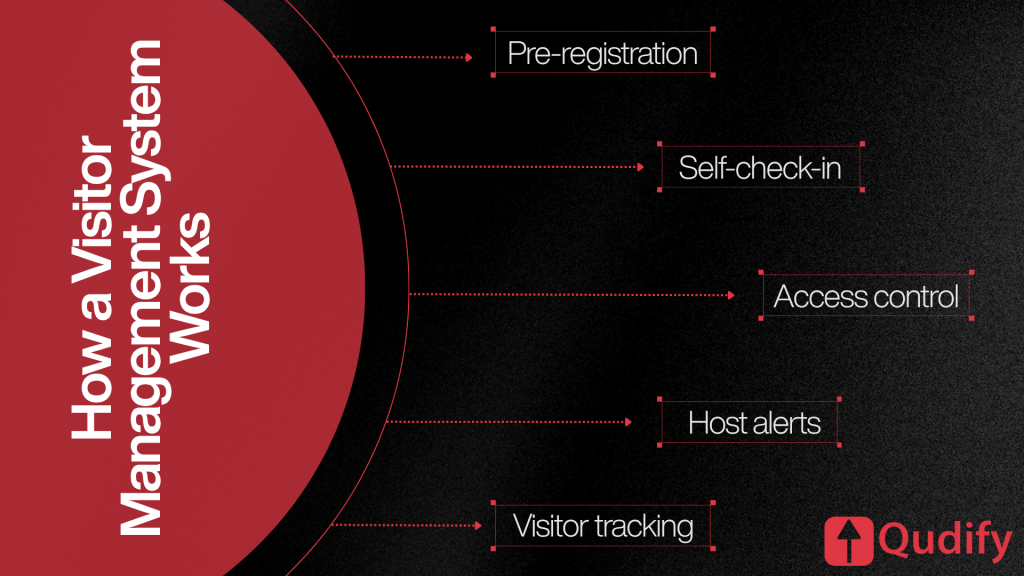
A modern VMS processes each visit through a structured, five-stage lifecycle:
- Pre-registration: The host sends a digital invitation. The visitor completes identity details in advance, signs required documents (NDAs, safety briefings), and receives a unique QR code or digital pass.
- Arrival and self-check-in: The visitor scans their QR code at an entrance kiosk or display. The system captures their photo, confirms their identity, and checks their name against internal and external watchlists.
- Access authorisation: The system issues a time-bound, zone-specific digital badge. Access permissions are tied to the purpose of the visit; a delivery driver cannot access a server room; a maintenance contractor cannot enter an executive floor.
- Real-time host notification: The moment check-in is complete, the host receives an automatic alert by SMS, email, or messaging platform.
- Post-visit logging and analytics: Every entry and exit is time-stamped and stored in an encrypted, tamper-proof cloud log. Facility managers access aggregated data on visitor patterns, peak hours, and compliance metrics.
The Market Behind the Momentum
The scale of adoption reflects an industry at an inflection point. According to market research from 360iResearch, the global VMS market was valued at approximately USD 2.75 billion in 2024 and is projected to reach USD 6.05 billion by 2030, growing at a compound annual growth rate of roughly 14%. Grand View Research places the 2023 market size at USD 1.63 billion with similar CAGR projections through 2030.
The divergence between analyst estimates, which range from roughly USD 1.4 billion to USD 3.7 billion in 2024, depending on methodology, reflects differences in how firms define the market perimeter (software-only versus integrated hardware-software solutions). What all major analysts agree on is the direction: consistent double-digit annual growth, driven by three converging forces.
- Regulatory pressure: Healthcare, financial services, and government sectors face increasingly stringent audit and access-documentation requirements from frameworks including HIPAA, GDPR, SOC 2, PCI-DSS, and ISO 27001.
- Rising security incidents: Workplace violence, data theft tied to physical access failures, and contractor management lapses have elevated the cost of inadequate visitor controls.
- Hybrid work adoption: Variable daily occupancy in corporate and co-working environments creates real-time headcount visibility needs that manual processes cannot address.
With that context established, here are the eight industries where a VMS delivers the highest and most measurable impact.
1. Healthcare: Where Security and Compliance Are Inseparable

No sector faces a visitor management challenge more acute than healthcare. Hospitals, specialist clinics, and medical centres must simultaneously manage an unrelenting stream of patients, family members, vendors, contractors, and regulatory inspectors, all while upholding strict legal obligations to protect patient privacy and staff safety.
The Security Reality in Clinical Settings
The numbers are stark. According to the Bureau of Labor Statistics and OSHA, healthcare workers are five times more likely to experience workplace violence than employees in any other private-sector industry. Between 2021 and 2022, healthcare professionals experienced more incidents of workplace violence than workers in any other private industry sector. A January 2024 survey of emergency physicians by the American College of Emergency Physicians found that 91% had personally experienced violence or had a close colleague who was a victim.
Uncontrolled access to sensitive zones drug storage rooms, ICUs, psychiatric wards, and server rooms amplifies this risk significantly. A visitor management gap is not merely an administrative failure in a clinical environment; it is a patient safety and staff security failure.
Compliance: The HIPAA Dimension
Healthcare facilities in the US must comply with HIPAA’s Physical Safeguards standard, which requires documented policies on facility access controls, visitor access procedures, and audit controls over who enters restricted areas. The EU equivalent under GDPR (Article 32) imposes similar obligations on European healthcare providers. Paper logbooks cannot reliably meet either standard; they are not encrypted, not searchable, can be altered, and cannot generate the on-demand audit reports that inspectors require.
A modern VMS resolves all of this. It performs real-time watchlist screening on every visitor, restricts movement to authorised zones, maintains encrypted and tamper-proof access logs, and generates inspection-ready compliance reports on demand.
| Healthcare VMS Capability | Security or Compliance Benefit |
| Real-time ID verification and watchlist screening | Prevents entry by flagged or restricted individuals before they reach clinical areas |
| Zone-restricted digital badges | Limits visitor movement to authorised areas only; protects drug rooms, ICUs, and server infrastructure |
| HIPAA-compliant encrypted visitor logs | Provides audit-ready documentation for regulatory inspections and legal proceedings |
| Health declaration screening forms | Screens symptomatic visitors applicable to infection control protocols |
| Automated expiration of visitor passes | Ensures no visitor can remain on-site after their authorised window closes |
2. Education: Protecting Students, Every Single Day

Campus security is one of the most scrutinised areas of public policy in the US and UK. Administrators, parents, school boards, and legislators all have a stake in how effectively schools manage who enters their buildings and the pressure to get it right has never been greater.
The Access Control Baseline
According to the US National Center for Education Statistics’ School Survey on Crime and Safety (2022), 97% of public schools reported controlling access to school buildings during school hours and requiring visitors to sign in and wear badges. That near-universal adoption tells one story. The more important story is the quality of enforcement behind those policies.
A paper sign-in book cannot screen a visitor against a sex offender registry in real time. It cannot automatically alert a teacher the moment an unscheduled parent arrives. It cannot generate an accurate headcount during an emergency evacuation. A modern VMS does all three as part of its standard check-in workflow.
Criminal Database Screening: A Non-Negotiable in K-12
The most consequential capability a VMS brings to K-12 education is automated, real-time screening of every visitor, including parents, volunteers, contractors, and delivery personnel, against national and local criminal databases and sex offender registries. If an individual appears on a watchlist, the system flags the entry attempt and alerts designated staff before the visitor moves past the front desk. This level of diligence is structurally impossible with manual processes.
For higher education, the challenge shifts toward balancing openness with security. Research facilities, laboratories, and data centres within university campuses require strict, role-based access control. Pre-registration workflows and QR-based check-in allow that control without creating bottlenecks that disrupt the daily rhythms of academic life.
| VMS Capability | Education Application |
| Automated criminal and sex offender database screening | Screens every visitor in real time; prevents entry by registered offenders |
| Instant host and staff notifications | Alerts relevant staff the moment a parent, contractor, or unscheduled visitor checks in |
| Digital, tamper-proof visitor logs | Produces audit-ready documentation for safeguarding compliance reviews |
| Emergency evacuation headcount reports | Generates real-time, accurate lists of everyone on-site during drills or live incidents |
| Self-service check-in via QR code | Reduces front-desk staffing burden; speeds entry during high-volume arrival windows. |
3. Corporate Offices and Technology Parks: Protecting People and IP

The corporate sector represents the largest end-user segment of the global VMS market by revenue. This reflects the dual pressure modern enterprises face: managing physical security in increasingly open, hybrid-work environments while simultaneously protecting intellectual property, sensitive client data, and personnel.
The Cost of Inadequate Physical Security
IBM’s 2024 Cost of a Data Breach Report, the most authoritative annual benchmark in the field, placed the global average cost of a data breach at USD 4.88 million, a 10% increase over 2023 and the largest single-year jump since the pandemic. For healthcare organisations, the figure reached USD 9.77 million. Physical security failures, including unauthorised access by visitors or contractors, contribute to a meaningful share of these incidents, particularly in IP-intensive environments.
For technology companies, financial firms, and R&D enterprises, the stakes around IP protection are especially high. The Commission on the Theft of American Intellectual Property has estimated annual losses to US businesses from IP theft at USD 225 billion to USD 600 billion. While the majority of IP theft occurs through cyber channels, physical reconnaissance and insider-assisted access remain vectors that uncontrolled visitor traffic enables.
The Hybrid Work Complication
As organisations shift to three- or four-day office weeks, daily occupancy fluctuates dramatically and unpredictably. Without a VMS, facilities teams cannot accurately track who is on-site, cannot optimise space allocation, and cannot produce reliable headcount data for health, safety, or emergency purposes. A cloud-based VMS solves this with a real-time occupancy dashboard that updates automatically with every check-in and check-out.
| Corporate Security Challenge | VMS Solution |
| Unauthorised access to sensitive floors or R&D areas | Pre-approved visitor lists and zone-restricted digital badges |
| IP exposure risk from unvetted contractors or vendors | Identity verification and restricted access tied to visit purpose |
| Visitor experience expectations from enterprise clients | Branded, QR-based self-check-in with instant digital pass delivery |
| Hybrid work occupancy visibility | Real-time dashboard showing on-site headcount by location and floor |
| Multi-location security standardisation | Centralised cloud platform managing protocols across all offices |
4. Manufacturing and Industrial Facilities: Safety, Compliance, and Zone Control

Manufacturing plants, warehouses, and industrial sites present a unique convergence of physical hazards, complex access requirements, and stringent regulatory obligations. In these environments, a visitor management failure is not just a compliance problem; it is a workplace safety risk that can result in serious injury, regulatory fines, and operational shutdown.
Managing a Facility with Multiple Restricted Zones
A typical manufacturing facility is divided into clearly delineated access zones: administration, production lines, chemical and raw material storage, quality assurance labs, R&D facilities, and logistics docks. Each zone carries distinct access requirements.
A packaging vendor must be channelled to the goods-in dock and no further. A third-party equipment inspector needs time-limited access to a specific production line but nothing beyond it. A regulatory auditor requires access to quality records and certain production areas but must be escorted at all times. Managing these distinctions manually with sign-in sheets and verbal instructions is operationally unreliable and a serious safety liability. A VMS automates this entirely, assigning zone-specific, time-bound digital badges based on each visitor’s pre-approved purpose.
Emergency Response and Regulatory Compliance
OSHA mandates that employers maintain an accurate headcount of all individuals on-site at all times and must be able to account for everyone in the event of an emergency. Paper visitor logs cannot satisfy this requirement during a fast-moving incident such as a chemical spill, fire, or structural failure. A VMS generates a real-time evacuation report including visitor names, check-in times, and last-known locations in seconds.
For facilities operating under ISO 45001 (occupational health and safety) or OSHA’s Process Safety Management (PSM) standard, a VMS also supports the documentation requirements of periodic compliance audits, generating complete, time-stamped visitor logs on demand.
| VMS Capability | Manufacturing-Specific Application |
| Pre-registration with NDA and safety briefing sign-off | Ensures all visitors acknowledge hazard protocols before arriving on-site |
| Zone-restricted, time-bound digital badges | Limits each visitor’s movement to their permitted area only |
| Real-time emergency evacuation reports | Provides accurate headcount for OSHA-compliant emergency response |
| Automatic pass expiry | Ensures temporary visitor access cannot extend beyond the authorised window |
| Contractor tracking and audit logs | Generates documentation required for ISO 45001 and OSHA compliance inspections |
5. Government and Public Sector: Security at Scale, Accountability by Design

Government buildings spanning municipal service centres, courts, legislative offices, regulatory agencies, and defence facilities face a visitor management challenge that is structurally different from the private sector. They must remain accessible to the public they are constitutionally obligated to serve, while simultaneously protecting sensitive information, public servants, and critical infrastructure.
The Dual Mandate: Open Access and Rigorous Control
A courthouse is a useful illustration of this tension. It may process several hundred visitors in a single morning, routing members of the public, legal professionals, witnesses, journalists, and court officers to different areas of the building. It must simultaneously maintain the ability to automatically deny access to individuals subject to restraining orders or those who appear on law enforcement watchlists. Paper-based processes cannot accomplish this reliably at speed.
The accountability standards governing public sector visitor records are also particularly demanding. Government visitor logs must be tamper-proof, individually time-stamped, and readily retrievable for security reviews, freedom-of-information responses, or legal proceedings. Any system that allows records to be altered, lost, or selectively omitted fails this requirement fundamentally.
Multi-Site Standardisation and Proactive Security
For agencies managing dozens or hundreds of locations, a centralised, cloud-based VMS platform allows administrators to enforce standardised security protocols across every site from a single interface. Watchlist updates propagate instantly to all entry points. Security incidents at one location are visible to central security operations in real time.
| Government Use Case | Required VMS Capability |
| Courthouse visitor verification and routing | Real-time ID check, watchlist screening, zone-based access |
| Multi-site government offices | Centralised dashboard, standardised protocols across all locations |
| Defence and sensitive government facilities | Biometric verification, escort management, strict zone control |
| Public service centres (high-volume walk-in) | High-throughput self-check-in, queue management integration |
| Security audits and legal discovery requests | Tamper-proof, time-stamped visitor records with instant retrieval |
6. Financial Institutions: Compliance-First Access Management

Banks, insurance companies, investment firms, and financial regulators operate within the most heavily regulated commercial environments on earth. Whether the applicable framework is SOX, GDPR, PCI-DSS, or RBI guidelines, these institutions are required to demonstrate verifiable, documented control over every aspect of their operations, including who physically enters their premises.
Physical Security as a Compliance Obligation
For financial institutions, physical access control is inseparable from their regulatory posture. Every visitor interaction, whether a routine audit by an external party, a contractor accessing a server room, or a short-term engagement by an external consultant, must be documented, verifiable, and immediately accessible for review.
IBM’s 2024 data breach research found that financial industry organisations faced average breach costs of USD 6.08 million, 22% above the global average, underscoring the sector’s elevated risk profile. A VMS provides compliance-grade documentation that manual processes cannot reliably produce: every visitor’s identity is verified upon entry, every access event is time-stamped, and every record is stored in a format that cannot be edited after the fact.
Proactive Risk Management: Blacklist and Watchlist Integration
Beyond compliance logging, modern VMS platforms integrate with internal blacklists maintained by compliance and risk teams. If an individual connected to a fraud investigation, a former employee under review, or a party named in regulatory enforcement action attempts to enter any branch or office, the system alerts security personnel before access is granted. This shifts the institution from a reactive to a proactive security model.
| VMS Capability | Financial Sector Impact |
| Automated, time-stamped ID verification | Ensures consistent security checks at every entry point across all locations |
| Tamper-proof, encrypted visitor logs | Provides audit-ready documentation satisfying SOX, PCI-DSS, and GDPR requirements |
| Blacklist and watchlist integration | Proactively blocks flagged individuals fraud suspects, restricted parties, and former employees |
| Third-party contractor access tracking | Generates a complete record of vendor and consultant access for accountability reviews |
| KYC-aligned visitor authentication workflows | Integrates visitor identity checks with existing internal compliance standards. |
7. Hospitality, Real Estate, and Co-Working Spaces: Experience Meets Access Control

The hospitality, property management, and flexible workspace sectors present a VMS challenge that differs from high-security environments. The primary tension here is not between openness and control; it is between frictionless guest experience and the practical need to know, at any given moment, who is in the building and why.
Hotels, Resorts, and Managed Properties
A large hotel or resort manages a complex, overlapping web of contractors, housekeeping teams, maintenance crews, delivery personnel, event vendors, and external guests often simultaneously, across multiple access zones. Without a structured visitor management process, accountability for this population becomes difficult to maintain. Third-party theft risk increases, and the paper trail for incident investigation is either incomplete or non-existent.
In residential and commercial real estate, VMS technology enables building managers to give residents direct control over their own visitor access. A resident can pre-register a guest, issue a time-limited QR-code pass to a courier, or schedule access for a property maintenance contractor all through a mobile interface without involving building management.
Co-Working Spaces: The Most Operationally Complex Case
Co-working environments simultaneously host dozens of companies, hundreds of individual members, and a rotating population of short-term and day-pass users, each associated with different host companies and requiring different levels of access. Without a structured VMS, front-desk reception becomes a bottleneck during peak arrival windows.
QR-code-based self-check-in eliminates the bottleneck. Visitors pre-register, arrive, scan their code, receive a digital badge specifying their authorised zones, and the host company is notified without a single manual step from reception staff.
| Sector | Primary VMS Application |
| Hotels and Resorts | Contractor and vendor tracking; accountability for third-party service personnel |
| Residential Towers | Resident-controlled guest pre-registration; time-bound courier and delivery access |
| Commercial Real Estate (Multi-tenant) | Centralised visitor routing; lobby management; per-tenant access logs |
| Co-Working Spaces | Self-check-in; multi-host notification; real-time daily visitor counts |
8. Data Centres and Critical Infrastructure: Zero Tolerance for Unauthorised Access

Data centres are the physical substrate of cloud computing, global financial transaction networks, healthcare record systems, and government communications infrastructure. A single unauthorised physical access event, whether for reconnaissance, hardware tampering, device implantation, or direct data theft, can have consequences that cascade across thousands of organisations and millions of individuals.
Certification Standards as Access Control Mandates
Data centres typically operate under certification frameworks with explicit physical access control requirements: SOC 2 Type II, ISO 27001, and PCI-DSS are the most common. These standards do not merely recommend controlled access; they mandate documented evidence of it. SOC 2 Type II auditors review physical access logs as part of their assessment of the Trust Services Criteria. A facility that cannot produce complete, time-stamped, tamper-proof records of every physical access event will fail its audit.
In this context, a VMS is not a front-desk convenience; it is an integral component of a certified physical access control programme. Every visitor, whether a hyperscale cloud client conducting a hardware inventory, a replacement parts vendor, or a regulatory inspector, must be pre-approved through a formal vetting process, identity-verified upon arrival, escorted throughout their time on-site, and restricted to specific authorised zones.
The Traceability Imperative
The record-keeping demands of data centre access management go further than any other sector covered in this article. Every movement must be logged against a specific individual identity, a specific authorised purpose, and a specific time window. Escort requirements must be documented. Zone boundaries must be enforced and recorded. The aggregate of these records forms the evidence base for a successful SOC 2 Type II audit, and their absence is a material deficiency with serious contractual and regulatory consequences.
| Data Centre Access Requirement | VMS Capability |
| Formal pre-approval vetting before arrival | Pre-registration workflows with identity and purpose documentation |
| Identity verification and photo capture at entry | Biometric-compatible check-in with mandatory photo and ID confirmation |
| Zone-specific access restriction | Digital badges specifying authorised cages, rows, or rooms |
| Escort requirement documentation | Escort assignment and tracking with time-stamped log entries |
| SOC 2, ISO 27001, and PCI-DSS audit evidence | Tamper-proof, encrypted access logs with instant retrieval for auditors |
Industry Comparison: VMS Benefits at a Glance
| Industry | Primary Risk Driver | Key Compliance Framework | Most Critical VMS Feature |
| Healthcare | Workplace violence; patient privacy violations | HIPAA (US) / GDPR (EU) | Watchlist screening; encrypted audit logs |
| Education | Child safety; predator access | NCES safeguarding regulations | Criminal database check; real-time alerts |
| Corporate Offices | IP theft; data breaches via physical access | GDPR; internal data policies | Pre-registration; zone-restricted access |
| Manufacturing | Safety zone violations; contractor mismanagement | OSHA; ISO 45001 | Zone-based badges; evacuation reporting |
| Government | National security; public accountability | Public sector audit standards | Watchlist integration; tamper-proof logs |
| Financial Services | Regulatory non-compliance; fraud | SOX; PCI-DSS; GDPR; RBI | KYC-aligned check-in; blacklist management |
| Hospitality / Real Estate | Unaccounted third-party access; theft | Varies by jurisdiction | Pre-registration; self-check-in; host alerts |
| Data Centres | Unauthorised physical access to infrastructure | SOC 2 Type II; ISO 27001; PCI-DSS | Full traceability; pre-approval workflows |
VMS vs Traditional Paper Logbook: A Practical Comparison
| Capability | Paper Logbook | Modern VMS |
| Watchlist / Criminal Database Screening | Not possible | Automated at check-in |
| Data Accuracy and Legibility | Unreliable; handwriting errors common | Structured digital entry; always accurate |
| Audit Trail Integrity | Can be altered or removed | Tamper-proof, encrypted cloud storage |
| Emergency Headcount Generation | Manual; slow; error-prone | Instant real-time report on demand |
| Regulatory Compliance (HIPAA, GDPR, SOC 2) | Cannot satisfy requirements | Purpose-built for compliance reporting |
| Multi-Location Standardisation | Impossible | Centralised cloud dashboard |
| Visitor Experience | Slow; paper forms; manual badge writing | Fast; contactless; digital pass to phone |
| Analytics and Reporting | Not possible | Comprehensive dashboard with trend data |
| Data Retention and Search | Manual filing; difficult to search | Searchable; configurable retention policy |
How to Choose the Right Visitor Management System
With many platforms available ranging from simple check-in apps to enterprise-grade, multi-site systems, selecting the right VMS requires matching the platform’s capabilities to your specific risk profile and operational context. Evaluate these criteria in every shortlisting exercise:
- Deployment model: Cloud-based platforms offer faster deployment, automatic updates, and multi-site centralisation. On-premise deployments may be required for defence or government facilities with strict data sovereignty requirements.
- Integration ecosystem: Does the system integrate with your existing access control hardware (turnstiles, door locks, CCTV), HR directory (Active Directory, SCIM), and compliance tools?
- Check-in methods: QR code, facial recognition, badge scan, or mobile wallet each has different cost, privacy, and user experience implications.
- Watchlist and database screening: Does the platform connect to national watchlists and criminal databases? How frequently are these updated?
- Compliance reporting: Can the system generate the specific audit reports your regulatory frameworks require HIPAA access logs, SOC 2 physical access evidence, GDPR data processing records?
- Scalability: Can a single subscription cover multiple sites under one centralised dashboard, or does each location require a separate account and contract?
- Visitor experience: Is the check-in process genuinely frictionless, ideally QR-based with no app download required, or does it create a queue at reception?
- Data retention and deletion: Does the platform support configurable data retention periods and right-to-erasure workflows in compliance with GDPR Article 17?
Implementation Considerations
Deploying a VMS is not simply a technology purchase; it is a change management exercise. Even the most capable platform will underperform if the rollout is not planned carefully.
Stakeholder Alignment Before Go-Live
Security, compliance, IT, HR, and facilities management must all be involved in the configuration stage. Each function has different requirements: security needs watchlist integration; compliance needs specific audit report formats; IT needs data residency and API documentation; HR needs directory sync. Alignment before deployment avoids costly configuration changes later.
Visitor Communication
If your VMS requires visitors to pre-register before arriving, the pre-registration invitation must be clear, mobile-friendly, and arrive in time for the visitor to complete it without friction. A poorly designed invitation flow results in visitors arriving unregistered, defeating the purpose of the system.
Staff Training
Front-desk staff need to understand what the system does, what to do when a visitor is flagged on a watchlist, how to handle exceptions, and how to override the system in legitimate emergency scenarios. A VMS creates a clear process; human judgment is still required to operate it well.
The Future of Visitor Management

The next generation of VMS technology is already being shaped by three converging developments:
AI-Powered Threat Detection
Machine learning models are increasingly being applied to visitor behaviour data not to surveil visitors, but to identify anomalous patterns that may indicate a security risk. A visitor who accesses the same secure area multiple times without a host escort, or whose stated purpose is inconsistent with their access pattern, can trigger an automated alert for security review.
Biometric and Wallet-Based Identity
Digital identity credentials stored in mobile wallets such as Apple Wallet or Google Wallet are beginning to replace QR codes as the primary check-in mechanism in high-security environments. Biometric verification (facial recognition matched against a pre-registered photo) is being adopted in data centres and government facilities where identity assurance requirements are highest.
Integration with Smart Building Infrastructure
VMS platforms are increasingly embedded within broader smart building ecosystems, sharing data with environmental controls, energy management systems, and emergency response platforms. In this model, the VMS becomes not just a security tool but a core component of operational infrastructure.
The Real Cost of Operating Without a VMS
Organisations frequently frame the VMS decision as a cost question. The more accurate frame is risk-adjusted cost. Consider what operating without a capable visitor management system actually exposes:
- Regulatory fines: HIPAA violations carry penalties ranging from USD 100 to USD 50,000 per violation, with annual caps of USD 1.9 million per violation category. A healthcare facility that cannot produce visitor access documentation during an audit faces material financial risk.
- Data breach costs: IBM’s 2024 research puts the global average data breach cost at USD 4.88 million. Physical access failures, unescorted visitors, and unvetted contractors contribute to breach pathways.
- Operational inefficiency: Manual visitor processes consume front-desk staff time that could be redirected to higher-value tasks. In high-traffic facilities, this is a measurable labour cost.
- Reputational damage: A security incident involving an unauthorised visitor, particularly in healthcare or education, carries reputational consequences that are difficult to quantify and costly to address.
- Emergency response failures: In the event of an evacuation, a facility that cannot produce a real-time headcount faces both safety risk and potential OSHA liability.
A cloud-based VMS typically costs a fraction of any single one of these consequences, while delivering value that compounds over time in compliance confidence, operational efficiency, and security posture.
Frequently Asked Questions: Visitor Management Systems
A Visitor Management System (VMS) is a digital platform that automates the registration, verification, tracking, and management of all individuals entering a facility. It replaces paper sign-in logbooks with a structured, secure process covering the complete visitor lifecycle from pre-registration through to post-visit analytics
The industries with the highest VMS adoption and the clearest return on investment are healthcare, education, corporate offices, manufacturing, government, financial services, hospitality and real estate, and data centres. Each sector benefits for reasons specific to its risk profile and compliance obligations.
A VMS provides several capabilities that a paper logbook structurally cannot: real-time screening against criminal and watchlist databases, tamper-proof and searchable digital audit trails, zone-restricted access through digital badges, automated alerts when flagged individuals attempt entry, and on-demand compliance reporting for regulators and auditors.
Yes. Modern VMS platforms are purpose-built to generate the encrypted, time-stamped, and immediately retrievable access logs that these frameworks require. For HIPAA, this covers the Physical Safeguards standard. For GDPR, it supports Articles 25 and 32. For SOC 2 and PCI-DSS, it provides the physical access control evidence that auditors assess.
An Access Control System (ACS) manages the physical hardware that controls entry door locks, turnstiles, card readers, and barriers. A VMS manages the human workflow around that hardware: who is authorised to request access, what identity verification is required, what records are kept, and how those records are made available for compliance. In a well-configured facility, the two systems integrate to form a complete physical security layer.
For the majority of commercial applications, yes. QR-code systems are hardware-light, cost-effective, and highly scalable. They provide sufficient identity assurance for most corporate, healthcare, educational, and hospitality use cases. Biometric verification is most appropriate in environments with the strictest identity assurance requirements: defence facilities, data centres, and high-security financial infrastructure.
A VMS maintains a real-time, continuously updated list of every visitor currently on-site, with their check-in time and last-known authorised zone. In an emergency, facility managers can generate an instant evacuation headcount report from any device, significantly faster and more reliable than reconstructing a paper sign-in sheet during an active incident.
Yes. Cloud-based VMS platforms allow organisations to manage visitor flows across multiple sites from a single office to hundreds of global locations, through a centralised dashboard. Security protocols, watchlist updates, and compliance settings propagate across all sites simultaneously.
A well-implemented QR-based VMS substantially accelerates check-in compared to manual processes. Visitors who have pre-registered scan a QR code on arrival, receive their digital badge instantly, and proceed to meet their host with no queue, no manual data entry, and no receptionist involvement required.
The system prevents check-in from completing and immediately alerts the designated security or reception staff. The visitor does not receive a badge, and the attempted access event is logged in the audit trail. The specific response protocol, whether staff approach the visitor, contact law enforcement, or initiate another escalation, is configured by the facility administrator.
A well-designed VMS includes configurable data retention policies allowing organisations to set automatic deletion timelines for visitor records and supports manual deletion requests in response to GDPR Article 17 erasure requests. Data is stored encrypted, with access limited to authorised administrators.
VMS pricing varies considerably by platform, feature set, and number of locations. Cloud-based, QR-centric platforms typically offer subscription pricing in the range of USD 50 to USD 300 per month per location. Enterprise platforms with biometric integration, custom API development, and multi-site management capabilities are priced on a contract basis. In all cases, the cost is substantially lower than the regulatory, security, or reputational cost of not having a capable system in place.