

Quick Answer
A paper visitor register appears cheap until you account for what it actually costs to run one. The true expense is spread across receptionist and security guard time lost to manual check-ins, premium office space consumed by archival binders, and the compliance exposure created by an open logbook that meets none of India’s DPDP Act requirements.
A mid-range digital Visitor Management System consistently costs less per year than a paper-based operation of equivalent size, and typically pays for itself within 12 months through labour savings alone. For any Indian office beyond minimal visitor volumes, the switch is a financial decision, not just a technology preference and with DPDP Act enforcement arriving in 2027, it is increasingly a legal one too.
Key Statistics at a Glance
| Metric | Figure | Source |
| Global VMS market size (2024) | ~$1.7 billion | GMI Research |
| Projected CAGR (2025–2034) | 13–16% | Multiple analysts |
| Cybersecurity incidents in India (2024) | 22.68 lakh | PIB / CERT-In |
| Max DPDP Act penalty (breach notification failure) | ₹200 crore | EY India |
What Does a Paper Visitor Register Really Cost?
Picture any mid-sized office lobby in Bengaluru or Gurugram: a security guard at the entrance, a thick register on the counter, and a line of visitors leaning over to scrawl names, companies, and contact numbers. The process takes three to eight minutes per person. Entries blur, handwriting is illegible, and exit times are rarely logged.
The register costs maybe ₹500. That price tag is profoundly misleading. The real cost is buried across three budget lines that rarely appear on the same spreadsheet: staff productivity, storage and retrieval overhead, and regulatory risk.
Direct Material Costs
A standard 200-page visitor register costs ₹500–₹1,000 for a professional, cardboard-bound format; factory-grade options start around ₹414 (IndiaMART, May 2026). For an office handling 50 visitors per day and completing roughly two lines per entry, a single book lasts 50–100 working days, meaning four to six registers are consumed annually before counting pens, sticker badges, and printed guest passes.
Annual Direct Material Cost (50 Visitors/Day)
| Item | Qty/Year | Unit Cost (₹) | Annual Cost (₹) |
| Visitor Register (200 pgs) | 5 books | 500–1,000 | 2,500–5,000 |
| Ballpoint Pens | 24 pcs | 10–20 | 240–480 |
| Visitor Badge Stickers | 1,200 | 2–5 | 2,400–6,000 |
| Printed Guest Passes | 1,200 slips | 1–2 | 1,200–2,400 |
| Archival Binders | 2 | 100–200 | 200–400 |
| Total | — | — | ₹6,540–₹14,280 |
₹6,540–₹14,280 per year looks trivial for a mid-sized business. It is. The problem is that stationery represents only the most visible cost, and the visible costs are also the smallest ones.
How Much Staff Time Does a Paper Register Waste?
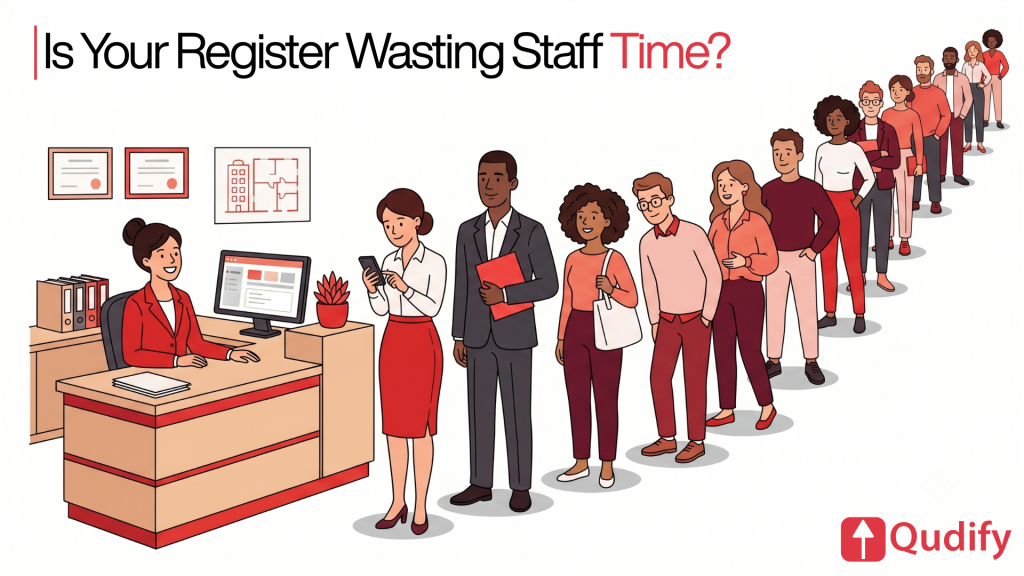
The highest and most ignored cost of a paper-based system is staff time. Every visitor requires a manual sequence: greeting, prompting the entry, inconsistently verifying identity, calling the host, writing out a badge, and logging an exit. At busy offices, those steps compound into hours of lost productivity every single day.
Receptionist and Security Guard Time
The average monthly salary for a receptionist in India is ₹14,114, based on 2,400+ salary reports on Indeed India (October 2025). If visitor management tasks consume 25% of a receptionist’s working day, a modest estimate for a busy front desk, the annual cost attributable to manual visitor handling is:
- Receptionist annual salary: ₹14,114 × 12 = ₹1,69,368
- Visitor management share (25%): ₹42,342
- Security guard time (25% of ₹12,000/month): ₹36,000
- Total attributable labour cost: ~₹78,342
Multi-gate campuses scale this figure per staffed entry point.
Visitor Wait Time: The Opportunity Cost
A paper check-in takes 5–8 minutes end to end. A digital kiosk completes the same process in under 60 seconds, with instant push/SMS/email notification to the host.
Manual vs. Digital Check-In Workflow
| Metric | Paper Register | Digital VMS |
| Average Check-in Time | 5–8 minutes | Under 60 seconds |
| Host Notification | Manual call (1–3 min) | Instant (Push/SMS/Email) |
| Badge Issuance | Manual sticker | Automated print |
| Exit Tracking | Often missed | Automated |
| Data Searchability | Physical page search | Instant digital search |
| NDA / Document Signing | Not scalable | Digital signature at kiosk |
| Watchlist Screening | Impossible | Automated |
For an office with 50 daily visitors, manual processing creates 250–400 minutes of wasted time every day, roughly 4–6.5 hours. Over 1,000–1,625 person-hours lost annually, which is roughly 250 working days. For client-facing businesses, that wasted time is also the first impression left on every visitor who walks through the door.
What Are the Storage and Data Loss Risks of Paper Visitor Logs?
Physical visitor logs don’t disappear after they are full; they move to a shelf, and that shelf occupies valuable office space. In Mumbai, Bengaluru, or Delhi, prime commercial space costs ₹8,000–₹20,000 per square foot. Four square feet of dedicated register storage adds a real, calculable number to your annual occupancy bill.
Physical vs. Digital Archival
| Factor | Paper System | Digital VMS |
| Physical Storage Space | Yes (binders, racks) | None |
| Retrieval Time (6-month record) | 15–30 minutes | Under 10 seconds |
| Risk of Data Loss | High (fire, water, pests) | None (cloud backup) |
| Annual Storage Cost (4 sq ft) | ₹2,000–₹8,000 | ₹0 |
Real-World Impact: During a compliance audit, locating a single visitor entry from six months ago takes 15–30 minutes in a paper system. A digital VMS returns the same result in under 10 seconds. Multiply that by a dozen audit queries per year, and you have added a full working day of unplanned labour at minimum.
How Much Does a Digital VMS Cost in India?
Pricing Models
Digital VMS providers in India operate on three main structures:
- SaaS subscriptions (monthly or annual billing, no large upfront CAPEX) are dominant in the SME and mid-market segment.
- One-time licence + maintenance suited to large enterprises or government bodies with on-premise data requirements.
- Custom enterprise contracts covering multi-campus deployments, biometric integration, and deep access-control tie-ins.
Indicative Pricing Tiers (India, 2025–2026)
Digital VMS Pricing by Office Scale
| Tier | Suitable For | Software/Year (₹) | Hardware (One-Time) | Year-1 Total (₹) |
| Entry-Level SaaS | Startups, <20 visitors/day | 10,000–19,200 | ₹0 (existing tablet) | 10,000–19,200 |
| Starter / Basic | SMEs, 20–50 visitors/day | 19,200–36,000 | ₹8k–₹20k | 27,200–56,000 |
| Mid-Range | Medium offices | 50,000–1,00,000 | ₹20k–₹50k | 70,000–1,50,000 |
| Enterprise | Large campuses | 1,00,000–3,00,000+ | ₹50k–₹2,00,000+ | 1,50,000–5,00,000+ |
Hardware note: A reliable Android tablet (v10+) for a kiosk costs ₹8,000–₹25,000. A thermal badge printer (e.g., Brother QL-series) adds ₹15,000–₹25,000. Many entry-level plans run on existing office hardware.
Paper Register vs. Digital VMS: Which Is Cheaper for Your Office Size?
The following scenarios account for labour, materials, storage overhead, hardware amortisation, and compliance risk exposure. All figures use conservative estimates.
Scenario A: Small Office (20–30 Visitors/Day)
| Category | Paper (₹/yr) | Digital VMS (₹/yr) |
| Materials | 6,000–8,000 | 1,000–3,000 |
| Labour (Receptionist, 25%) | 33,872 | 8,468 (~80% reduction) |
| Storage & Archival | 1,000–3,000 | 0 |
| Software Subscription | 0 | 14,000–19,200 |
| Hardware (Amortised) | 0 | 4,000–8,000 |
| Estimated Total | ₹40,872–₹44,872 | ₹27,468–₹38,668 |
✅ Verdict: Cost-Competitive in Year 1. Even at low visitor volumes, the total cost of ownership tips toward digital once labour is included. Break-even is typically within 12 months.
Scenario B Mid-Size Corporate Office (50–100 Visitors/Day)
| Category | Paper (₹/yr) | Digital VMS (₹/yr) |
| Materials | 12,000–20,000 | 3,000–6,000 |
| Labour (Reception + Security) | 90,000–1,20,000 | 25,000–35,000 |
| Storage & Archival | 3,000–8,000 | 0 |
| Software Subscription | 0 | 36,000–75,000 |
| Hardware (Amortised) | 0 | 10,000–20,000 |
| Compliance / Risk Exposure | 5,000–20,000 | 0–2,000 |
| Estimated Total | ₹1,10,000–₹1,68,000 | ₹74,000–₹1,38,000 |
✅ Verdict: ₹30,000–₹70,000 Annual Savings. This is where the switch becomes a clear financial decision, not just a technology preference.
Scenario C: Large IT Campus / Tech Park (200+ Visitors/Day)
| Category | Paper (₹/yr) | Digital VMS (₹/yr) |
| Materials (Multiple Checkpoints) | 40,000–60,000 | 8,000–15,000 |
| Labour (4–6 Staff) | 3,50,000–5,00,000 | 80,000–1,20,000 |
| Storage & Archival | 10,000–25,000 | 0 |
| Software Subscription | 0 | 1,00,000–3,00,000 |
| Hardware Investment | 0 | 30,000–60,000 |
| Security Incident Exposure | 50,000–2,00,000 | 10,000–30,000 |
| Estimated Total | ₹4,50,000–₹7,85,000 | ₹2,28,000–₹5,25,000 |
✅ Verdict: Several Lakhs Saved Annually. At campus scale, ROI typically arrives within 6–9 months. The security exposure line alone can dwarf the entire VMS subscription cost.
DPDP Act Compliance: Paper as a Legal Liability
The Regulatory Reality
India’s Digital Personal Data Protection (DPDP) Act, 2023 received Presidential assent on 11 August 2023. The implementing DPDP Rules were notified on 13 November 2025, setting a phased compliance calendar with full enforcement and Schedule 1 penalties up to ₹250 crore effective 13 May 2027.
Under the Act, your business becomes a “Data Fiduciary” the moment it collects a visitor’s name, phone number, or ID proof. That creates legal obligations around consent, data minimisation, secure storage, and breach notification obligations that a paper register structurally cannot meet.
Key Penalty Figures (DPDP Act Schedule 1)
- Failure to notify the Data Protection Board of India (DPBI) of a personal data breach: up to ₹200 crore
- Breach of obligations relating to children’s data: up to ₹200 crore
- Other non-compliance: up to ₹250 crore per breach
The DPBI can investigate, adjudicate, and impose these fines without offering a cure period.
Why Paper Fails Compliance
A physical logbook is, by design, open-access data. Anyone standing at your reception counter visitors, couriers, contract workers can read prior entries. There is no access control, no encryption, no consent log, and no mechanism for automated data deletion after a retention period expires.
India’s cybersecurity incident count reached 22.68 lakh in 2024, more than double the 10.29 lakh recorded in 2022 (PIB/CERT-In). An open paper register in this environment is not an administrative quirk; it is a documented vulnerability.
DPDP Act Compliance: Paper vs. Digital VMS
| Compliance Aspect | Paper Register | Digital VMS |
| Data Minimisation | Difficult to enforce | Configurable per field |
| Formal Consent Management | Rarely implemented | Automated & logged |
| Retention & Deletion Policy | Inconsistent | Policy-driven / automated |
| Security Safeguards | None (open book) | Encrypted, access-controlled |
| Audit Trail | Incomplete | Complete & timestamped |
| Breach Notification Capability | Extremely difficult | Built-in automated alerts |
| Identity Verification | None (easy to falsify) | Photo & ID scan |
| Watchlist / Blacklist Screening | Impossible | Automated |
| Emergency Evacuation Roll Call | Manual and slow | Real-time digital |
Practical Note: The DPDP Act does not stagger penalties by sector. A boutique law firm in Delhi and a multinational IT campus in Hyderabad face the same penalty schedule. What differs is how much personal data they hold and how prepared they are when the DPBI starts investigations expected from May 2027.
Feature Comparison: What You Actually Get
Functional Capabilities: Paper Register vs. Mid-Range Digital VMS
| Feature | Paper Register | Digital VMS (Mid-Range) |
| Visitor Pre-Registration | Not possible | QR invite, advance check-in |
| Photo Capture | Not possible | Automated at check-in |
| Government ID Scan | Not possible | Supported (most platforms) |
| Host Notification | Manual phone call | Instant SMS / Email / App |
| NDA / Document Signing | Not scalable | Digital signature at kiosk |
| Analytics & Reporting | Not possible | Dashboard & CSV export |
| Multi-Location Sync | Separate registers | Centralised dashboard |
| Returning Visitor Recognition | Manual memory | Automatic profile matching |
| Access Control Integration | Not possible | API-based (most platforms) |
| Offline Reliability | Always works | Depends on platform |
| Power Dependency | Zero | Requires device power |
The two categories where paper genuinely wins zero power dependency and unconditional offline operation are real operational considerations for Tier-3 locations and facilities with erratic power supply. Everywhere else, the digital system delivers capabilities a paper register cannot approximate.
Why Indian Offices Choose Qudify
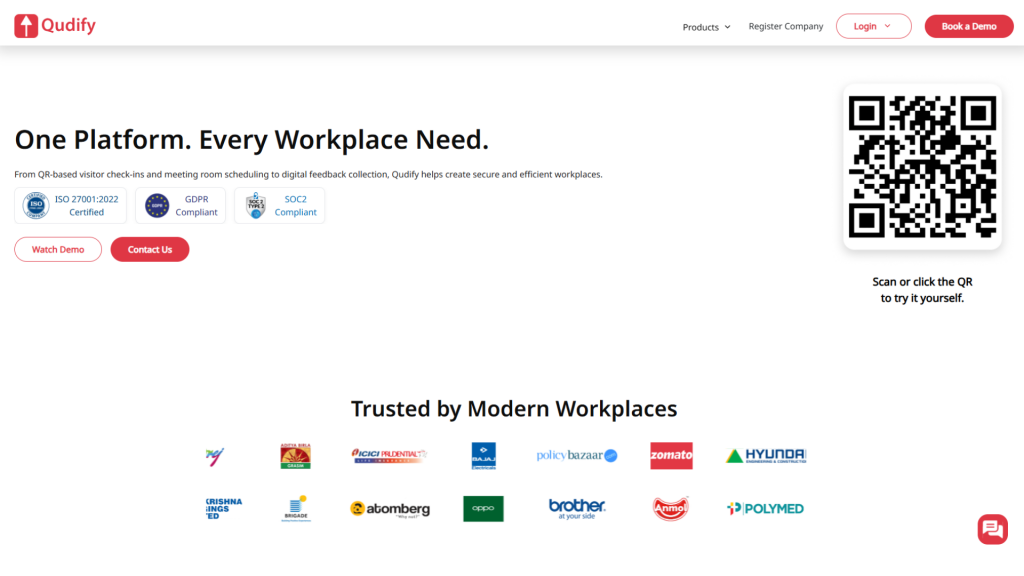
Once you decide to move off paper, the next question is which system to trust with your front door. Qudify is built specifically for the Indian enterprise context: DPDP-aligned, hardware-flexible, and designed to work for a single office or a 50-location rollout without changing platforms.
What Qudify Replaces (And What It Does Instead)
Every friction point in the paper register workflow has a direct Qudify equivalent:
- Manual log entry → Visitors self-check in via QR code or kiosk in under 60 seconds, with photo capture and ID scan built in
- Receptionist calling the host → Instant SMS, email, and app notification the moment a visitor checks in
- Paper badges and sticker handwriting → Automated thermal badge printing with visitor name, photo, host name, and time
- NDA clipboards and printed forms → Digital document signing at the kiosk, timestamped and stored automatically
- Handwritten exit logs (that nobody fills in) → Automated exit tracking with real-time occupancy visibility
- Filing cabinets of old registers → Encrypted cloud storage with instant search across any date range
- No way to screen against a watchlist → Automated blacklist and watchlist screening on every check-in
Built for DPDP Act Compliance from Day One
Qudify was designed with India’s data protection obligations in mind, not retrofitted. The platform captures formal digital consent at check-in, enforces configurable data retention and deletion policies, restricts visitor record access to authorised staff only, and generates audit-ready logs with full timestamps. When the DPBI begins enforcement in May 2027, Qudify customers will have documentation to show, not a paper register to explain away.
Scales With You
Whether you are a 30-person startup in Pune or a 3,000-employee IT campus in Hyderabad, Qudify runs on the same platform. Start with a single Android tablet at one entry point. Expand to multiple gates, multiple floors, or multiple cities, all managed from one centralised dashboard. No hardware lock-in. No system replacement when you grow.
| What You Need | What Qudify Delivers |
| Fast visitor check-in | Under 60 seconds via QR or kiosk |
| Host notification | Instant SMS / Email / WhatsApp |
| DPDP Act compliance | Consent logs, encrypted storage, auto-deletion |
| Badge printing | Automated thermal print at check-in |
| Watchlist screening | Automated on every visitor |
| Multi-location visibility | Centralised real-time dashboard |
| Hardware flexibility | Runs on existing Android tablets (v10+) |
| Access control integration | API-ready for turnstiles, boom barriers, smart locks |
When Paper Still Makes Sense
A fair analysis acknowledges where paper remains the rational choice:
- Very low visitor volumes: A neighbourhood boutique, a small non-profit, or a five-person consultancy averaging three to five visitors per week does not generate the throughput to justify ongoing SaaS costs.
- Infrastructure-constrained locations: Remote sites with erratic power supply and no reliable internet, common across Tier-3 cities and certain industrial zones, cannot depend on cloud-connected kiosks.
- Regulated government and defence facilities: Certain agencies are legally prohibited from using cloud-based third-party software for visitor data. On-premise servers or paper are the only compliant options.
- Short-term operational transitions: A startup that expects to relocate within six months has legitimate reasons to delay VMS implementation until their space is stable.
Decision Matrix
| Visitor Volume / Context | Recommended System |
| <5 visitors/day (very tight budget) | Paper Register |
| 5–20 visitors/day (stable ops) | Free-tier VMS or Paper |
| 20–50 visitors/day (growth phase) | Entry-level Digital VMS |
| 50–200 visitors/day (compliance focus) | Mid-range Digital VMS |
| 200+ visitors/day (multi-location) | Enterprise Digital VMS |
| Government / sensitive facility (mandate) | On-premise or Paper per mandate |
Implementation Roadmap
Transitioning from paper to digital is a four-to-six week process when managed as a phased project. The single biggest mistake is attempting a “big bang” cutover across all entry points simultaneously.
Five-Phase Digital Migration Plan
| Phase | Timeline | Key Milestone |
| 1: Baseline Assessment | Weeks 1–2 | Map workflows, count daily visitors, track stationery spend |
| 2: Vendor Shortlisting | Weeks 2–4 | Compare options; run three vendor demos |
| 3: Hardware Procurement | Weeks 3–5 | Source tablets/kiosks; order badge printers if required |
| 4: Pilot Deployment | Month 2 | Run at one entry point; gather staff and visitor feedback |
| 5: Full Rollout | Month 3 | Retire paper logs; complete staff training |
| 6: Compliance Audit | Month 4 | Update data privacy policy for DPDP Act alignment |
Critical Implementation Tips
Involve reception staff early. They are the power users. When they understand the system eliminates manual log maintenance and automates host notifications, buy-in follows naturally.
Don’t overspend on hardware. For offices under 50 visitors/day, an existing Android tablet (v10+) is sufficient. Reserve kiosk hardware investment for high-volume or high-security environments.
Retain physical registers. Even after going digital, store old registers for the full statutory retention period applicable to your industry before secure shredding.
Run a 30-day pilot. Never attempt a full cutover without a pilot at one entry point first. It surfaces configuration gaps without impacting facility-wide security.
Conclusion
The paper visitor register isn’t cheap. It only appears cheap because its real costs receptionist productivity, security guard time, premium office storage, and escalating compliance exposure never appear on the same invoice as the ₹500 book.
For any Indian business processing more than 20 visitors per day, a digital Visitor Management System pays for itself within the first year. By Year 3, the cumulative savings are material. By May 2027, DPDP Act compliance becomes mandatory, and at that point, a paper register transitions from an operational inefficiency into a documented legal liability.
The decision is not whether to modernise your front desk. It is how quickly you want to start recovering the costs you are already incurring.
Ready to make the switch? Book a free Qudify demo and see how India’s offices are replacing paper registers with compliant, intelligent visitor management.
Frequently Asked Questions
The register itself costs ₹500. The complete system labour, storage, retrieval overhead, and compliance exposure costs ₹40,000 to ₹1,68,000 per year depending on office size. An entry-level digital VMS starts at ₹10,000/year and typically reaches break-even within 12 months through labour savings alone.
The Digital Personal Data Protection Act 2023 classifies your business as a “Data Fiduciary” once it collects visitor personal data. This requires formal consent, data minimisation, encrypted storage, and breach notification to the Data Protection Board within 72 hours. A paper register meets none of these requirements. Full enforcement with penalties up to ₹200–₹250 crore per breach begins 13 May 2027.
Most modern cloud VMS platforms include offline mode or local caching. The system continues capturing visitor data, which syncs automatically once connectivity restores. Verify this capability explicitly with any vendor during evaluation.
No. Entry-level SaaS plans run on an existing Android tablet (version 10 or later). Hardware investment dedicated kiosks, thermal badge printers is only warranted when daily visitor volume or security protocols specifically require it.
Yes, on most mid-range and enterprise platforms. API integration with boom barriers, turnstiles, or smart locks allows a visitor’s profile to trigger gate access automatically upon successful check-in. Confirm this capability and specific hardware compatibility during your demo.
Retain them for the statutory period applicable to your industry and sector. Once that retention period expires, shred them securely to protect visitor data privacy. Registers contain personally identifiable information that falls under DPDP Act obligations; don’t simply bin them.
A compliant digital VMS encrypts visitor data at rest and in transit, restricts access to authorised staff only, logs all data interactions with timestamps, automates consent capture at check-in, and enforces configurable data retention and deletion policies, all of which directly address DPDP Act requirements.
Yes. Entry-level SaaS plans start at under ₹15,000 per year and can run on existing hardware. For offices averaging fewer than five visitors per day, however, a paper logbook remains entirely adequate and cost-effective.