
How to Eliminate Ghost Meetings and Reclaim Empty Conference Rooms
Table of Contents
- Ghost Meetings Overview
- The Consequences of Ghost Meetings
- Common Causes of Ghost Meetings
- Conference Room Utilisation: How to Measure It
- Detecting Ghost Meetings
- Eliminating Ghost Meetings: Most Effective Strategies
- Implementing Room Booking Policies
- Role of Technology in Ghost Meeting Prevention
- Example Scenario
- Conference Room Utilisation Optimisation Model
- Conclusion
- Frequently Asked Questions
Key Takeaways
- A ghost meeting is a booked room that nobody uses, which makes available space look occupied and inflates your utilisation numbers.
- Across multiple workplace analytics providers, 30–45% of booked room time goes unused in offices without check-in or auto-release policies.
- The real signal is the gap between booking utilisation and occupancy utilisation. If you only measure bookings, you are measuring intentions, not usage.
- Mandatory check-in plus automatic room release is the highest-impact, lowest-effort fix available.
- The goal is not more rooms. It is getting honest use out of the rooms you already pay for.
Quick answer: A ghost meeting is a room reservation that no one shows up for, so the space sits empty while the calendar reports it as busy. You eliminate ghost meetings by measuring actual occupancy instead of bookings, requiring a check-in to hold a room, and auto-releasing any room nobody confirms within about 10 minutes. In most offices, this recovers far more usable space than building or leasing additional rooms.
Walk any hybrid office at 2 pm on a Tuesday, and you will see the contradiction. Your booking tool says every room is taken for the next three hours. The floor tells a different story: dark rooms, untouched chairs, a laptop charger someone left behind a week ago. Somebody three desks away is standing in the corridor because the system insists there is nowhere to meet.
That gap between “booked” and “actually used” is the whole problem, and it has a name. These are ghost meetings, and they are the single biggest reason offices believe they are short on rooms when they are not. This guide gives workplace and facilities teams a practical way to find them, size them, and shut them down.
What Is a Ghost Meeting?
A ghost meeting is a scheduled meeting that reserves a conference room but never actually happens. The room stays blocked in the booking system even though no one arrives, which makes the space unavailable to everyone else and quietly corrupts your utilisation data.
The behaviours behind it are mundane, not malicious:
- A recurring meeting outlives the project it was created for and keeps holding the slot.
- A meeting gets cancelled, but releasing the room is treated as a separate step and skipped.
- The team decides to take it on Zoom from their desks and never touches the booking.
- Someone books two overlapping rooms “to be safe” and only uses one.
- Plans change at the last minute, and the reservation simply stays put.
None of these is bad-faith acts. They are what happens when booking a room takes five seconds and releasing one takes deliberate effort that nobody is accountable for. Density, which uses occupancy sensors to study this, found that for one Fortune 500 client across its Atlanta and Chicago offices, more than a quarter of all booked meetings 783 of them were ghosted.
Why Ghost Meetings Cost More Than One Empty Room
One empty-but-booked room looks trivial. The damage shows up when you multiply it across a floor and a quarter.
They manufacture a room shortage that does not exist. Reservations consume the limited supply of bookable slots even when the rooms behind them are empty. Employees hit “no availability” while standing next to three free rooms, which is corrosive in a way that pure scarcity is not.
They burn real time. A Senion office-worker survey found roughly 4 in 10 employees lose up to an hour a week hunting for an available desk, room, or colleague. That hour is spent walking floors and rescheduling, not working.
They erode trust in the system. Once people learn the calendar lies, they stop trusting it and start booking defensively, holding rooms they might need for longer than they need. That defensive behaviour is itself a leading cause of the next ghost meeting, so the problem compounds.
They poison your data. If your reports count reservations rather than occupancy, every ghost meeting registers as “usage.” Your dashboard can read 85–90% utilised while sensors put real occupancy closer to 40%. Decisions made on that number will be wrong.
They drive avoidable real estate spend. Inflated utilisation data is exactly the evidence a team uses to justify leasing more space. The most expensive consequence of a ghost meeting is a lease signed to solve a shortage that was never real.
The Five Most Common Causes
Cause | What it looks like | Why it happens | Operational impact |
Stale recurring meetings | A weekly hold continues long after the meeting stopped | Recurring events are set once and rarely revisited | Prime mid-week slots are permanently occupied by nothing |
Cancellations left on the calendar | Meeting is cancelled, room stays booked | Cancelling and releasing are separate actions; the second is skipped | Room is blocked with no meeting behind it |
No-shows | Organiser and attendees never arrive | Priorities shift, the meeting moves online | Textbook ghost meeting; capacity sits idle |
Room hoarding | People hold rooms “just in case” or grab several slots | Perceived scarcity drives defensive booking | Hoarding deepens the very shortage people fear |
Poor size matching | A 12-person boardroom booked for a 1:1 | Booking tools surface availability, not fit | Large rooms become unavailable to teams that actually need them |
That last one is more common than most teams assume. Across its deployments, MySeat reports that 45–50% of meetings are a single person or pair sitting in a room built for a group. A room can be “in use” and still be badly wasted.
How to Measure Conference Room Utilisation
Most organisations try to fix a utilisation problem using the one metric that hides it: bookings. Track these four instead.
Metric | What it measures | Why it matters |
Booking utilisation | Hours reserved ÷ hours available | Shows demand on paper |
Occupancy utilisation | Hours actually occupied ÷ hours available | Shows real usage |
Check-in rate | Share of bookings where someone confirms arrival | Exposes no-shows |
Room release rate | Share of unused bookings automatically recovered | Quantifies capacity you win back |
The number that matters most is the gap between booking utilisation and occupancy utilisation. Average organisations measure the first. Strong ones measure the second. The distance between them is your ghost-meeting problem, expressed as a figure you can take to leadership.
On benchmarks: most workplace data providers put a healthy booked-hours figure at roughly 60–75%, high enough to get value from the space, low enough to leave room for spontaneous meetings (CoworkingCafe summarising the Ronspot 2026 benchmark). For the booking-to-occupancy ratio specifically, Worklytics’ analysis of anonymised workplace data describes a slide from about 0.85 in 2023 to 0.71 in 2025, i.e. close to 30% of booked rooms now going unused, which it attributes to hybrid “just in case” booking (Worklytics). Treat that as one provider’s dataset rather than a universal law, but the direction is consistent with what every sensor vendor is reporting.
The deeper issue is industry-wide. JLL’s 2025 benchmarking found that while 74% of organisations now collect utilisation data, only 7% rate that data as “excellent.” Most teams are flying on numbers they do not trust, which is exactly how ghost meetings stay invisible.
How to Spot Ghost Meetings in Your Office
You can diagnose this in an afternoon. Watch for five signs:
- Rooms show as fully booked but are visibly empty during a floor walk.
- People complain about room shortages on a regular basis.
- Booking reports read high while observed occupancy reads low.
- Recurring meetings dominate the calendar.
- Peak-hour demand stays high even when you can see empty rooms.
Quick self-assessment: tick what applies:
- [ ] Empty rooms appear booked
- [ ] Employees complain about room shortages
- [ ] High booking rates, low observed occupancy
- [ ] Recurring meetings fill the calendar
- [ ] Peak demand without matching usage
Three or more ticks and ghost meetings are almost certainly distorting your utilisation. A short occupancy audit, even a clipboard and a floor walk at peak times for a week, will confirm the scale before you spend anything on tooling.
The Strategies that Actually Eliminate Ghost Meetings
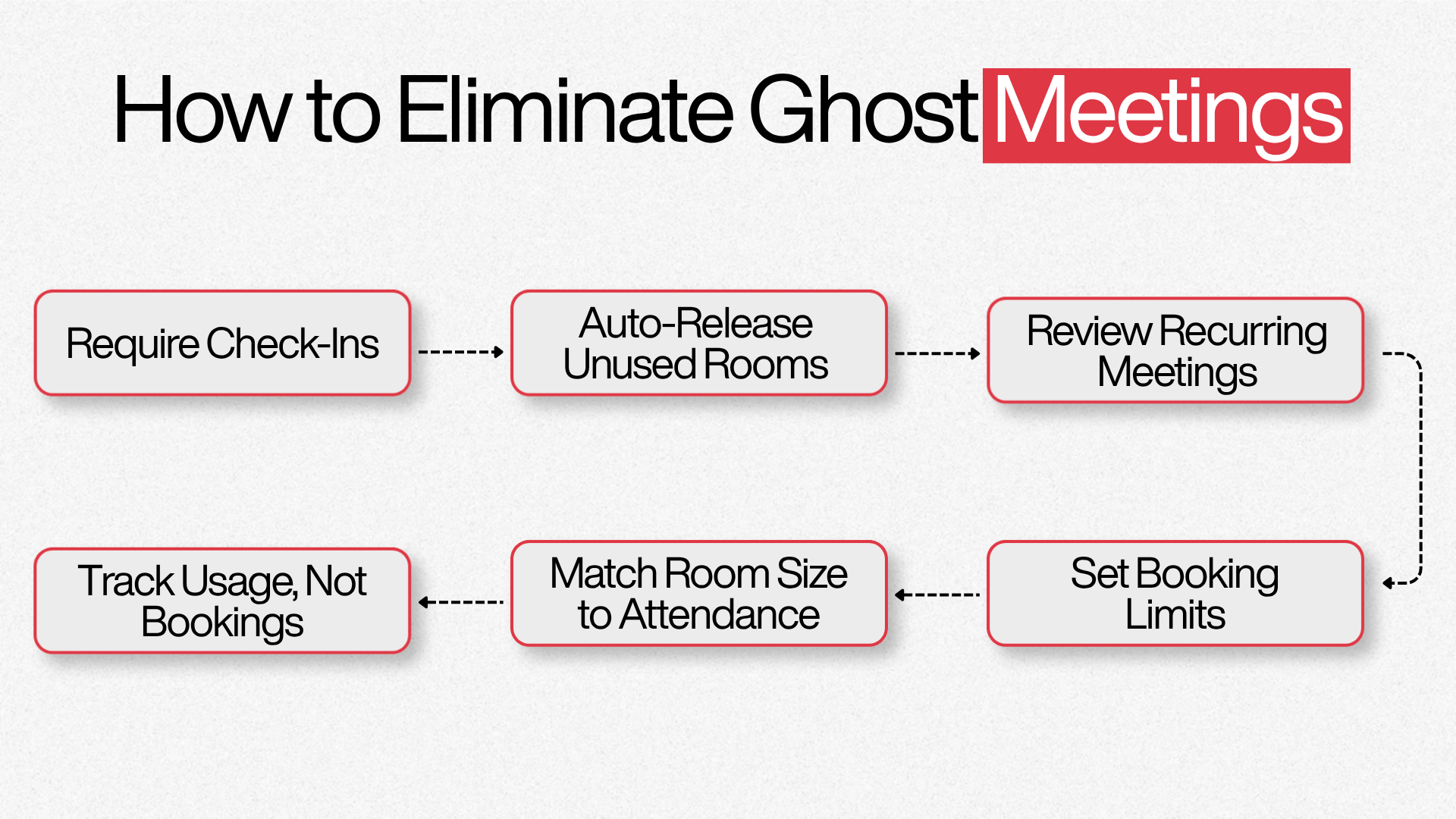
These are ordered by impact-to-effort. Start at the top.
- Require a check-in to hold the room. The organiser confirms attendance from a door panel, a calendar prompt, or a mobile app. The rule is one line everyone can remember: no check-in, no room. This single step forces every booking to prove it is real.
- Auto-release rooms nobody confirms. If no one checks in within a short grace period, the room returns to the pool automatically. Common windows are 5, 10, and 15 minutes; 10 minutes is the widely used default, long enough to cover a late arrival, short enough to recover the slot the same hour. Check-in flags a no-show; auto-release actually recovers it. You want both.
- Audit recurring meetings every quarter. Recurring holds are usually the largest single block of dead bookings precisely because nobody revisits them. A 30-minute quarterly sweep that kills inactive series tends to free up prime Tuesday-to-Thursday slots immediately. Many teams recover meaningful capacity from this habit alone.
- Cap hoarding with booking limits. Maximum durations, sensible advance-booking windows (30–60 days is plenty for most teams), and a light fair-use policy stop the defensive over-booking that scarcity encourages.
- Match room size to group size. Nudge or restrict large rooms away from 1:1s. If your data shows half your meetings are solo, this is where capacity is hiding.
- Report on occupancy, not reservations. Shift every dashboard and every leadership conversation from “what was booked” to “what was used.” This is the change that makes all the others stick, because it puts the right number in front of decision-makers.
A booking policy that holds up
Policy area | Recommendation |
Check-in window | 10 minutes |
Auto-release | Enabled by default |
Recurring-meeting review | Quarterly |
Booking limit | 30–60 days |
Room-size matching | Required/nudged |
Utilisation review | Monthly |
The point of a written policy is not control; it is consistency. Once people trust that an unused room will reliably come back into the pool, the incentive to hoard “just in case” disappears, and the system starts correcting itself.
A reasonable target to manage against: keep your no-show rate under 15%. Persistent double-digit no-shows usually point to friction in the tooling or the policy, not to a genuine room shortage.
Where Technology Actually Helps
Shared calendars and spreadsheets can record a reservation. They cannot verify that anyone showed up, release a room that went unused, or tell you how full it was. In other words: they manage reservations, not reality.
Modern meeting room booking and occupancy systems close that gap by tracking, in one place:
- Reservations
- Check-ins
- Actual occupancy (via sensors or sign-in)
- Real-time availability
- Utilisation trends over time
That is the shift that matters from passive scheduling to active space management. Instead of asking “is this room booked?”, the workplace team starts asking the three questions that actually drive real estate decisions: Is the room being used? How many people are in it? Is it the right size for them?
You do not need the most expensive sensor platform to start. Check-in plus auto-release, enforced through whatever booking tool you already run, will recover most of the easy capacity. Sensors earn their place when you need ground-truth occupancy data to defend or right-size a lease.
The practical test for any tool you put in front of employees is simple: is booking and check-in frictionless enough that people actually do it, and does the system capture whether the room was really occupied? If the answer to either is no, ghost meetings continue regardless of what else the tool can do.
How Qudify Fits Into This
Everything above comes down to three jobs: make booking and check-in effortless, show people what is actually free, and turn usage into data you can act on. Qudify is a QR-based meeting room and desk booking platform built around those three jobs.
Scan to book and check in no app to install: An employee scans a QR code on the room or desk with any phone and books or confirms the slot in seconds. Keeping that confirmation step this low-friction is what makes check-in actually happen, and a check-in that happens is the one thing that turns a no-show from wasted time into recovered capacity.
Live availability instead of guesswork: Real-time displays show which rooms and time slots are genuinely open, so people stop walking the floor to find space the calendar insists does not exist.
Recurring bookings and calendar sync: Recurring reservations are supported, and automatic email confirmations and calendar invites keep the booking system and everyone’s calendar in agreement rather than drifting apart. (You will still want the quarterly recurring-meeting audit; no tool removes the human habit of forgetting a series.)
A utilisation dashboard, not just a calendar: Every booking and check-in feeds an analytics dashboard that surfaces usage, bookings, and trends in one place. That is the shift this whole article argues for: measuring what was actually used, not just what was booked.
One system for rooms, desks, and visitors: The same QR approach extends to hot-desk booking and contactless visitor check-in, useful in hybrid offices, where room scarcity and desk scarcity are usually the same measurement problem wearing two hats. Qudify is used across sectors including IT, banking, healthcare, telecom, and co-working, and can be branded and scaled to the organisation.
If your calendar reads “full” while half your rooms sit empty, that gap is measurable and closing it starts with making check-in effortless and usage visible. You can book a Qudify demo to see it mapped to your own floor plan.
Worked Example (hypothetical)
The following scenario is illustrative, built from the patterns described above rather than a single named client.
A 300-person technology office in Bengaluru with 20 meeting rooms.
Before
- The booking calendar shows ~80% utilisation.
- Employees complain about room shortages most weeks.
- A peak-hour walk-through finds roughly a third of rooms empty.
- Leadership starts pricing additional office space.
Actions taken
- Mandatory check-in introduced.
- 10-minute auto-release enabled.
- One quarterly audit of recurring meetings.
After
- Unused rooms flow back into the pool automatically.
- Availability improves noticeably without any new rooms.
- Reports now reflect occupancy, so the “shortage” turns out to be a scheduling problem.
- The plan to lease more space is shelved.
The office gains usable capacity without adding a single room, which, in a city where commercial space runs at a premium, is the whole point.
Traditional Office vs Optimised Office
Dimension | Traditional office | Optimised office |
Booking visibility | Calendar only | Real-time occupancy |
Room release | Manual | Automatic |
Utilisation data | Reservation-based | Occupancy-based |
Recurring meetings | Unmanaged | Audited quarterly |
Employee experience | Perceived scarcity | Predictable availability |
Space planning | Assumption-based | Data-driven |
The Bottom Line
Most organisations are not short on meeting space. They are short on honest data about the space they have, and ghost meetings, abandoned bookings, and stale recurring holds are why.
The fix is consistent across office sizes and industries:
- Measure occupancy, not reservations.
- Require check-in to hold a room.
- Auto-release anything nobody confirms.
- Audit recurring meetings every quarter.
- Back the policy with a tool that can actually enforce it.
Do those five things and the room shortage you have been managing usually turns out to be a measurement problem you can solve for a fraction of the cost of more square footage.
Frequently Asked Questions
What is a ghost meeting?
A ghost meeting is a booked conference room that no one uses. The reservation stays on the calendar, so the room looks occupied and counts toward utilisation, while in reality it sits empty. Most ghost meetings come from forgotten bookings, cancellations left on the calendar, or recurring meetings that no longer happen.
Why are conference rooms booked but empty?
Because reserving a room and releasing it are two separate actions, and the second one is easy to skip. Cancellations, no-shows, stale recurring meetings, and last-minute hybrid schedule changes all leave reservations in place after the need has gone. The result is artificial scarcity: the calendar runs out of rooms long before the building does.
How much room capacity do ghost meetings waste?
Across multiple workplace analytics providers, 30–45% of booked room time goes unused in offices without check-in or auto-release policies. One sensor vendor put a single client’s ghosted-meeting rate above 25%. The exact figure depends on your culture and tooling, but anything in double digits is worth fixing.
How do I identify ghost meetings in my office?
Look for five signs: rooms booked but visibly empty, frequent shortage complaints, high booking rates with low occupancy, recurring meetings dominating the calendar, and peak demand without matching usage. If three or more apply, run a short occupancy audit to confirm the scale.
What is the best way to prevent meeting room no-shows?
Mandatory check-in is the most effective single measure: the organiser confirms attendance on arrival via a panel, prompt, or app. Pair it with automatic release of unconfirmed rooms so the no-shows that check-in flags are actually recovered, not just recorded.
What is automatic room release?
It is a rule that returns a reserved room to the available pool if nobody checks in within a set grace period. Common windows are 5, 10, or 15 minutes, with 10 minutes the usual default. It is one of the highest-impact, lowest-effort fixes because it recovers no-show time continuously with no staff intervention.
Should recurring meetings be audited regularly?
Yes. Recurring holds are often the largest block of dead bookings because they are set once and rarely revisited. A quarterly review that removes inactive series frees prime mid-week slots and noticeably improves availability, often the single biggest capacity win.
How do you measure actual room utilisation?
Measure occupancy, not just bookings. Track four metrics: booking utilisation, occupancy utilisation, check-in rate, and room release rate. The gap between booking and occupancy utilisation is, in effect, your ghost-meeting problem stated as a number.
Do room booking systems reduce ghost meetings?
Capable ones do, because they manage occupancy rather than just recording reservations, tracking check-ins and real usage, releasing unconfirmed rooms automatically, and reporting on occupancy trends. Spreadsheets and shared calendars cannot, because they have no way to know whether anyone showed up. A QR-based platform like Qudify, for example, ties booking, check-in, and a usage dashboard together so the calendar reflects what is actually happening in the room.
What metrics should facility managers track?
Beyond raw bookings: occupancy utilisation, no-show rate, check-in rate, room release rate, and how group size maps to room capacity. A no-show rate under 15% is a reasonable target; persistent double digits signal a policy or tooling gap. Pair these with peak-time analysis to tell whether the real issue is room count, room size, or behaviour.
Do we need more meeting rooms or better room management?
Almost always better management. When occupancy sits near 40% while the calendar reads “full,” the constraint is wasted capacity, not a real shortage. Measuring occupancy, enforcing check-in and auto-release, and auditing recurring meetings typically recovers more usable space than adding rooms at a fraction of the real estate cost.