
Visitor Management System Pricing in India 2026: What You Should Actually Pay
Key Takeaways
- Envoy lists Visitors Premium at three different prices across its own website and billing docs. Screenshot whatever page you were quoted from.
- India-priced platforms start at ₹399 monthly. Dollar-priced ones start near ₹35,000 per location monthly. Both sell visitor check-in.
- The counting unit per location, per invitee, per door shifts your bill further than any headline rate.
- Cheap capped plans lose to costlier uncapped ones above roughly 1,400 check-ins monthly at one site.
- Envoy locks admins out of the dashboard once a capped plan hits its monthly entry limit.
- Foreign subscriptions carry 18% IGST under reverse charge. Without your GSTIN on file, that tax never comes back.
- No visitor management system is DPDP-certified, because no such certification exists. Judge retention controls and audit logs instead.
The Invoice That Moves While You're Not Looking
A facilities lead in Gurugram buys a visitor management system in March. Three sites, one tidy monthly number. Within a fortnight, the receptionists have stopped wrestling with the paper register and security has stopped arguing with couriers about who they’re here to see. Good purchase, sensibly made.
Then October’s renewal invoice arrives, and it doesn’t match March’s.
The vendor hasn’t raised prices. What happened is that the company opened a fourth office in Pune, which tripped a fourth per-location licence. Badge printing turned out to sit one tier above the plan they’d bought. The subscription bills are in dollars, and the rupee drifted. And because nobody put the GSTIN on file at signup, eighteen percent of every invoice since March has walked out of the building and not come back as input tax credit.
None of it was hidden. It was on the pricing page, or the page behind the pricing page, or in a tax rule that was never the vendor’s job to explain. It just wasn’t added up anywhere.
So here’s the addition. What follows comes from vendors’ own pricing pages and billing documentation, checked on 22 August 2026. Where a company publishes nothing, we say so rather than borrowing a figure from a comparison site and dressing it up as fact.
If you read one line and leave: the answer to “what does a VMS cost in India” turns far less on which product is better than on which currency you’re billed in and which unit somebody is counting you by.
What It Actually Costs: The 2026 Bands
Band | Price | What’s in it | Who it suits |
Free | ₹0 | Capped entries, host alerts, one location, small directory. No badge printing. | One quiet reception replacing a register |
India-priced entry | ₹399 – ₹2,000/month | QR or kiosk check-in, e-passes, SMS and email alerts, visitor logs | Under 50 staff, one or two sites |
India-priced growth | ₹2,000 – ₹6,000/month | Higher volume, multi-site dashboards, NDA capture, printed badges, OTP | 50–250 staff, two to five sites |
India-built enterprise | Quote-only | Custom workflows, access control, evacuation, contractor and vehicle tracking, SLAs | Campuses, plants, multi-tenant towers |
Global platform | ₹54,000 – ₹4,16,000 per location per year | SSO, ID scanning, blocklists, guest Wi-Fi, deep integrations, global support | MNCs standardising one stack across countries |
Roughly twenty times separates the third row from the fifth, and those products overlap heavily on whatever an ordinary Indian front desk touches on a Tuesday morning. The premium buys enterprise security architecture, integration depth and follow-the-sun support. Whether you’ll consume any of it is the entire decision, and most buyers answer it by accident.
Verified Pricing, Side by Side
USD converted at ₹95.7 and GBP at ₹130, mid-market on 22 August 2026. Indicative only; your bank will do worse, and both rates move; reconvert at today’s rate before you quote any dollar or sterling figure below as a rupee number.
Vendor | Origin | Counting unit | Entry | Top published tier |
Qudify | India | Not published | Quote-only | Quote-only |
VizMan | India | Invitees + users; sites unlimited | ₹399/mo (₹3,999/yr) | ₹5,999/mo (₹59,999/yr) |
Vizitor | India | Per location | ₹1,600/mo/location (₹19,200/yr) | ₹3,200/mo/location (₹38,400/yr) |
Sign In App / SwipedOn | UK | Per site | $630 /site/yr | $1,890/site/yr |
Envoy Visitors | USA | Per location | Free (100 entries/mo) | $362/location/mo (≈₹4,16,000/yr) |
Veris | India | Not published | Quote-only | Quote-only |
Spintly | India | Not published | Quote-only | Quote-only |
truMe | India | Not published | Quote-only | Quote-only |
Read the third column twice. It’s carrying more weight than the fourth.
If you’re still narrowing the field on capability rather than cost, our fact-checked comparison of visitor management systems in India covers the feature side of these same vendors and pairs directly with this page.
The Envoy Pricing Problem
This one earns its own heading, because it’s the most useful thing a buyer in this category can know right now and no competing page currently covers it.
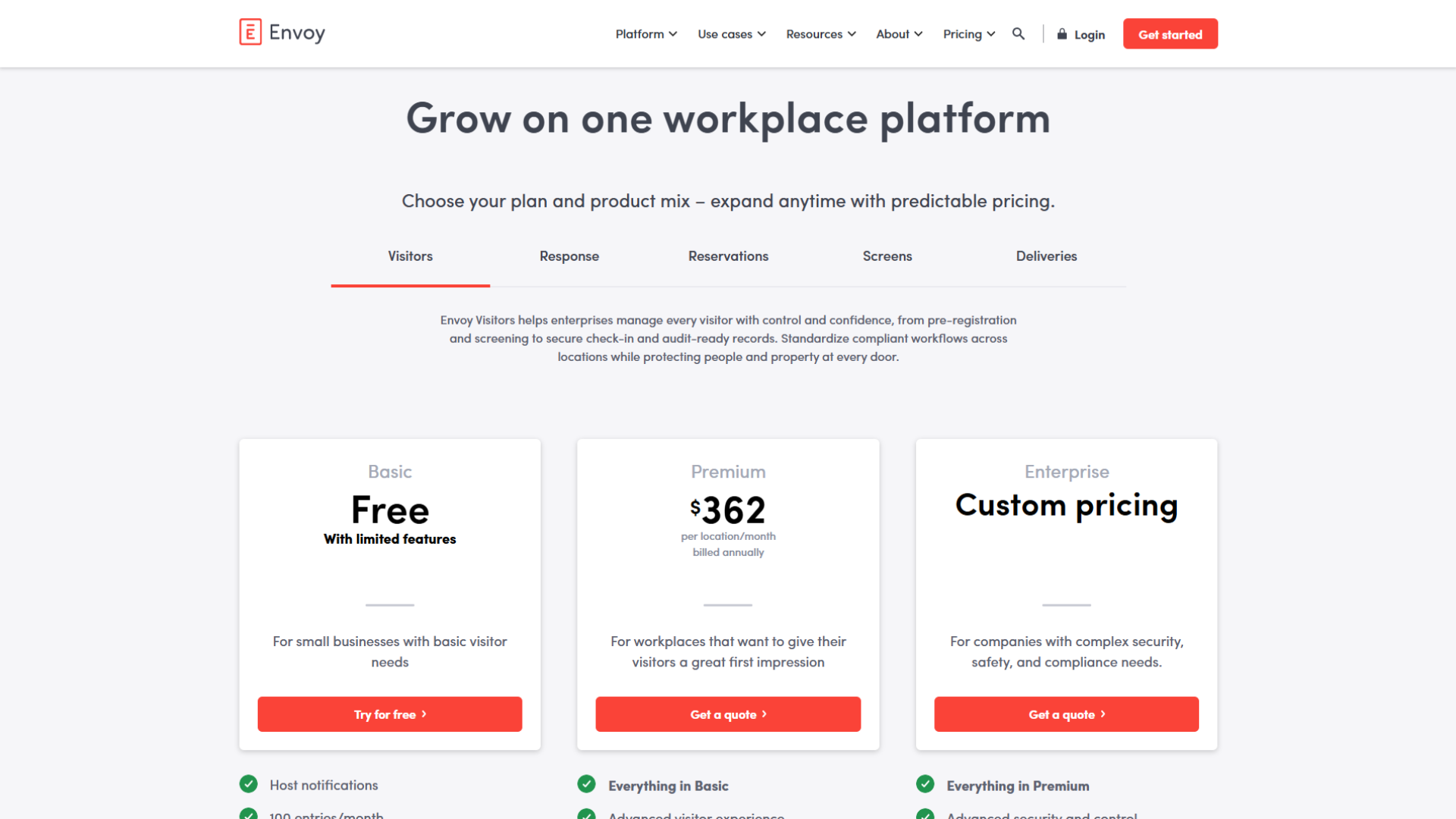
On 22 August 2026, Envoy’s public pricing page shows Visitors in three tiers: free Basic capped at 100 entries a month, Premium at $362 per location per month billed annually, and a custom Enterprise tier.
Scroll down that same page into the expandable “compare plans” blocks, and a Standard tier appears at $109 per location per month beside a Premium tier also listed at $109.
Now open Envoy’s billing documentation in their help centre. The worked example there prices a Visitor Premium licence at $329 per location per month, or $3,948 a year.
Three properties. Three prices. Same tier.
We’re not alleging anything improper; large pricing pages drift, and stale modules survive redesigns. But for an Indian buyer negotiating a multi-site contract, the consequence is real, and it generalises well past Envoy: make your quote name a specific tier and a specific figure in writing, and keep a dated screenshot of whatever page you were shown. Across three locations, $109 versus $362 a month is about ₹8.7 lakh a year.
That billing documentation repays reading for three more reasons, none of which surface on the pricing page.
Hitting the cap doesn’t cost you money; it costs you the system. Envoy states that from 1 May 2026, Basic is limited to 100 visitor entries per calendar month and Standard to 500, and that admins cannot access the Envoy dashboard once the limit is reached until the counter resets at month start. That’s not an overage charge. That’s your visitor log going dark, and it will go dark during audit week or a plant shutdown rather than on an average Tuesday, because those are the months that breach the cap.
A “location” might be a doorway. Envoy defines it as a physical office or a separate entrance within the same building. A campus running three gates that wants separate logs per gate is a three-licence campus.
Closing a site doesn’t close the billing. Their documentation is explicit: deactivating a Visitors location lets you redeploy that licence elsewhere but does not remove it from your bill. Consolidating offices won’t shrink the subscription on its own.
One correction in Envoy’s favour, which most comparison articles get wrong: you can pair unlimited iPads per location on Basic, Standard and Premium. Devices aren’t the constraint. Printers are one per location on Standard and Premium, with multiple printers held back for Enterprise.
Cost Per Check-In: The Comparison Nobody Runs
Comparing monthly prices across vendors that count in different units produces noise. Normalise instead: annual software cost at one site, divided by check-ins.
Plan | Annual cost | At 300/month | At 1,000/month | At 3,000/month |
VizMan Premium | ₹19,999 | ₹5.56 | Caps at 300 | |
VizMan Ultimate | ₹59,999 | ₹5.00 | Caps at 1,000 | |
Vizitor Starter | ₹19,200 | ₹5.33 | Caps at 300 | |
Vizitor Premium | ₹38,400 | ₹10.67 | ₹3.20 | caps at 1,000 |
Sign In App Core | $1,890/site/yr | ₹50.10 | ₹15.03 | ₹5.01 |
Envoy Visitors Premium | ≈₹4,15,700 | ₹115.47 | ₹34.64 | ₹11.55 |
What falls out of that table cuts against every “best budget VMS India” listicle, including the ones that would have flattered a domestic vendor.
Past roughly 1,400 check-ins a month at a single site, the sterling-priced uncapped plan is cheaper per visitor than the rupee-priced capped one. Vizitor Premium at ₹3,200 a month is the smaller absolute number, but it stops dead at 1,000 check-ins. Sign In App Core works out to about ₹4,496 a month at today’s rate and never stops. Beyond that crossover, the “expensive” foreign product wins on unit economics, and beyond 1,000 it’s the only one of the two still functioning without an enterprise quote.
Add sites and the picture inverts again, because both bill per site and VizMan don’t.
Which is the actual lesson. There’s no cheap vendor and no expensive vendor here. There are vendors whose counting unit happens to match your shape and vendors whose doesn’t, and the gap between those two outcomes dwarfs anything on a feature grid.
The Five Counting Units
Per location: Vizitor, Envoy, Sign In App. Envoy requires every location on an account to share a plan, payment method, and billing cycle, prorating mid-cycle additions to a common renewal date. Sign In App draws its line at the postcode. This unit punishes growth, and Indian companies grow by adding small offices.
Per invitee or per user: VizMan counts monthly invitees and named users, with unlimited devices and multi-site management from its entry tier. For a firm with five modest offices, that single decision outweighs anything on the comparison chart.
Per check-in: A volume cap riding on top of a per-location price. Caps break budgets because visitor traffic is seasonal rather than average. Size for your worst month, not your typical one.
Per door: Access-control-first platforms like Spintly bolt a visitor module onto infrastructure priced around doors and readers. Already buying access control? The VMS may be close to free. Not buying it? You’re purchasing something far larger than you asked for.
Per bookable resource: This one applies when visitor management is a module inside a workplace platform. Envoy prices Reservations desks, rooms, and parking at $5 per bookable resource per month, Screens at $12 per device, and deliveries at $250 per delivery location. Each carries the note “price excludes platform fee”, and that platform fee isn’t published anywhere. Anyone building a business case for a full platform is therefore building it around a blank.
Worth knowing if room booking is in scope: platforms bill it very differently. Sign In App sells desk and meeting-room booking as a £125–£370 per site per year add-on tied to how many spaces you manage. Envoy meters it per resource. Qudify’s meeting room and desk booking runs off the same QR layer as check-in, with a tablet outside the room showing status while the booking itself happens on the visitor’s or employee’s phone. Three genuinely different cost curves, and the one you want depends on whether your room count or your headcount grows faster.
Vendor Notes
VizMan is the cheapest credible INR entry point.
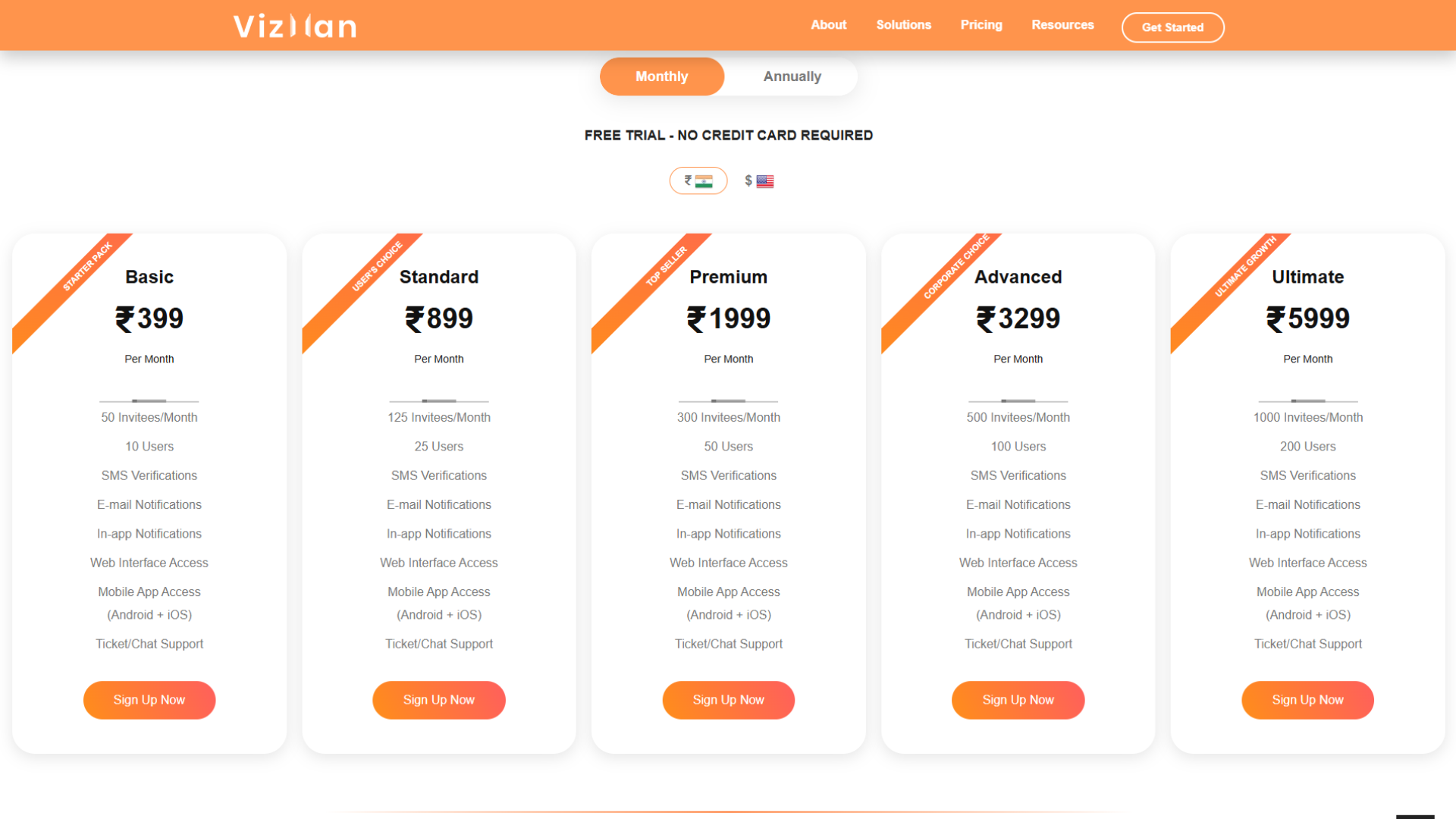
Five published tiers, an INR toggle, no coyness. Basic runs ₹399 a month or ₹3,999 a year for 50 invitees and 10 users. The ladder climbs through Standard (₹899/₹8,999), Premium (₹1,999/₹19,999) and Advanced (₹3,299/₹32,999) to Ultimate at ₹5,999 a month or ₹59,999 a year for 1,000 invitees and 200 users. Annual billing saves about 17%.
Two design choices make it cheaper than it reads. Devices are unlimited on every paid tier, so a plant with four gates doesn’t pay four times over. And multi-location management is included from Basic, which means the per-site multiplication running through this entire article simply doesn’t bite.
The trade-off deserves stating plainly, because it’s where projects fail. Multi-language check-in, offline check-in, NDA capture, parking, evacuation alerts, Slack and Google Directory all sit inside a quote-only Enterprise tier. What’s published is a capable digital front desk. It is not a compliance platform, and buying it expecting one is a mistake that surfaces during an audit rather than during the demo.
Vizitor is a documented ladder, with a pricing wobble of its own
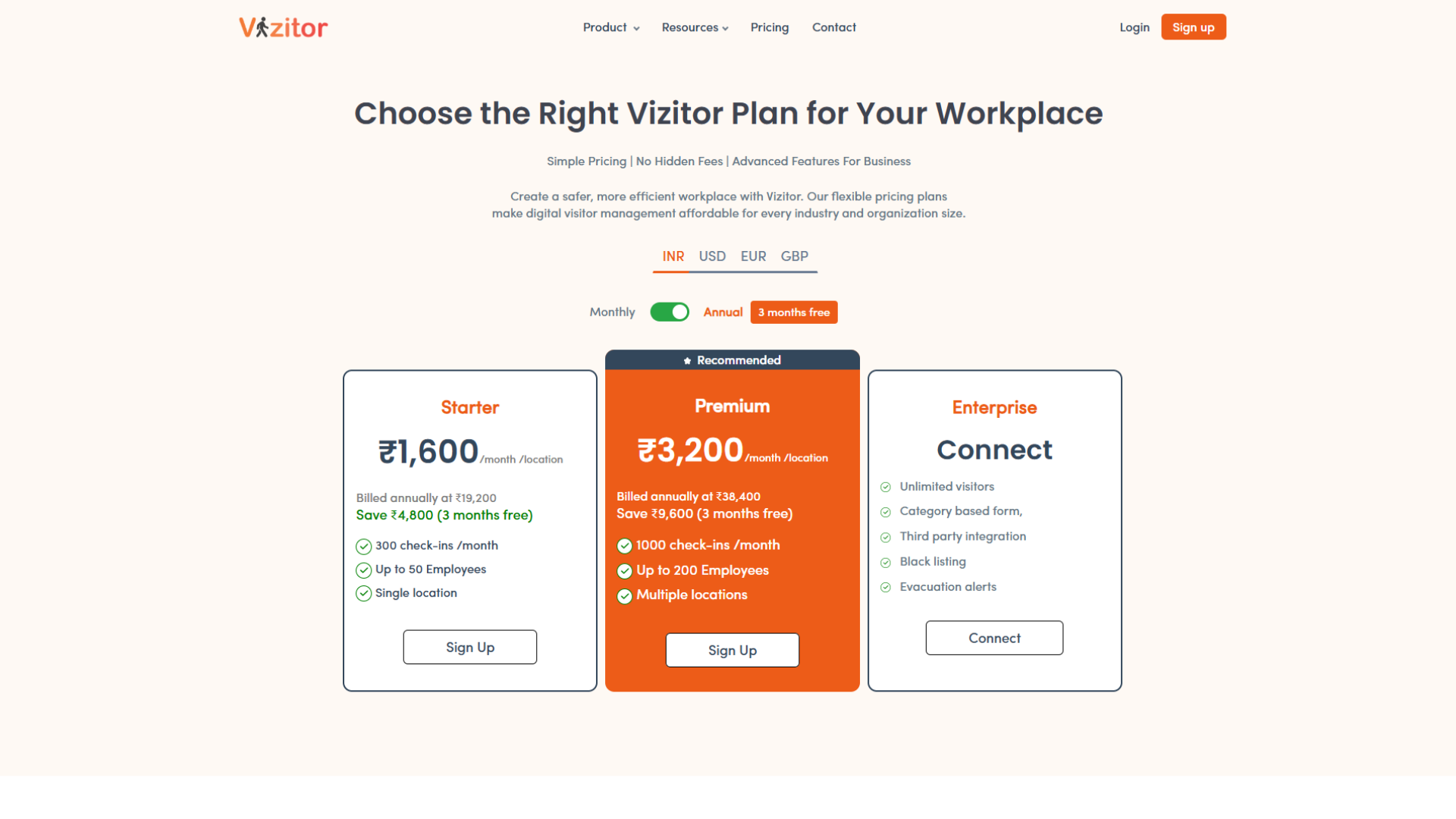
Starter is ₹1,600 a month billed annually (₹19,200 a year) for 300 check-ins, 50 employees, one location, one device. Premium is ₹3,200 a month billed annually (₹38,400) for 1,000 check-ins, 200 employees, two locations, four devices. Enterprise is quote-only and includes the security layer: blocklisting, evacuation alerts, overstay and outstay alerts, Slack and Google Directory.
The published feature grid is unusually granular, which genuinely helps a buyer. Before any sales call, you can see that NDA capture, printed badges and OTP authentication all begin at Premium. Vizitor also states there are no setup or installation fees and that it runs on standard Android tablets or iPads.
Same caution as Envoy, different vendor. Vizitor’s site currently carries at least three entry prices across different pages: ₹1,600 a month on the pricing page, ₹999 a month on one landing page, and $36 a month on another, and its pages disagree on whether a permanent free plan exists or only a trial. Legacy pages and campaign variants would explain it. Ask which one applies to you, and get the answer in writing.
Sign In App (and SwipedOn) uncapped, in sterling
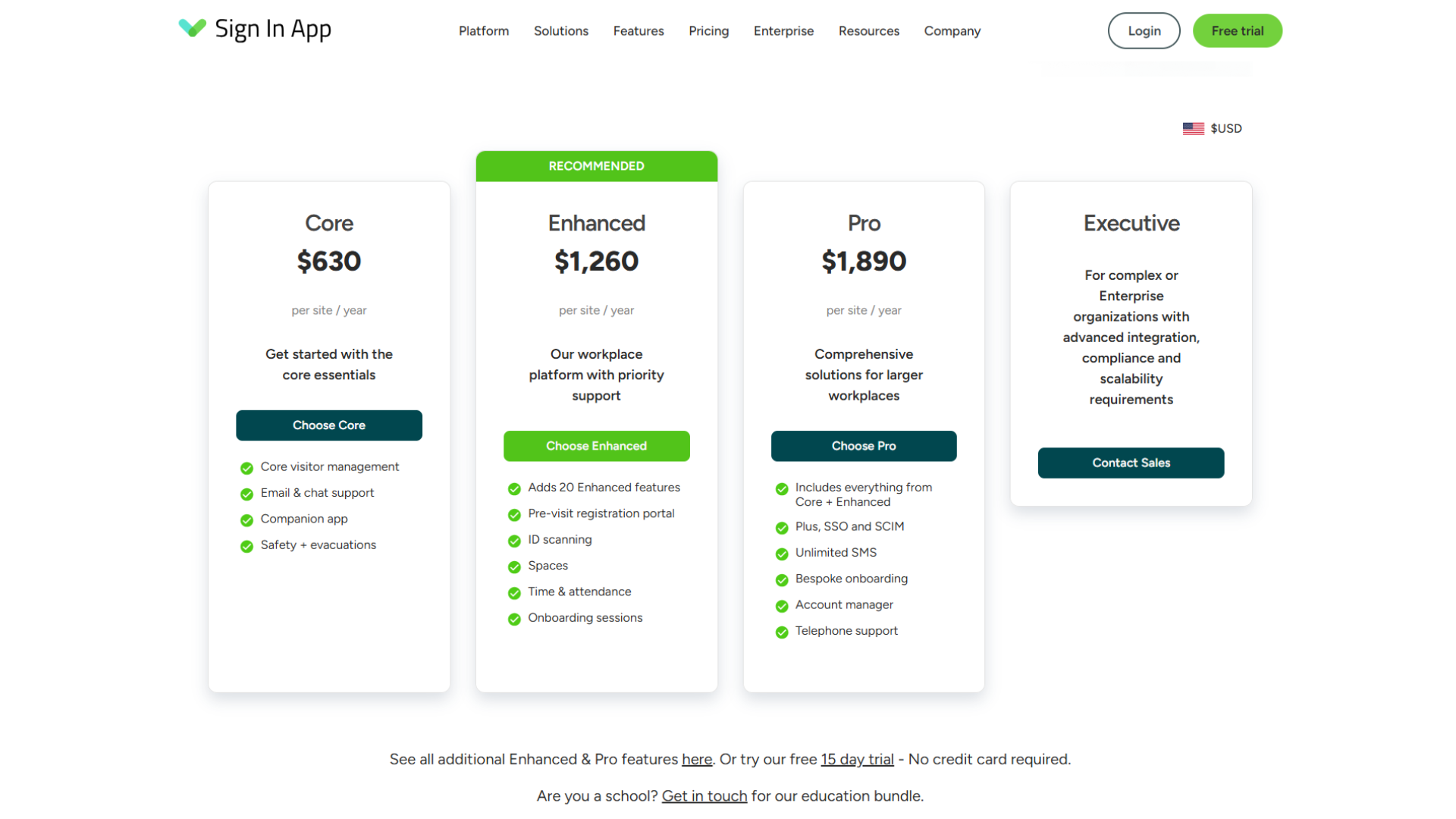
Sign In App / SwipedOn is priced per site, with an entry tier at ₹54,000 per site per year and a top published Pro tier at ₹1,63,000 per site per year, with an Executive tier above that. The inclusion policy is the most generous in this comparison by some distance. Unlimited employees, unlimited monthly sign-ins, unlimited connected iPads, unlimited portal users, on every tier including Core. Badge printing is in Core. Entra ID, Google Workspace, Teams, Slack, custom webhooks and a documented API sit in the base subscription instead of being gated upward. Enhanced adds pre-visit registration, ID scanning and unlimited SMS. Pro adds SSO, SCIM, a named account manager and telephone support.
Add-ons are priced separately and honestly: room and desk booking at £125–£370 per site per year by space count, appointment scheduling at £360 per 2,400-appointment bundle, time and attendance from £420 to £1,890 per portal per year by headcount. Hardware ships as a package with £14.95 delivery per location. The company states outright that it doesn’t discount below ten sites.
Any Indian shortlist still carrying SwipedOn as the budget pick needs updating. swipedon.com/pricing now resolves to this page following the move into the Sign In Solutions portfolio, and the old low tiers have gone with it.
Envoy Visitors: the platform tier
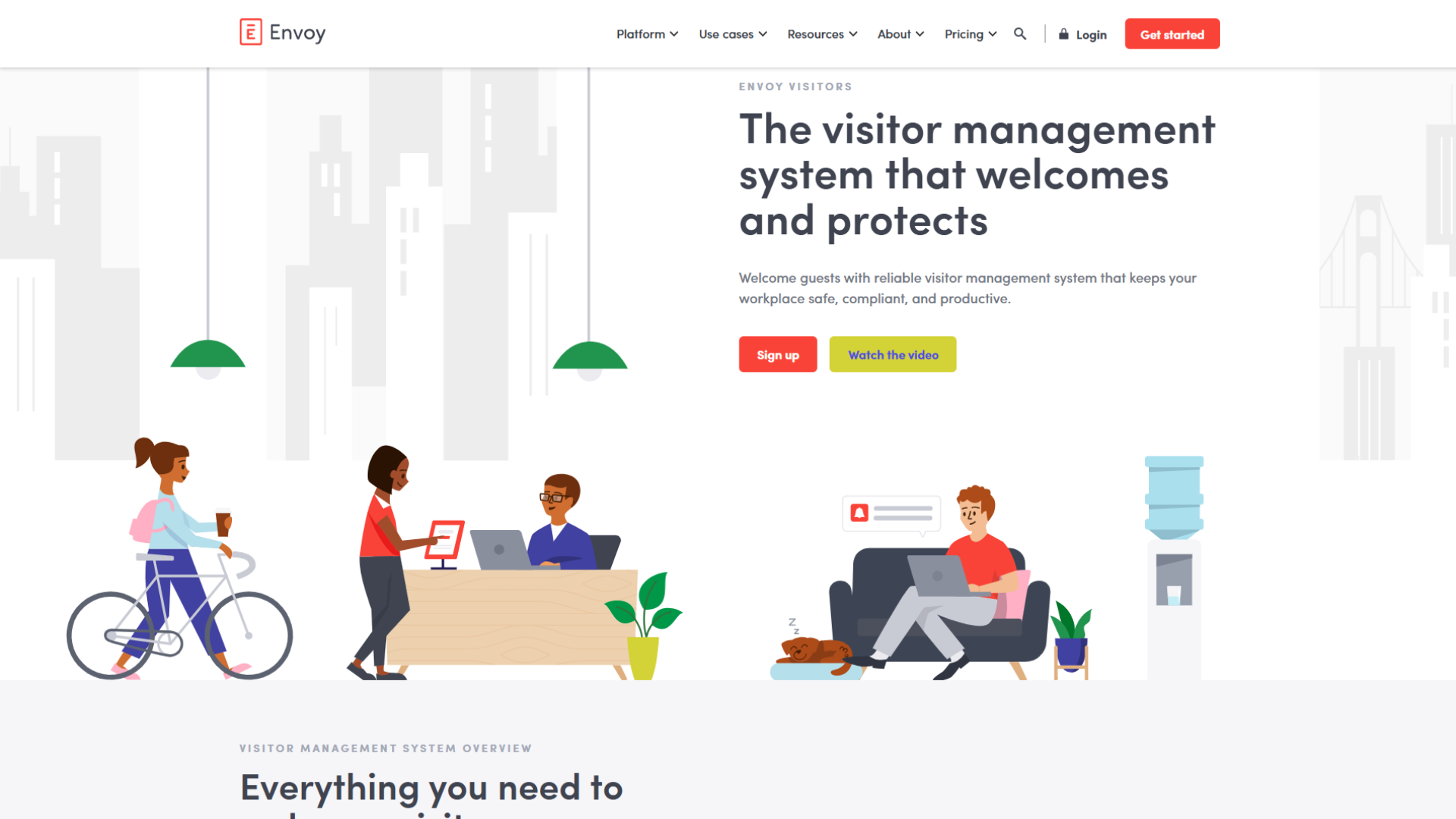
Covered above. Premium holds badge printing, legal documents, branding, visitor photos, analytics, SSO and directory integrations. Enterprise adds blocklist scanning, access control and guest Wi-Fi integrations, ID scanning at 500 scans a year included, and emergency notifications to visitors. It’s priced as a workplace security platform, and for an organisation with restricted-party screening obligations across fifteen countries that price is defensible engineering. For a three-office Indian mid-market firm, it’s capacity nobody will ever open.
Veris, Spintly, truMe India-built, quote-only
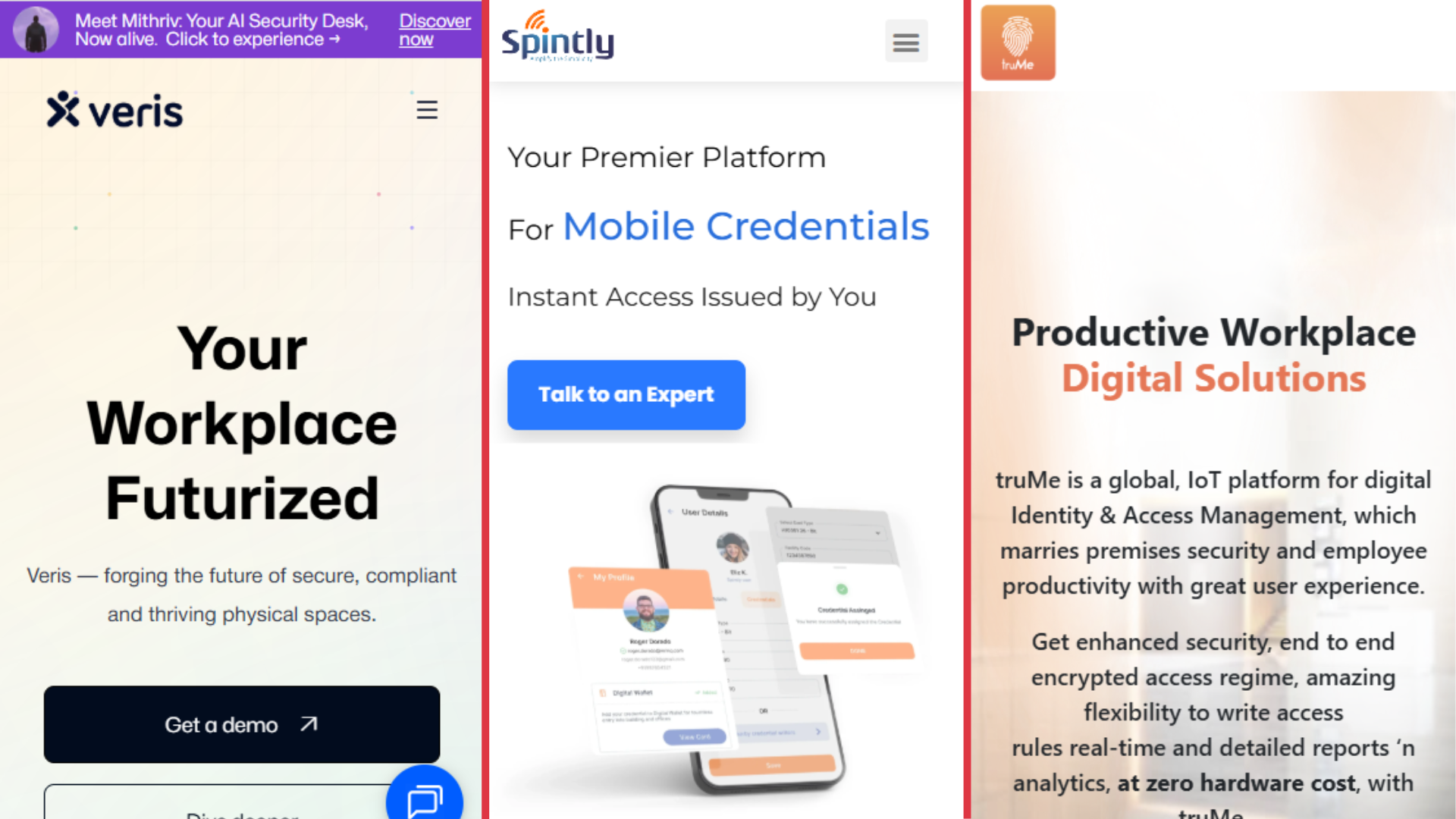
Veris is the most established India-built enterprise visitor platform, with a track record across multi-tenant commercial towers, co-working operators and high-security manufacturing, spanning visitor management, meeting rooms and desking. Spintly arrives from the access-control side, a wireless BLE-mesh platform with a visitor module attached, which makes it compelling when doors and readers are already in the budget. truMe sits in the same bracket.
None publishes list pricing. Comparison sites will hand you numbers for all three; those are estimates or aged quotes, and repeating them here as fact would hollow out everything else on this page. Budget for a discovery call and expect pricing shaped by sites, doors, integrations and SLA rather than a seat rate.
Indian marketplaces do surface useful INR anchors for smaller vendors: SeQure from ₹500 onwards, Alleviz from ₹25,000 onwards on Techjockey, though marketplace figures are lead-generation prices rather than contracts.
Qudify our disclosure
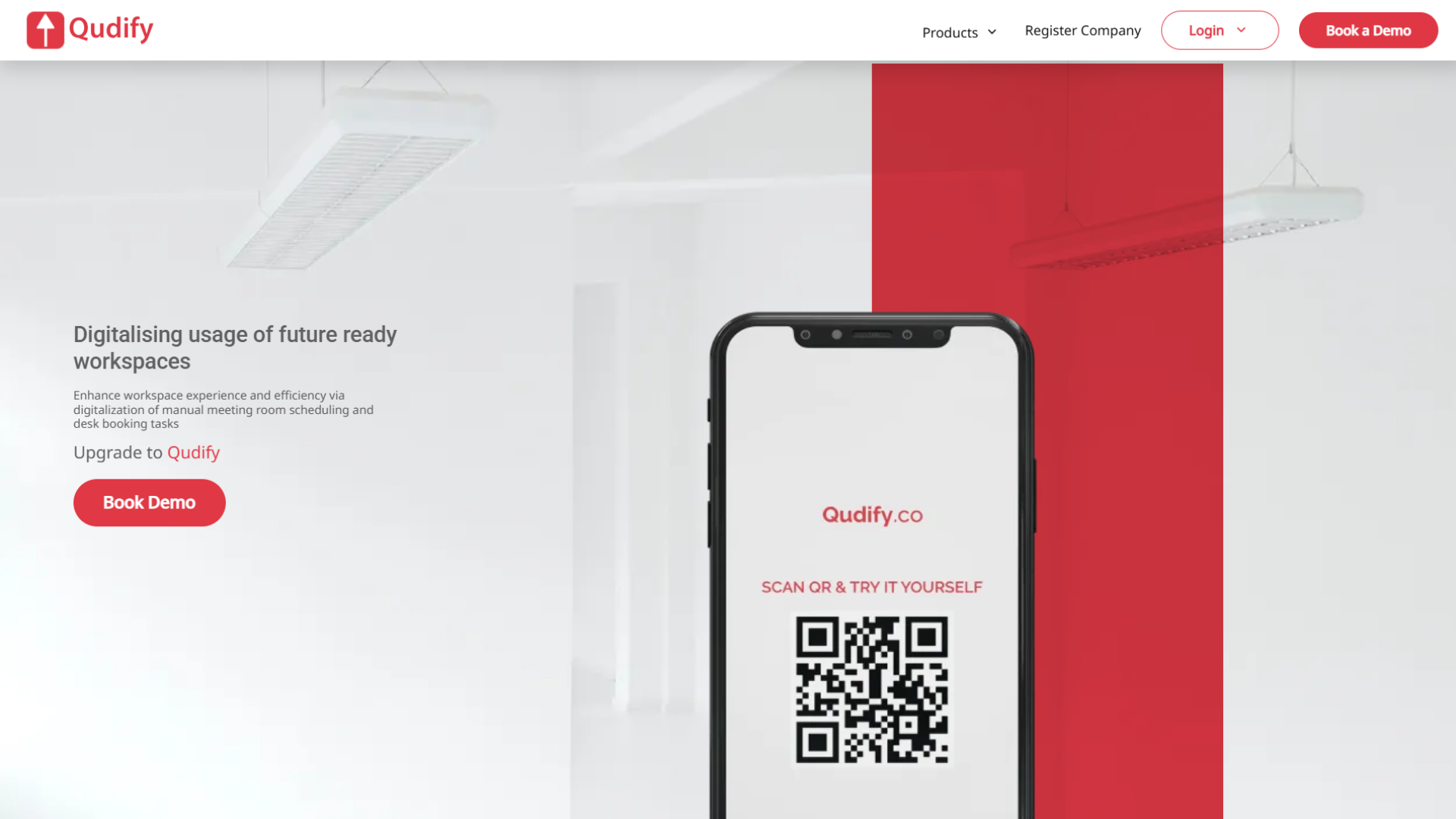
We sell a QR-based visitor management system, and don’t publish list pricing either. We’ve marked ourselves as not publicly listed in the same table as Veris and Spintly, because writing three thousand words about pricing transparency and then quietly exempting ourselves would be worth less than not writing at all.
What we can describe is structural rather than commercial. The model removes the kiosk: visitors scan a code on their own phone, hosts approve over WhatsApp, and the standard flow involves no tablet, no enclosure, no badge printer, and no app download. Whatever the subscription costs, the hardware column stays near zero and stays near zero when you open site number five. Qudify’s own materials cite 500+ live sites, 400+ clients, and over a million QR scans. Those are self-reported and haven’t been independently audited; treat them exactly as you’d treat any other vendor’s numbers on this page.
The Costs That Aren't on Any Pricing Page
18% GST, and the credit you may be throwing away
SaaS in India carries GST at 18%. With a domestic vendor, that’s simple: they invoice it, you reclaim it as input tax credit.
Foreign vendors are where money quietly disappears. A US or UK subscription delivered over the internet counts as an OIDAR service. Supply your GSTIN and the vendor typically stops charging Indian GST; you then self-assess 18% IGST under reverse charge in GSTR-3B and claim the identical amount as input tax credit that same month. Net cash impact: roughly nothing.
Leave the GSTIN off, and the vendor treats you as a consumer, charging 18% under its non-resident OIDAR registration. That tax doesn’t flow through your GSTR-2B and can’t be reclaimed. On three Envoy Premium licences it’s about ₹2.2 lakh a year, gone, and gone again next year.
Checking whether your GSTIN sits on file with every foreign software vendor you use is the highest-return five minutes anywhere in this article.
A contract that never changed price and still got 10% dearer
The pound bought about ₹130 on 22 August 2026. Twelve months earlier it bought about ₹117. A £415 site subscription didn’t rise a penny in sterling. It rose roughly 10% in rupees, and no email went out.
Layer on the 2–3.5% FX markup most Indian corporate cards apply, and a flat foreign-currency contract carries an annual variance that a rupee contract doesn’t. Across a three-year commitment that belongs in the business case, not a footnote at the end of it.
Hardware, and the consumables trailing behind it
Kiosk systems need a tablet per check-in point, a secure enclosure, and, if badges are printed, a label printer plus a permanent supply of media. Entry-level iPad pricing in India swings hard by channel: an Apple Authorised Reseller listed the 11-inch A16 Wi-Fi 128GB at an MRP of ₹49,900 in August 2026, while marketplace street pricing for the same generation has sat considerably below that. Get a written quote rather than trusting a range, including ours.
Buyers miss two things here with real regularity. An unsecured tablet on a reception desk eventually walks, so the enclosure was never optional. And badge media scales with visitor volume indefinitely; a site printing 800 badges a month is buying label rolls forever, and no software business case has ever carried that line.
Which is precisely why phone-based check-in changes the arithmetic. Not because the software costs less, but because the marginal hardware cost of location four is a printed code.
The paywall map
The same handful of features sit above the entry tier almost everywhere. Budget for the tier holding what you need, not the one that looks affordable.
Feature | Where it starts |
Printed badges | Standard (Envoy), Premium (Vizitor), Core (Sign In App) |
NDA / legal document capture | Premium (Vizitor, Envoy), Core (Sign In App) |
Blocklisting and watchlist screening | Enterprise (Vizitor, VizMan, Envoy) |
Evacuation and emergency alerts | Enterprise (Vizitor, VizMan) |
SSO and directory sync | Premium (Envoy), Pro for SSO/SCIM (Sign In App) |
Slack / Google Directory | Enterprise (Vizitor, VizMan); base (Sign In App) |
Multi-language check-in | Enterprise (VizMan); base (Vizitor, Envoy) |
Multiple badge printers per site | Enterprise (Envoy) |
Implementation, which nobody invoices for
Guards work rotating shifts, and they turn over. A check-in flow needing eleven taps and a laminated instruction card gets quietly abandoned inside a quarter, and the paper register reappears beside the tablet. We’ve watched that happen at sites running perfectly good software, and it’s the same failure pattern we see with feedback and complaint boxes: adoption collapses at whichever step asks the most of a person who is busy, tired, or new that week.
The most expensive visitor management system in India is the one that’s been paid for and isn’t used, and its price appears in none of the tables above.
Practical corollary: pilot at your worst reception, not your best. Busiest gate, newest guard, noisiest morning. Whatever survives that will survive anywhere.
Worked Example: Three Offices, 800 Check-ins a Month, Badges Required
Bengaluru, Pune, Noida. Around 800 visitor check-ins a month across all three. Printed badges and a central dashboard are non-negotiable.
Vendor | Plan required | Annual software cost |
VizMan | Ultimate: 800 invitees need the 1,000 tier; multi-site included, so one subscription covers all three | ₹59,999 |
Vizitor | Premium × 3 locations; badges start at Premium | ₹1,15,200 |
Sign In App | Core × 3 sites; badges in Core, sign-ins uncapped | ≈₹1,61,850 |
Envoy Visitors | Standard × 3 at $109, or Premium × 3 at $362, depending on which published figure your quote uses | ≈₹3,75,600 – ₹12,47,000 |
Software only. Hardware, GST, FX and implementation stack on top of every row.
That spread isn’t pure margin, and pretending otherwise would be dishonest. At the top of the range, Envoy sells a security and compliance platform. Sign In App sells uncapped volume and directory integration in its base tier. VizMan at ₹59,999 sells a competent digital front desk and nothing resembling an evacuation workflow.
So the question was never which is cheapest. It’s whether your organisation actually consumes what the higher rows contain. For a lot of Indian mid-market firms with three offices and ordinary visitor traffic, the answer is no, and the difference is being spent on headroom nobody will open. For a pharmaceutical site carrying restricted-party screening obligations, the answer is yes, and the cheap row is a false economy that surfaces during an inspection rather than during procurement.
Bengaluru, Pune, Noida. Around 800 visitor check-ins a month across all three. Printed badges and a central dashboard are non-negotiable.
Compliance, Costed Honestly
India’s Digital Personal Data Protection Rules were notified on 13 November 2025 via Gazette G.S.R. 846(E). Commencement runs in stages: definitions and the Data Protection Board from November 2025, enforcement powers and Consent Manager registration around November 2026, and the substantive obligations notice, consent, data principal rights, retention, cross-border transfer, and breach reporting in full from mid-May 2027. Advisers cite either 13 or 14 May 2027 depending on how the eighteen-month count runs from the gazette date. Plan against the earlier one, and note that a January 2026 MeitY consultation floated compressing the transition to twelve months; that hasn’t been notified, but a firm sizing a three-year contract should treat the 2027 date as a ceiling that could move forward rather than a fixed floor. Maximum penalty for failing to take reasonable security safeguards is ₹250 crore.
A visitor management system captures names, phone numbers, ID details, photographs and movement logs belonging to people who don’t work for you. That places it inside your DPDP scope and makes it one of the more exposed pieces of software in an average Indian office.
Two consequences for pricing.
There is no DPDP-certified VMS, because no certification scheme exists. Any vendor claiming one is describing something that isn’t there, which tells you something useful about the rest of their claims. Evaluate the underlying controls instead: where data sits, how consent is captured at check-in, whether retention periods are configurable, whether deletion is actual deletion, whether audit logs export cleanly. All of that is demonstrable inside a demo if you ask.
And the affordable tier may not be the compliant tier. Retention controls, anonymisation and audit-log export get gated routinely. Sign In App, for instance, places visit-record anonymisation in Enhanced and above. If your compliance position depends on a feature, price the tier that holds it, and remember DPDP programme costs sit entirely outside the software line.
Which Model Fits You
Assign these honestly. Most buyers over-specify, and no vendor has an incentive to correct them.
- Single office under 50 people: India-priced per-invitee plans, or a free tier if you’ll genuinely stay under the entry cap and don’t need badges.
- Multi-location Indian business: anything not priced per location. Biggest single cost driver for distributed companies, and the easiest one to design around.
- High volume, few sites: uncapped per-site plans. Past roughly 1,400 check-ins a month at one reception, uncapped beats cheap-but-capped on unit cost; past the cap it’s the only thing still working.
- Microsoft 365 environment: find where directory sync sits in the ladder before comparing headline prices. Sign In App includes Entra ID in the base; Envoy places SSO at Premium.
- Manufacturing and industrial campuses: quote-based Indian platforms with contractor, vehicle and materials tracking. Published pricing won’t help; this is Enterprise-tier functionality everywhere.
- Already buying access control access-first platforms, where the visitor module rides infrastructure you’re purchasing anyway.
- Expecting to open sites with hardware-free QR check-in, because the marginal cost of site five decides your three-year number.
- Regulated environments needing screening: Envoy Enterprise or an India-built enterprise platform. Blocklist scanning and ID verification are real engineering, priced accordingly.
Pricing Your Own Deployment
Fifteen questions. Answer them before taking a single vendor call, and you’ll arrive with a specification rather than a shortlist.
- Count entry points, not offices, and check the vendor’s definition, since Envoy treats a separate entrance as a location.
- Count sites the way the vendor counts them. Postcode? Building? Reception?
- Count check-ins in your busiest month. Never your average.
- Count employees who need host notifications. Free tiers commonly cap the directory at 50, silently excluding most of your staff.
- Decide on badges now. It’s the most common tier trigger, and it drags printer and consumables costs behind it.
- Map compliance requirements to specific features, then locate the tier holding them.
- Confirm where directory sync and SSO sit.
- Establish whether you need blocklist or ID screening. Yes puts you in enterprise regardless of budget. No means refusing to pay for it.
- Choose hardware or hardware-free, then price tablets, enclosures, printers and media per entry point, including next year’s.
- Confirm the billing currency and model a 10% adverse move.
- Put your GSTIN on file, and confirm in writing who remits the GST.
- Ask what happens at the cap: surcharge, warning, or lockout. In writing.
- Ask about setup and implementation fees. Some Indian vendors state there are none; enterprise vendors rarely do.
- Model three years including one new site and projected visitor growth.
- Ask what happens to billing when you close a site. At least one major vendor keeps charging.
What This Adds Up To
A week inside vendor pricing pages produces one finding that outlives any individual price. This category prices in units that don’t fit the shape of Indian companies.
Indian businesses tend to run more sites with fewer people in each than the American and European organisations these pricing models were built around. A per-location licence designed for a firm with three large offices behaves very differently against a firm with eight small ones. That mismatch not feature gaps, not build quality is what generates the twenty-fold spread in the worked example above.
The advice is therefore narrower than “it depends on your needs.” Establish three numbers before you look at a single price: your site count, your peak monthly check-ins, and your list of compliance-critical features. Those three will determine your cost more than any product choice you make. Then go find the vendor whose counting unit is kindest to your particular shape.
For one high-traffic reception carrying real compliance obligations, an uncapped international platform is often better value than its sticker suggests. For a distributed Indian mid-market company, a flat multi-site Indian platform will beat it by an order of magnitude. And for anyone who expects to keep opening offices, the hardware column deserves the same scrutiny as the software one, which is the specific problem we built Qudify around, and the reason we spend more time thinking about the cost of location five than the cost of location one.
Whatever you land on: verify the price on the vendor’s own page the day you sign, screenshot it, and put your GSTIN on file. Those three habits are worth more than any comparison table, this one included.
Frequently Asked Questions
How much does a visitor management system cost in India in 2026?
India-priced platforms run from ₹399 a month to roughly ₹6,000 a month for published high-volume tiers. Per-location international platforms start near ₹54,000 per site per year and reach about ₹4.16 lakh per location per year. India-built enterprise deployments are quote-only.
Is there a genuinely free visitor management system?
Yes, with hard edges. Envoy’s Basic tier is free at 100 entries a month, one location, a 50-person directory, and no badge printing; admins lose dashboard access once that cap is hit. Several Indian vendors advertise free plans alongside trials, so confirm which you’re being offered. A 14-day trial and a free-forever plan are very different products.
Why is Envoy roughly ten times the price of Indian alternatives?
Because it’s a different product. Its upper tiers carry SSO, ID scanning, blocklist screening, access-control and guest Wi-Fi integrations, emergency notifications and global enterprise support. Whether that justifies the multiple depends entirely on whether you’ll use them.
Do I pay GST on a foreign visitor management subscription?
Yes, 18%, as an OIDAR service. With your GSTIN on file, you self-assess IGST under reverse charge and reclaim it as input tax credit, so the cash impact is broadly neutral. Without it, the vendor charges the 18%, and you can’t reclaim it.
Per-location or per-user pricing, which works out cheaper?
Per-location suits a few sites with high volume. Per-user or per-invitee suits many sites with modest volume. Run both against your real site count first; for a five-office business, the difference routinely exceeds the entire software budget.
What hardware do I actually need?
Kiosk systems: a tablet per check-in point, a secure enclosure, and a label printer plus media if you print badges. QR systems where visitors use their own phones: a printed code at reception. Most platforms run on standard iPads or Android tablets; confirm this, because proprietary kiosks change the economics substantially.
What happens if we exceed the plan's check-in limit?
It varies, and it matters more than buyers expect. Some vendors sell overage or prompt an upgrade. Envoy’s documentation states admins lose dashboard access until the counter resets at the start of the next month. Ask, and get it in writing.
Can a visitor management system make us DPDP compliant?
No product makes you compliant, and no DPDP certification exists for vendors to hold. A well-configured VMS supports compliance through consent capture at check-in, enforced retention limits, and exportable audit logs. The obligations, in force from mid-May 2027, stay yours.
How long does implementation take?
Cloud platforms typically go live at one site within a day, and several vendors claim under an hour for basic configuration. The real timeline is set by change management training, guards across rotating shifts, and getting employees to pre-register guests takes weeks.