
Visitor Management Compliance in India: The Six Laws That Now Govern Your Front Desk

Key Takeaways
- India has no single visitor management law; six frameworks (DPDP, Shops & Establishments, NBC, PSARA, POSH, Factories Act) govern it together.
- Under the DPDP Act, an open paper register is now a live personal-data exposure, not a harmless formality.
- Fire and life safety codes require a real-time headcount of everyone inside including visitors for lawful evacuation readiness.
- The security guards logging your visitors are regulated professionals under PSARA; a lapsed licence becomes your risk too.
- POSH protection covers visitors, so your visitor log becomes evidence in any harassment inquiry involving guests.
- DPDP obligations don’t scale down by size; a ten-person office carries the same core duties as a large campus.
- A digital system like Qudify doesn’t replace these laws; it makes satisfying all six practical daily.
Ask most facility managers what a visitor register is for, and the answer is usually “security.” Ask a data protection lawyer, a fire officer, and a labour inspector the same question, and you’ll get three different answers, each one backed by a different statute, each one enforceable, and each one now capable of turning your reception desk into a liability.
There is no single “Visitor Management Act” in India. Instead, the way you collect a visitor’s name, capture their photo, log their entry time, and store that record sits at the overlap of at least six legal frameworks. Handle it well, and you’ve quietly satisfied several regulators at once. Handle it the way most offices still do: an open paper register and a phone call to the host, and you’ve created a documented gap that shows up at the worst possible moment: during a data-breach inquiry, a fire NOC renewal, or a workplace harassment complaint.
This guide breaks down each of those six frameworks, what it actually demands of you, and where the real exposure sits so you can build a visitor process that holds up under scrutiny rather than one that simply looks tidy.
Quick answer: Which laws govern visitor management in India?
Visitor management in India is regulated indirectly through six overlapping laws:
- Digital Personal Data Protection (DPDP) Act, 2023: governs how visitor personal data (name, phone, photo, ID, vehicle number) is collected, stored, and deleted.
- State Shops and Establishments Acts require commercial premises to be registered and to maintain inspectable records.
- National Building Code (NBC) 2016, Part 4: mandates accurate real-time occupancy figures, including visitors, for fire and life safety.
- Private Security Agencies (Regulation) Act, 2005 (PSARA): regulates the security guards who typically staff your gate and reception.
- POSH Act, 2013: extends workplace safety and harassment protection to visitors, not just employees.
- Factories Act, 1948 / OSHWC Code, 2020: governs access control and record-keeping at industrial premises.
No law names a “visitor management system” as mandatory. What is mandatory is the outcome each law demands, and a digital visitor log is the most practical way to satisfy all six at once.
Why visitor data stopped being a housekeeping detail
For two decades, the spiral-bound register at reception was treated as a formality, a courtesy for the security guard. Three shifts have changed that.
- First, India now has a comprehensive data protection law. A visitor’s phone number is no longer just a scribble on a page; it’s regulated personal data the moment it’s recorded or later digitised.
- Second, urban fire departments have tightened enforcement of occupancy and evacuation norms, making “how many people are inside right now?” a question you must be able to answer instantly.
- Third, Indian courts have steadily widened the definition of who counts as being “at the workplace,” pulling visitors into safety obligations that employers once assumed applied only to staff.
The practical result: visitor management now answers to the Ministry of Electronics and Information Technology, state labour departments, municipal fire services, state police (for security licensing), and the judiciary simultaneously. A process designed for 2015 was never built to satisfy all of them.
The Digital Personal Data Protection (Dpdp) Act, 2023: India's Core Privacy Law For Visitor Data
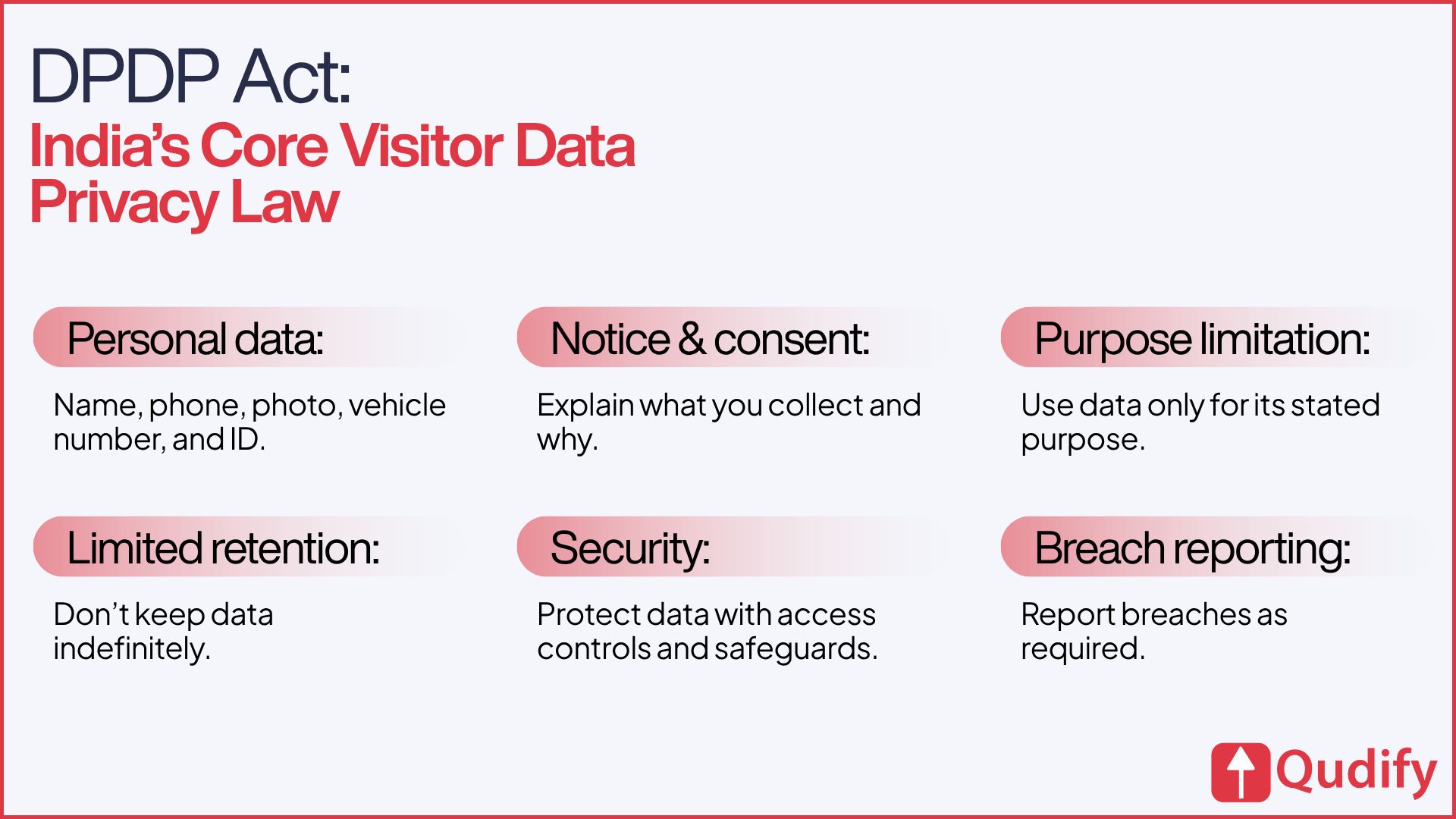
The Digital Personal Data Protection Act, 2023, is the single most consequential law for visitor management today. It is India’s first dedicated, cross-sector data protection statute, and it is built around three ideas: consent, accountability, and breach reporting.
What counts as visitor "personal data"?
A visitor’s name, mobile number, photograph, vehicle number, or scanned government ID is personal data under the Act. Crucially, the law covers data collected digitally and data collected on paper that is later digitised, which is exactly what happens when a receptionist types the day’s register entries into a spreadsheet at close of business. There is no “it was only on paper” defence.
Your obligations as a Data Fiduciary
Once you collect that data, your organisation becomes a Data Fiduciary, with concrete obligations:
- Notice and consent: Visitors must be told, in plain language, what you’re collecting and why, at or before the point of collection.
- Purpose limitation: Data gathered for access control can’t quietly migrate into a marketing list.
- Storage limitation: Records shouldn’t be retained indefinitely once the visit is over.
- Reasonable security safeguards: Access controls, encryption, and audit trails move from “best practice” to legal expectation.
- Breach reporting: Personal data breaches must be reported to the Data Protection Board of India.
Why the paper register is now the biggest risk
The open paper register, long considered the “safe, old-fashioned” option, is now the biggest offender. A logbook where the next visitor can read the name, company, and phone number of everyone before them is a live, continuous disclosure of personal data to unauthorised parties. That’s precisely the harm the DPDP Act was written to prevent.
This is where a purpose-built platform matters. A QR- and WhatsApp-based check-in flow like Qudify keeps each visitor’s details private to their own entry rather than exposed on a shared page, time-stamps it in a cloud audit trail, and hands the organisation direct control over retention and access. The tool doesn’t make you compliant on its own, but it gives you the levers the law assumes you have.
The enforcement timeline and penalties
The DPDP Rules, 2025, set a phased implementation timeline, giving organisations a transition runway before the full weight of enforcement, including penalties that can reach ₹250 crore under the Act’s schedule for failure to maintain reasonable security safeguards, applies. That runway is not an excuse to wait; it’s the window in which to fix your practices before they’re tested.
Shops And Establishments Act: The State-Level Rules Every Front Desk Answers To
Before privacy law even enters the picture, nearly every commercial premises in India offices, showrooms, hotels, restaurants, business centres operates under a state-specific Shops and Establishments Act. It’s easy to overlook because it’s framed as labour law, not security law.
Two provisions touch visitor management directly:
- Statutory registers and record-keeping. Establishments must maintain inspectable records. A coherent, time-stamped visitor log complements these and signals a well-run operation to any inspector.
- Inspection rights. State labour departments can inspect premises and records. If you can’t produce a clear account of who was on-site on a given day, it undermines your broader compliance posture, not just your visitor process.
Because these Acts are state-administered, the rules differ between Karnataka, Maharashtra, Delhi, Telangana, and every other state. A business operating in multiple cities must register in each and shouldn’t assume its Bengaluru practices satisfy Pune or Gurugram.
Takeaway: multi-location organisations need location-specific compliance, and a centralised digital visitor log makes it far easier to demonstrate consistent record-keeping across every site during an inspection.
Fire And Life Safety Norms: The National Building Code And Occupancy Accountability
Fire safety rarely gets mentioned alongside visitor management, yet it’s where the consequences are most severe. The National Building Code of India (NBC), 2016, Part 4 Fire and Life Safety is the reference framework most states adopt. It classifies buildings by occupancy type and prescribes evacuation routes, exit discharge, fire detection, and life-safety systems as an integrated package.
Why occupancy load includes visitors
Life-safety planning depends on knowing how many people are inside a building at any moment. That figure is only accurate if it includes visitors alongside employees. A meeting with fifteen external attendees can materially change a floor’s occupancy load, and a compliance figure that ignores them isn’t a compliance figure at all.
The evacuation headcount problem
In a drill or a genuine emergency, the fire warden needs a complete, current list of everyone on the premises to confirm a full evacuation. A visitor sitting in a third-floor meeting room, invisible to any live log, is exactly the person most likely to be missed in a headcount.
Fire NOCs are increasingly tied to demonstrated evacuation readiness, and enforcement has tightened after repeated building-fire incidents in major cities. A static paper trail from the morning tells you nothing at 3 p.m. A cloud-based visitor system that maintains a live, exportable “currently checked-in” list gives fire teams the one piece of information life-safety compliance actually depends on: who is inside, right now.
Psara, 2005: Regulating The Guards Who Manage Your Front Desk
If a security guard checks IDs and logs entries at your gate, that guard’s employer is a licensed, regulated entity under the Private Security Agencies (Regulation) Act, 2005 (PSARA). Businesses routinely outsource this function and then forget the compliance chain runs back to them.
Under PSARA:
- No agency can legally operate without a valid, current PSARA licence from the state Controlling Authority.
- Agencies must conduct background (antecedent) verification of every guard and supervisor and meet prescribed training standards.
- The Controlling Authority can inspect an agency’s records and suspend or cancel licences for non-compliance.
What this means for you: verify your security vendor’s PSARA licence before signing, and treat a lapsed licence as a direct risk to your own premises’ legal standing, not a mere vendor headache. Access control, visitor handling, and evacuation support are meant to function as one integrated system, which is why your security contract and your visitor process can’t be assessed in isolation.
Posh Act, 2013: Why Visitors Fall Within Your Workplace Safety Obligations
The Sexual Harassment of Women at Workplace (Prevention, Prohibition and Redressal) Act, 2013 (POSH Act) wasn’t written with visitor management in mind, but its reach surprises most organisations.
The foundational Vishaka Guidelines expanded “workplace” beyond office walls. Crucially, the protection runs both ways: a woman does not have to be an employee to invoke the Act. A visitor, client, vendor representative, or contractor who experiences harassment during a work-related visit is covered and can complain even if the person responsible isn’t from her own organisation.
Two operational consequences follow:
- You need an accountability trail. If an incident involving a visitor is reported, you must be able to establish who was on-site, when, and in whose company, precisely what a proper visitor log preserves.
- Your duty of a safe environment extends to guests. Once your headcount crosses ten and an Internal Complaints Committee (ICC) becomes mandatory, your premises must be treated as safe for everyone lawfully present, not just payroll staff.
A visitor management system won’t resolve POSH compliance by itself; that requires policy, training, and a functioning ICC. But it provides the factual backbone (who, when, with whom) that any inquiry will need.
Factories Act, 1948 And The Oshwc Code: Visitor Records At Industrial Premises
For manufacturing units, warehouses, and industrial campuses, the framework shifts to the Factories Act, 1948, now being progressively folded into the Occupational Safety, Health and Working Conditions (OSHWC) Code, 2020. The Act applies to premises with ten or more workers using power-driven machinery (or twenty or more without it) and centres on worker safety in potentially hazardous environments.
The Act mandates extensive statutory registers, muster rolls, registers of workers, and identity cards all open to Factory Inspectors. While it doesn’t name a “visitor register,” the same logic applies with force: uncontrolled foot traffic near hazardous processes and heavy machinery is a direct safety liability. Inspectors expect facilities to prove control over exactly who is on the shop floor at any moment.
The direction of travel is unmistakably digital. The OSHWC framework pushes factories toward electronic registers, online accident reporting within tight windows, and risk-based inspections. A visitor system that logs contractor and vendor entries with timestamps and host approvals fits naturally into this modernisation and gives a safety officer an instant, exportable answer during an accident investigation or surprise inspection.
The compliance-at-a-glance matrix
Law | What it governs | The question it asks | What you must be able to show |
DPDP Act, 2023 | Visitor personal data | “How is this data collected, stored, and deleted?” | Consent notice, retention limits, access controls, breach process |
Shops & Establishments Acts | Commercial premises records | “Are your records inspectable?” | State registration + coherent visitor/premises logs |
NBC 2016, Part 4 | Fire & life safety | “Who is inside right now?” | Live, exportable occupancy list |
PSARA, 2005 | Private security agencies | “Are your guards legally deployed?” | Valid PSARA licence + verified personnel |
POSH Act, 2013 | Workplace safety for women | “Can you prove who was present?” | Visitor log as evidence + functioning ICC |
Factories Act / OSHWC | Industrial premises | “Who is on the shop floor?” | Digital, timestamped entry records |
Notice the pattern across the right-hand column. Nearly every regulator is asking a version of the same three questions: Who was here? What did you do with their information? Can you prove it?
The Cost Of Getting Visitor Compliance Wrong
“Compliance risk” sounds abstract until you attach consequences to it:
- Up to ₹250 crore is the maximum penalty under the DPDP Act’s schedule for failing to implement reasonable security safeguards for personal data.
- Failed or delayed fire NOC renewals increasingly tied to demonstrated evacuation readiness, which a static paper register can’t provide.
- Labour inspection flags under state Shops and Establishments Acts, where weak record-keeping colours the entire assessment.
- Vendor licence disputes under PSARA that expose your premises when a guarding agency’s licence lapses.
- The evidentiary void: the discovery, usually during an incident rather than before it, that no one can say definitively who was in the building.
And here’s the point most small businesses miss: the DPDP Act doesn’t scale its obligations down by headcount. A ten-person startup with a shared reception and a spiral register carries the same core data-protection exposure as a 500-person corporate campus.
How A Digital Visitor Management System Actually Closes These Gaps
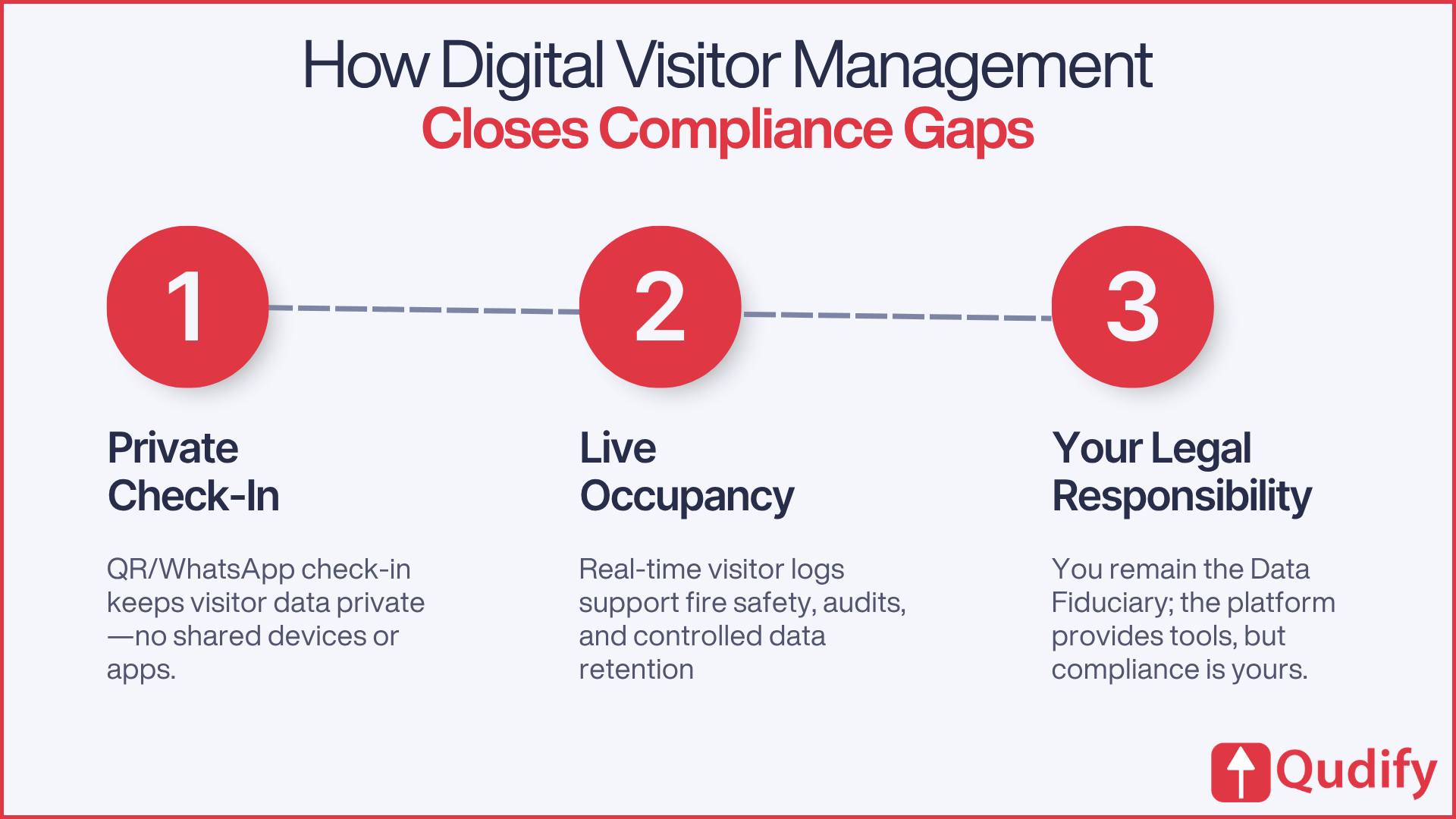
Once you see the shared pattern who, what, prove it the role of a digital system becomes obvious. It’s not a gadget that replaces the law; it’s the operational tool that makes satisfying the six laws practical on a busy Monday.
Private-by-design check-in
With a QR- and WhatsApp-based flow like Qudify, a visitor scans a code on their own phone, fills a short form, and the host is alerted instantly for approval no shared tablet, no kiosk, no app install. Each entry stays private to that visitor and host, directly answering the DPDP concern about open registers.
Real-time occupancy for fire safety
A cloud-based system keeps a live, exportable list of everyone currently checked in, exactly what a fire warden needs during an evacuation and what turns an audit into a two-click export. Retention windows and access permissions can be configured so you enforce data minimisation and restrict who can view historical visitor records, while timestamped audit trails support POSH inquiries, factory inspections, and security reviews alike.
Who is legally responsible: you or the vendor?
This is where organisations get caught out: under the DPDP Act, your office remains the Data Fiduciary, not the software vendor. A good platform gives you consent capture, retention controls, audit logs, and access permissions. But configuring and using them correctly is your legal responsibility. Choose a system that makes the right configuration easy, and the compliance burden shrinks dramatically. Choose a paper register, and there’s nothing to configure, which is precisely the problem.
For high-risk or high-footfall sites, heavier layers of vehicle tracking, detailed contractor management, and biometric access can sit on top of the same foundation, added only where a site’s genuine risk profile justifies the added cost and privacy sensitivity.
Building A Practical Compliance Checklist For Your Organisation
Turn six laws into a Monday-morning action list:
- A written visitor data notice at check-in explaining what you collect and why (DPDP consent and transparency).
- A defined retention period after which visitor records are automatically purged, not kept forever.
- Access controls limiting who can view historical visitor data; not every employee needs it.
- Current state Shops & Establishments registration, with statutory registers ready for inspection.
- A verified, current PSARA licence on file for any third-party guarding agency.
- A live, exportable occupancy list fire wardens can use in drills and emergencies (NBC alignment).
- A documented POSH incident-reporting path that accounts for visitors, with the visitor log available as evidence.
- Digital, timestamped registers at industrial sites, in line with where the OSHWC Code is already pushing.
None of this requires heavy capital outlay. It requires a decision to stop treating the front desk as an afterthought and start treating it as the first compliance touchpoint your organisation has with the outside world.
The Bottom Line
For years, the reception register was the most ignored object in the building a formality nobody read, and nobody questioned. That era is over. The same six words now sit behind every regulator knocking on your door: who was here, and can you prove it? The DPDP Act asks it of your data. Fire codes ask it of your evacuation plan. POSH asks it of your duty of care. PSARA asks it of the people enforcing it all at your gate.
What’s genuinely encouraging is that these laws don’t pull in different directions. They reward the same four habits: collect only what you need, keep it private, always know who’s inside, and be able to prove it on demand. Get those right, and you’re not juggling six compliance regimes; you’re running one clean process that quietly satisfies a data regulator, a fire officer, a labour inspector, and an ICC inquiry at the same time.
The organisations that will struggle aren’t the ones with the biggest campuses or the most visitors. They’re the ones still treating the front desk as an afterthought, relying on an open logbook that, on the wrong day, becomes Exhibit A rather than evidence in their favour. The fix isn’t complicated, and it isn’t expensive. It’s a decision to treat your first point of contact with the outside world as your first point of compliance too.
That’s exactly what Qudify was built for: a hardware-free, privacy-first check-in that captures consent, keeps every visitor’s data private to their own entry, and gives you a live, exportable record of who’s on your premises at any moment. The law sets the standard. Qudify makes meeting it a two-tap reality instead of a compliance headache.
See how it works on your front desk. Book a quick Qudify demo and turn your visitor register from a liability into your easiest compliance win.
Frequently Asked Questions
Is a digital visitor management system legally mandatory in India?
No single law mandates specific software. What’s mandatory is the outcome: lawful handling of visitor data under the DPDP Act, accurate occupancy records under fire codes, and verified security staff under PSARA. A digital system is the most practical way to meet all of these at once, but the legal obligation attaches to the outcome, not the tool.
Does the DPDP Act apply to small offices with few visitors?
Yes. The Act contains no exemption based on organisation size or visitor volume. Any entity that collects and processes visitor personal data, even a ten-person office, is a Data Fiduciary with the same core obligations as a large enterprise.
Can a visitor file a POSH complaint against someone from another company?
Yes. The POSH Act protects any woman visiting a workplace, and its definition of who can complain reaches beyond payroll staff to visitors, clients, and vendor representatives, provided the incident arises from or during a work-related interaction.
How long can we legally keep visitor data under the DPDP framework?
Only as long as necessary for the purpose it was collected for. There’s no universal number, so document a specific retention window, commonly a few months to a year depending on your risk profile, and ensure your system can actually enforce automatic deletion afterward.
What happens if our security agency's PSARA licence lapses?
The agency faces suspension or cancellation by the state Controlling Authority. Because a guard’s legitimacy at your premises rests partly on that licence being current, the lapse exposes your business to operational and reputational risk too. Verify it before contracting and monitor renewals.
Do these rules apply to co-working spaces and business centres?
Yes. Shared and managed offices are still subject to the relevant state Shops and Establishments Act, applicable fire and building codes, and DPDP obligations for any visitor data collected regardless of how many tenants occupy the space.