
How QR-Based Feedback Improves Workplace Culture
Short answer: QR-based feedback improves workplace culture by removing three of the four barriers that keep employees silent: the distance to the channel, the fear of being identified, and the delay before feedback reaches someone who can act. A worker scans a code on the wall, submits anonymously in their own language from their own phone, and the complaint routes to a named owner in seconds. What a QR code cannot do is guarantee that anyone responds. That last part whether the loop actually closes is where culture is won or lost, and it is a management decision, not a software feature.
Key Takeaways
- Culture is not a value painted on a wall. It is the aggregate of everyone’s private estimate of what happens when they speak up. Change that estimate, and you change the culture.
- Silence has four causes, not one: Distance, Identity, Latency, and the Void. A QR code eliminates the first three in an afternoon. It cannot touch the fourth.
- The fourth cause is the expensive one. Research on employee voice distinguishes two drivers of silence: fear and futility, and futility is the more corrosive of the two.
- Loop Closure Rate is the metric that best predicts whether people keep speaking up, not submission volume, not survey scores.
- “Survey fatigue” is largely a misdiagnosis. What organisations read as fatigue is usually trust fatigue, a rational response to a loop that never closed.
- India already mandates a grievance channel. The POSH Act, the Industrial Relations Code, 2020 (in force since 21 November 2025), and the Companies Act, 2013 each require one. Most companies satisfy the letter of the law with a committee on paper and a box on a wall.
- If you cannot staff the response, do not launch the channel. An unanswered inbox is worse than no inbox, because it converts hope into evidence that nobody is listening.
There is an object in most Indian workplaces that has outlived the typewriter, the fax machine and the punch card. It is a wooden box with a slot cut into the lid, screwed to a wall somewhere between the pantry and the fire exit. It has a label. It sometimes has a pen tied to it with string. Almost nobody uses it.
Not because employees have nothing to say. They have a great deal to say, and they say it constantly in WhatsApp groups, in the smoking corner, in the car on the way home, and eventually in an exit interview. They just don’t say it to the box.
This piece is about why that box failed, what a QR code changes about the physics of speaking up, what it emphatically does not change, and why the difference between those two things is where workplace culture is actually built.
Why the Suggestion Box Never Worked
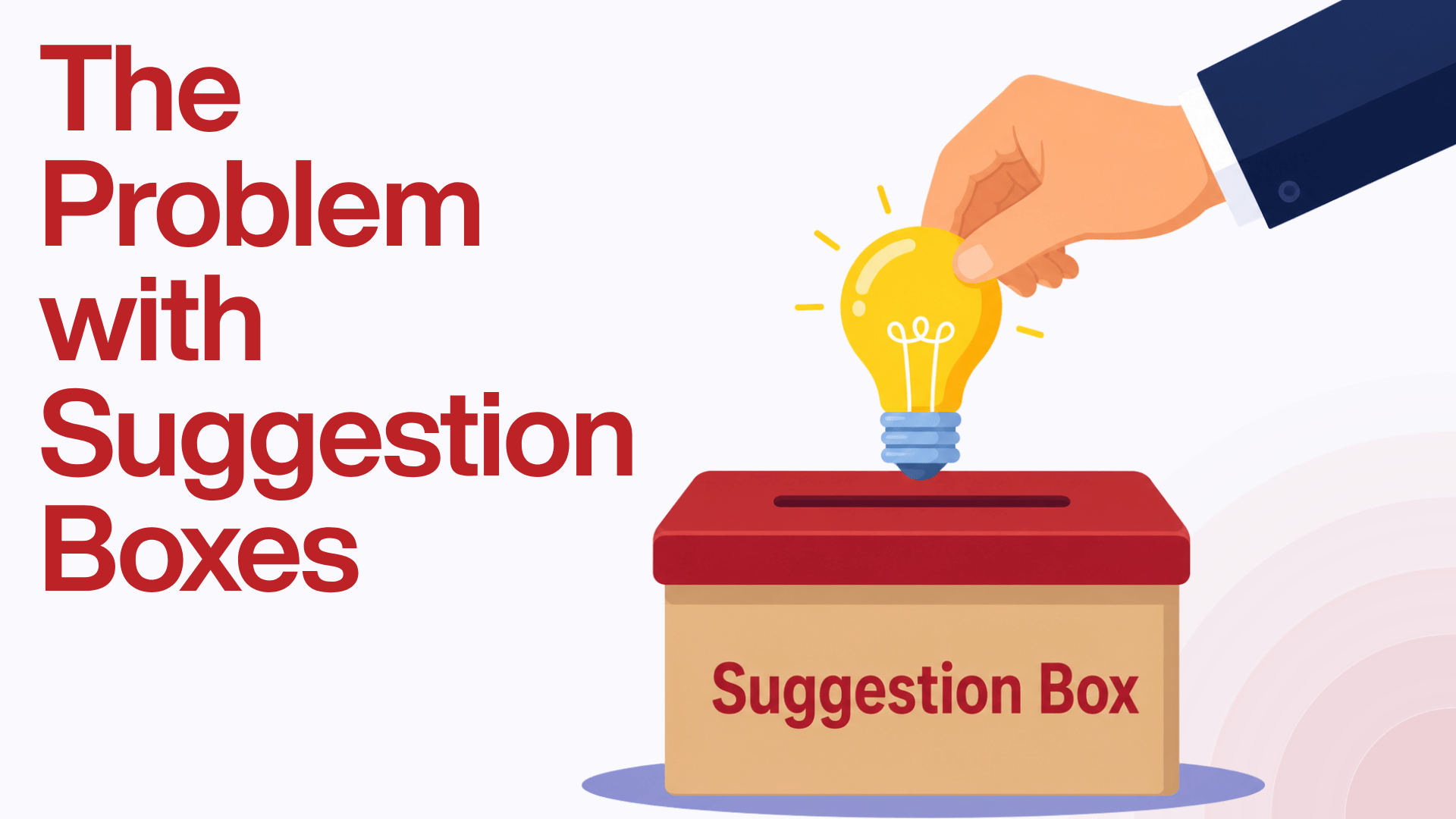
The suggestion box was designed with an unexamined assumption baked into it: that the bottleneck in organisational listening is collection.
It isn’t. It never was.
The Box Was a Symbol, Not a System
Look at what the object actually asks of a person. Walk to a specific physical location, in view of colleagues, while carrying something you would rather nobody knew you were carrying. Find a pen. Write, by hand, often in your second or third language, on a slip of paper, a description of a problem that may involve your own manager. Fold it. Post it into a sealed container whose key is held by the administration department.
Then wait with no acknowledgement, no reference number, and no idea whether the box is emptied weekly, quarterly, or ever.
Every step in that sequence is a tax. The people willing to pay it are a strange, self-selecting minority: the very brave and the very angry. Everyone in between, which is to say, almost everyone, pays the tax by not paying it. They stay quiet.
So the box does not measure what people think. It measures who is willing to be seen thinking it.
The Modern Version Has the Same Bug
Most organisations believe they retired the box. They didn’t. They digitised it and, in some ways, made it slower.
The annual engagement survey is the box with a login screen. It arrives once a year, often runs to 30–60 questions, and typically takes months to produce an action plan, by which point the problem the employee described has either resolved itself or metastasised. Participation among frontline populations is frequently low, and the silent majority remains, precisely, silent.
The numbers underneath this are not improving. Gallup’s State of the Global Workplace: 2026 report found that global employee engagement fell to 20% in 2025, down from a peak of 23% in 2022, the first time Gallup has recorded two consecutive years of decline. Each percentage point represents roughly 21 million workers. Gallup estimates that disengagement now costs the world economy more than $10 trillion a year in lost productivity, equivalent to about 9% of global GDP.
South Asia, primarily India, recorded the steepest single-year fall in manager engagement of any region, an eight-point drop.
The Four Frictions That Silence a Workforce
If collection is not the bottleneck, what is? Four gates. A person speaks only if all four are open, and most organisations have at least one jammed shut.
Friction 1 Distance: "Where do I even put this?"
The physical and procedural cost of reaching the channel at the moment you want to use it. The box is on another floor. The portal needs a password you’ve forgotten. The survey opens in April, and it is currently September. The HR business partner sits in a different city.
Distance is why feedback is rarely captured at the moment of frustration, and almost always reconstructed weeks later, if at all.
Friction 2: Identity: "Will they know it was me?"
Not whether the system promises anonymity, but whether the person believes the promise. A form with a name field is not anonymous. A form where your manager hands you the paper is not anonymous. A portal that requires an SSO login is not anonymous, no matter what the privacy policy claims, because everyone assumes IT can see everything.
Belief is the operative variable, and belief is earned structurally, not stated in a footer.
Friction 3 Latency: "Will it still matter by the time it lands?"
Feedback has a half-life. A complaint about a broken exhaust fan in the packing hall is worth acting on today. In six weeks it is no longer information; it is evidence that nobody was listening. The value of a piece of feedback decays from the second it is felt, and most systems are engineered to guarantee decay.
Friction 4 The Void: "Did anything happen last time?"
This is the one that kills organisations, and it is the one almost nobody instruments.
Research on employee voice identifies two distinct drivers of workplace silence: fear and futility. Fear is dramatic and gets the attention. Futility is quieter and often more corrosive.
Futility is what happens when an employee raises a concern in good faith, receives a polite acknowledgement, watches nothing change, and draws the only rational conclusion available. It is not an emotional overreaction. It is a correct inference from the available data. The employee has run an experiment, observed the result, and updated.
And the update is durable. Fear can be reduced by policy. Futility can only be reduced by evidence.
The People Your Feedback System Cannot Hear.
Every channel has an entry requirement, and every entry requirement is an exclusion criterion. This is the part of the conversation that HR technology tends to skip, because the excluded population does not answer the survey that would reveal it.
The 83% Without an Email Address
Around 2.7 billion people work in deskless roles worldwide, roughly 80% of the global workforce. In India, a country of factory floors, hospital wards, warehouses, construction sites, hotel kitchens, retail counters, security cabins and housekeeping bays, that proportion is not lower.
Now look at what your feedback stack quietly assumes.
Your channel | What it silently requires | Who that excludes |
Engagement survey by email | A corporate email address | The ~83% of frontline workers who don’t have one |
HR portal/intranet | An SSO login and a browser | |
Employee app | A download, a device, and storage | Shared-device and low-storage phone users |
Skip-level meeting | A calendar and confidence | Anyone junior, shy, or on a night shift |
Town hall Q&A | Willingness to speak in front of 300 people | Almost everyone with something difficult to say |
Meanwhile, roughly 69% of organisations still lead with email for internal communication, and only about 10% of non-desk employees say they are very satisfied with workplace communication.
This is not a reach problem. It is a design problem. You built a door and then wondered why the people without keys never came in.
Psychological Safety Falls Down the Org Chart
The exclusion is not only structural. It is felt.
Perceptyx research found that 87% of executives report positive perceptions of psychological safety. Individual contributors: 69%. Hourly and frontline workers: 66%.
Read that gap again, because it is the whole argument. The people closest to the actual work feel least safe describing it. The person who can see the loose railing, the mislabelled chemical drum, the supervisor who plays favourites, the process everyone quietly works around that person is the least likely to tell you.
That is roughly a twenty-one-point deficit, and it points in exactly the wrong direction.
Language, Literacy, and the Contract Worker
Two further exclusions that Indian workplaces produce almost automatically.
Language. A feedback form in English is a feedback form for the head office. If your workforce operates in Hindi, Tamil, Bengali, Marathi or Malayalam and your channel does not, you have not built a channel. You have built a filter.
Contract status. In many Indian establishments, a substantial share of the people on site are not on your payroll: housekeeping, security, canteen, facilities, drivers, contract technicians. They have no HRMS record, so they appear in no survey, so they exist in no dashboard. They are also, frequently, the people with the most to report and the least protection for reporting it. (Notably, the POSH Act’s protections extend to contract and daily-wage workers, interns and visitors even though the standard intake channel rarely reaches them.)
An inclusive feedback system does not add a diversity question. It is one that a night-shift contract housekeeping supervisor can actually use in her own language, without a company email address, without telling her contractor she used it.
What a QR Code Actually Changes
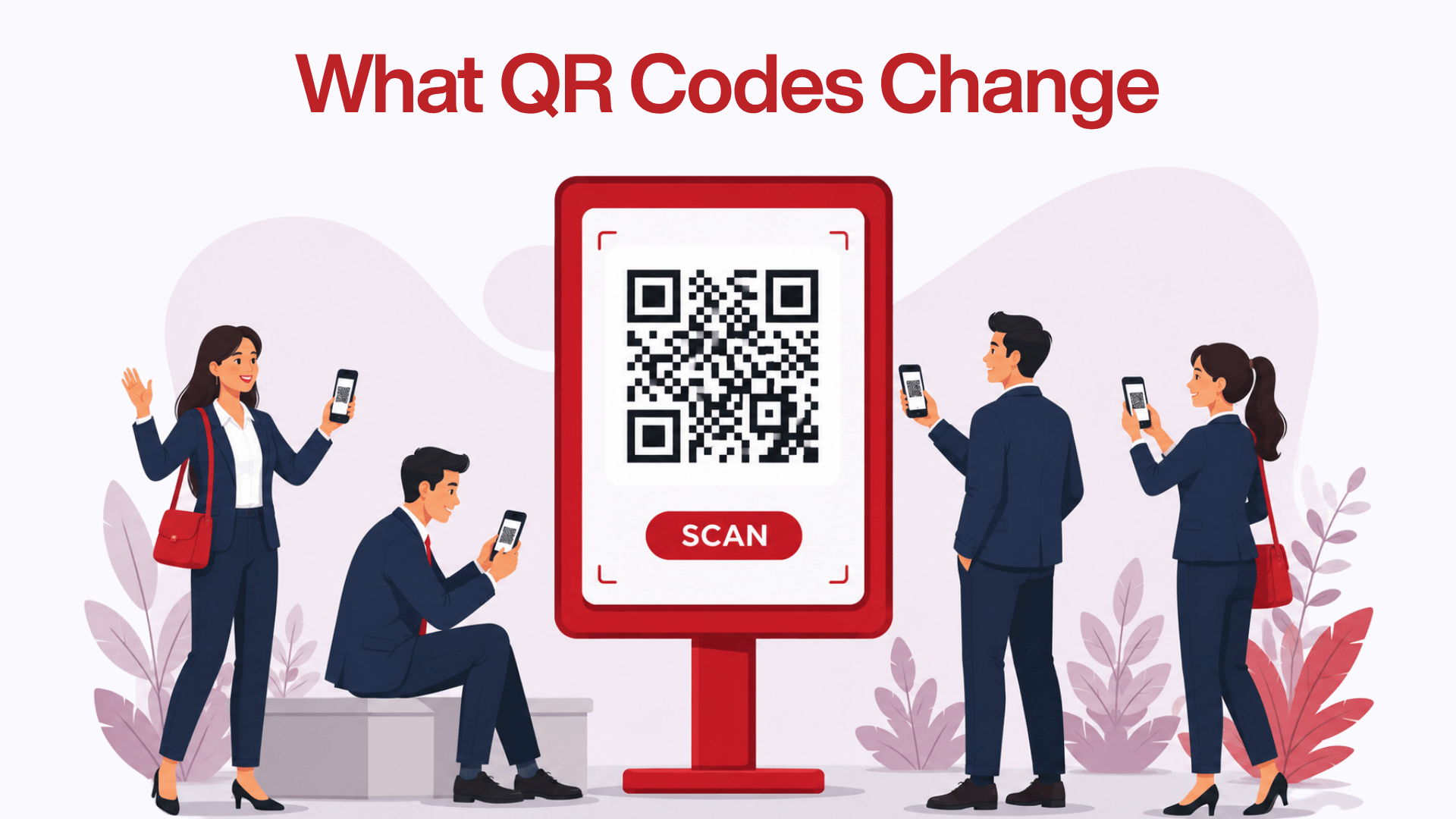
Here is where a lot of vendor content becomes useless, because it claims the technology solves everything. It doesn’t. It solves three specific things extremely well, and it is worth being precise about which three.
It Collapses Distance to Zero
A QR code is a channel that travels to the point of experience.
The code goes as far as the washroom door, not just the reception desk. On the cafeteria wall beside the counter, not in the HR handbook. On the shop-floor pillar, at the security cabin, in the hostel corridor, inside the lift lobby, on the back of the delivery-bay door. The complaint about the cafeteria gets made in the cafeteria, standing in front of the thing being complained about, in the sixty seconds while the feeling is still real.
There is no app to install, no password to remember, no email address to possess. There is a camera and a phone, both of which the person already has. That is the entire onboarding cost, and it is why this channel reaches the population the previous section described.
It Makes Anonymity Structural Rather Than Promised
The difference between “we promise not to look at who submitted this” and “there is no field in which your identity could be recorded” is the difference between a policy and a fact.
When the form has no name field, no login, and no device binding, anonymity stops being a trust exercise and becomes an architectural property. You are not asking the employee to believe you. You are removing your own ability to betray them.
That is a fundamentally different proposition, and the workforce can tell.
It Collapses Latency from Months to Seconds
A scan can route a submission to a named owner before the person has walked out of the room. Cafeteria hygiene goes to Admin. A loose cable goes to Facilities. A safety hazard goes to EHS. A harassment complaint bypasses every line manager in the chain and lands directly with the Internal Committee.
This is the point Qudify’s co-founder Akshat Tripathi made when the company launched its QR-based complaint box: the existing mechanism to capture feedback or complaints, he noted, is “manual, paper-based and inefficient,” often taking days to reach the right person. The gap he is describing is not a gap in willingness. It is a gap in plumbing.
And Now the Honest Part
A QR code cannot make anyone read the submission.
It cannot make a manager act. It cannot make the fix visible. It cannot stop retaliation. It cannot make a leadership team that wanted the appearance of listening suddenly want the substance of it.
Every one of those failures is a management failure wearing a technology costume. Buy the QR code for what it genuinely does: it removes three of the four frictions in an afternoon, which is remarkable. But understand precisely what you have bought: an entry point, not a culture.
The fourth friction is still there. Which brings us to the number that measures it.
Loop Closure Rate: The Metric That Predicts Everything
Most feedback dashboards track submission volume. This is worse than useless, because volume is ambiguous. A falling submission count could mean the workplace improved. It could equally mean the workforce gave up. The metric cannot distinguish between the two states you most need to distinguish between.
Here is a number that can.
Loop Closure Rate (LCR) = (submissions that received a visible, traceable outcome ÷ total submissions) × 100
Three words in that definition are doing the work.
Visible: the person who submitted it and ideally their colleagues saw that something happened.
Traceable: the outcome can be linked back to the specific submission that caused it.
Outcome: a resolution or a documented, explained rejection. Both count. “We looked at this, and we’re not doing it, here’s why” closes a loop. “We’ll look into it” does not.
The Ladder
LCR | What it means | What happens next |
0–25% | The Void | Submissions collapse within a quarter. Your data goes dark, and leadership calls it improvement. |
26–50% | Theatre | Enough action to point at, not enough to be believed. Volume plateaus, quality stays low. |
51–75% | Credible | The lurkers begin submitting. Complaint quality rises before volume does. |
76–100% | Compounding | People raise issues early, while they are still cheap to fix. This is the entire goal. |
Why "Survey Fatigue" Is Usually a Misdiagnosis
Organisations routinely conclude that participation dropped because they asked too often. The evidence more often points elsewhere. As Energage puts it: “What looks like survey fatigue is actually trust fatigue.” Harvard Business Review researchers have described the same phenomenon as “inaction fatigue.”
The corroborating data is consistent. WorkTango reports that pulse response rates below 60% typically signal that employees don’t believe their feedback leads to action, while its own internal programme (six questions every two weeks) sustains response rates of 80% or higher precisely because it acts on and shares back what it hears.
Frequency is not the variable. Closure is.
The Rest of the Instrument Panel
Metric | Healthy signal |
Loop Closure Rate | Above 75% |
Median time to first acknowledgement | Under 24 hours |
Median time to resolution or explanation | Under 14 days |
Repeat-submitter rate | Rising (people are coming back) |
Anonymous-to-named ratio | Falling over time |
Submissions from frontline roles | At or above their share of headcount |
Issues raised before escalation | Rising |
That fifth row deserves a note, because it is counter-intuitive and it is the most sophisticated read on your culture anywhere in this list.
A high and rising anonymous ratio is not a privacy success. It is a fear reading. If, eighteen months in, every single submission is still anonymous, your people are telling you something about what they expect to happen to them. As trust accumulates, people voluntarily start signing their names not because you made them, but because they have stopped needing the shield.
Watch that ratio. It is the closest thing to a lie detector your culture has.
How Feedback Actually Becomes Culture
We can now answer the question in the title properly, because the causal chain is finally visible. Culture does not change because you collected opinions. It changes through a specific mechanism, and skipping any step breaks the whole thing:
- Someone speaks because the channel is reachable, anonymous, and immediate.
- Someone owns it: a named person, not a department, with a clock attached.
- Something changes: the fix happens, or a clear, honest “no” is issued.
- Everyone sees it: the outcome is published where the workforce can see it.
- The estimate updates every observer’s private sense of “what happens when I speak” moves upward.
Then the loop runs again, from a higher baseline.
That is the whole mechanism. Culture is the sum of everyone’s private estimate of what happens when they speak. Every closed loop nudges that estimate upward, for everyone who saw it. Every ignored submission nudges it down, for everyone who noticed the silence.
You are not running a feedback programme. You are running an evidence campaign, and the workforce is a very careful jury.
The Legal Floor in India
Before this becomes a purely cultural argument, it is worth noting that India already requires you to have a working grievance channel. Three separate statutes say so, and most organisations satisfy them on paper only.
POSH: The Committee That Exists in a Filing Cabinet
Under the Sexual Harassment of Women at Workplace (Prevention, Prohibition and Redressal) Act, 2013, every workplace with 10 or more employees must constitute an Internal Committee (IC). Under Section 11(3), the IC holds powers equivalent to a civil court for the purposes of the inquiry, and under Section 11(4) it has 90 days to complete the inquiry, with the report due within 10 days of completion.
Here is the operational failure. Most organisations have the committee and nothing else. There is no intake mechanism that a woman on the night shift can use without walking into the HR cabin in full view of the floor, emailing an address she doesn’t have, or telling the supervisor who may be the subject of the complaint.
A QR-based channel with a POSH category that routes directly to the IC, bypassing every line manager in the reporting chain, is not a nice-to-have. It is the missing front door to a committee you have already been legally required to build.
The 30-Day Clock in the Industrial Relations Code
Section 4 of the Industrial Relations Code, 2020, brought into force on 21 November 2025, requires every industrial establishment employing 20 or more workers to constitute one or more Grievance Redressal Committees (GRCs). The details matter more than most HR teams realise:
- Equal employer and worker representation, with a maximum of ten members.
- Adequate representation of women workers, in proportion to their share of the workforce.
- A worker may file within one year of the cause of action.
- The GRC is to complete its proceedings within 30 days of receipt.
- Unresolved matters escalate to conciliation, then to the Industrial Tribunal.
(Operational implementation still depends on state-level rule-making under the Code, which is ongoing, but the framework and its timelines are now the law.)
That 30-day clock starts running from a moment you must be able to prove. A paper slip in a wooden box has no timestamp. A QR submission has one automatically, along with the routing history, the acknowledgement, and the resolution precisely the evidentiary chain a tribunal will ask for.
The Vigil Mechanism Under the Companies Act
Section 177(9) of the Companies Act, 2013, read with Rule 7 of the Companies (Meetings of Board and its Powers) Rules, 2014, requires certain classes of companies including every listed company, companies that accept public deposits, and companies with bank or public-financial-institution borrowings exceeding ₹50 crore to establish a vigil mechanism: a whistleblowing channel with safeguards against victimisation and direct access to the Audit Committee chairperson in appropriate cases. The same principle applies: the statute asks for a channel people can use without going through the person they are reporting on.
The pattern across all three is identical. India does not require you to want feedback. It requires you to be reachable. Most compliance programmes get the committee right and the front door wrong.
The 30-Day Rollout
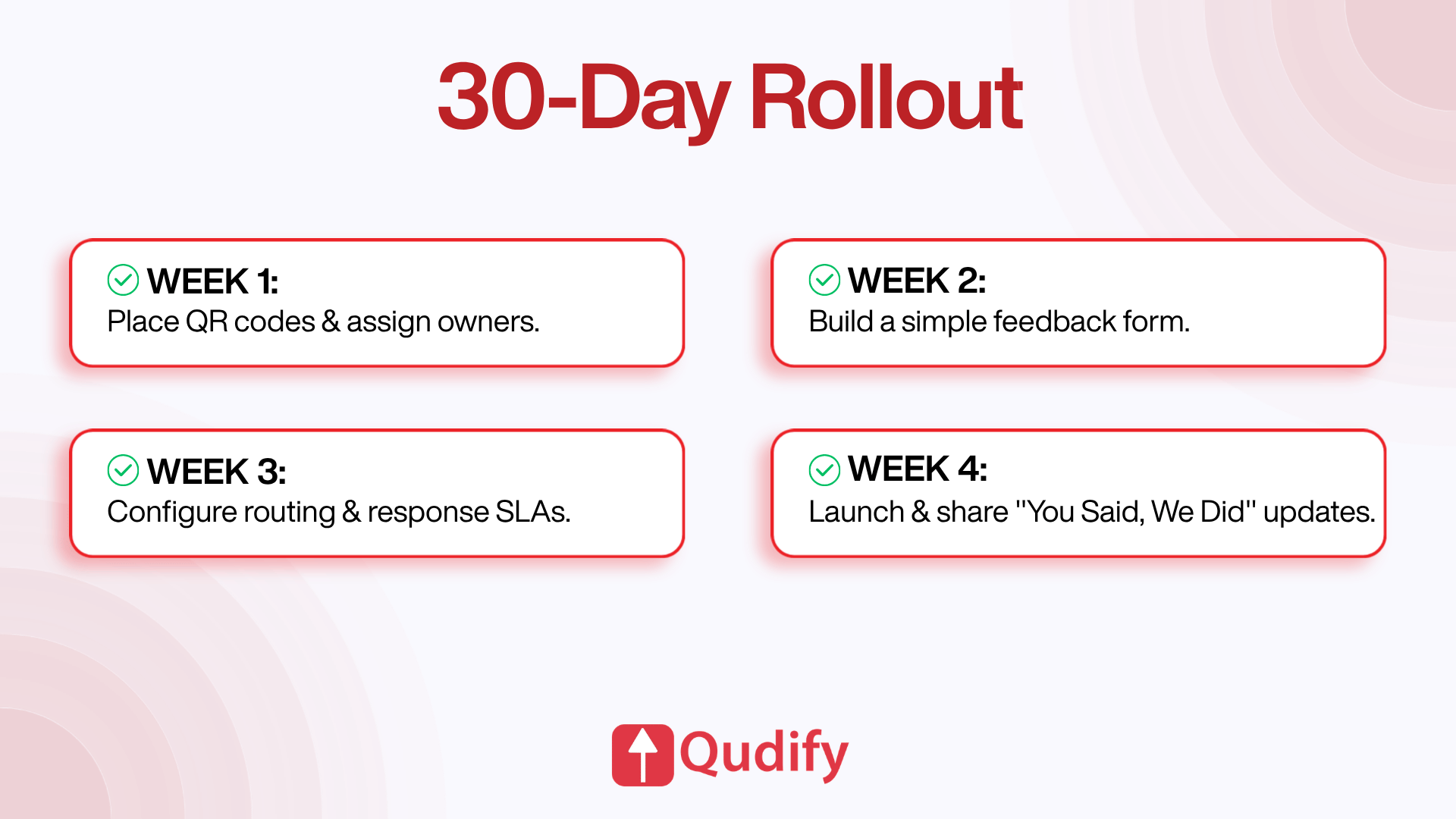
You are not installing software. You are making one public promise and then keeping it, visibly, four times in a row.
Week 1: Map the Moments, Not the Walls
Walk the site. Do not ask where the notice boards are; ask where frustration is actually felt. Washroom, cafeteria queue, shop floor, lift lobby, parking gate, hostel corridor, security cabin, loading bay.
Place the codes there at the point of experience, not at the reception desk where nobody is annoyed about anything.
Then do the part most rollouts postpone until it is too late: assign a named owner to every category before a single code goes on a wall. Not a department. A person, with a name, who will answer for that queue.
Week 2: Design the Form: Five Fields, Not Twenty-Five
Category. Location. Description. Optional photo. Optional name.
That’s it. Every field you add is a person who abandons the form. The photo field earns its place because a picture of the actual broken thing eliminates an entire round of clarifying emails.
Anonymity should be the default, not a checkbox buried three screens deep. And the language choice must happen at the moment of scan, before a single word is typed, because a Hindi-speaking supervisor should never have to navigate an English interface to reach a Hindi form.
Week 3: Build the Routing and Attach the Clock
Every category routes to a named human with an SLA:
- Acknowledge within 24 hours. Automated is fine. Silence is not.
- Resolve or explain within 14 days.
- POSH-category items bypass line management entirely and route straight to the Internal Committee.
Test the escalation path before launch by submitting a fake complaint about a senior person and confirming it does not land on their desk.
If you cannot staff Week 3, do not run Week 1. This is not a slogan; it is the single most important sentence in this article. An unanswered channel is materially worse than no channel, because a wooden box only wastes a person’s effort; an unanswered digital inbox documents that you received their concern and chose to do nothing.
Week 4: Launch Loud, Then Close Loops in Public
Announce it with a promise you can actually keep. Do not promise to act on everything; promise to answer everything.
Then publish, monthly, a “You said / We did” one-page, on the notice board and in the WhatsApp group, listing what came in and what happened.
And include the rejections. Publish the things you decided not to do, with the honest reason. Counter-intuitively, a well-explained “no” builds more trust than a silent “yes,” because it proves a human being read the submission, considered it, and made a decision. A silent fix proves nothing at all.
Five Ways This Dies After Launch
Failure mode | What it looks like | The counter-move |
The full inbox | Submissions arrive. No category has an owner. The queue becomes the new dusty box. | One named owner and one clock per category, agreed before launch. |
The silent fix | The AC is repaired. Nobody is told why. The workforce learns that nothing changed. | Monthly “You said / We did,” with the causal link stated explicitly. |
The manager filter | Complaints route through the line manager they are about. | Category-based bypass. People issues never touch the accused. |
The one retaliation | One person is punished for speaking. Every observer updates their risk calculus within a day. | Investigate the reprisal harder than you investigated the original complaint and be seen doing it. |
The vanity dashboard | Leadership tracks submission volume, sees it fall, and declares victory. | Track Loop Closure Rate. Falling volume with a low LCR is not improvement; it is surrender. |
Note what these have in common. Not one of them is a software defect. Every single one is a decision someone made or failed to make after the technology was already working perfectly.
How Qudify Approaches This
Qudify is a QR-first workplace SaaS platform built by Qdesq Realtech Pvt Ltd and headquartered in Gurgaon, Haryana. According to the company’s own figures, it runs across 500+ live sites and 400+ client organisations, and has processed more than a million QR scans. Its design constraint is deliberate and, in this context, unusually well-suited: the only hardware permitted is the smartphone the employee already owns.
The Feedback and Complaint Box applies that constraint to employee voice. Three consequences follow directly from the architecture:
No email address is required, so the deskless majority is actually in scope. The housekeeping supervisor, the contract electrician, the night-shift guard and the cafeteria staff can all reach the channel with the phone in their pocket. The exclusion described earlier in this article is not merely mitigated; it is structurally absent.
Routing is automatic and category-aware, which is what makes an SLA enforceable. Complaints reach a named owner in seconds rather than through a paper chain, with white-labelled submission pages, automated mailers, and a timestamped record of when the clock started the evidentiary chain that POSH and the Industrial Relations Code both quietly assume you have.
The dashboard is designed to be looked at, not decorated with. Real-time analytics and automated reporting exist so that Loop Closure Rate is a number someone is accountable for, rather than a concept in a blog post.
None of that closes a single loop by itself. That still requires a manager who answers, and a leader who publishes the answer. But it removes every excuse that isn’t one of those two things.
The Last Word
The wooden box on the wall was never really a listening device. It was a statement of intent the organisation never had to honour, and everybody in the building understood the arrangement perfectly.
A QR code changes the physics of the thing. It puts the channel in the employee’s hand, at the moment of experience, without asking for a name, an email address or a login. In doing so, it dismantles three of the four reasons people stay quiet, and it does it in the time it takes to print some stickers.
But it hands the fourth reason straight back to you.
Whether the loop closes, whether the fix is visible, whether the person who spoke up is thanked or quietly punished, none of that is a feature. It is a choice, made by a manager, on an ordinary afternoon, when nobody senior is watching.
Gallup’s research is blunt about the dependency: managers account for the majority of the variance in team engagement. The same is true of listening. The technology can carry the message to a manager’s screen in under a second. What that manager does in the next fourteen days is the entire culture.
Put up the codes. Then go and close the loop where everyone can see you do it.
Building a feedback channel your frontline can actually reach? Talk to the Qudify team.
Frequently Asked Questions
Won't anonymous feedback just fill up with venting and abuse?
Less than people expect, and the fix is structural rather than punitive. Require a category and a location, and the form itself filters out most pure venting; it is hard to be gratuitously abusive while also specifying which floor. Publish resolution statistics, and constructive submissions rise, because people begin to see the channel as a lever rather than a wall. If genuine abuse persists, that is diagnostic information about your culture, not about your form design.
How do we handle a complaint that names a specific person?
Route it by category, never by reporting line, and separate the intake from the investigation. The system’s job is to receive the complaint and get it to the right authority: Internal Committee, HR head, ethics officer with a timestamp. What happens next is governed by law and policy, not by software, but the software must guarantee that the accused person is never in the delivery path.
Should managers see feedback about their own teams?
Aggregated and delayed, yes. Raw and immediate, no. Managers need to see patterns in order to act on them, but a manager reading raw submissions in real time can often infer who wrote what, especially in a team of six. A sensible rule is a minimum threshold: say, five or more submissions before any team-level view unlocks.
What if we get almost no submissions in the first month?
Then you have a trust problem, not a tooling problem, and it is worth naming honestly. Silence in month one usually means people are waiting to see what happens to the first person who tries. The only cure is to find one real submission, resolve it fast, and publicise the resolution loudly. The second month will not look like the first.
Isn't this just another dashboard for HR to ignore?
That is the correct thing to be suspicious of. The distinguishing test is whether a named individual, not a department, is accountable for a specific number, and whether that number appears in a leadership review. If Loop Closure Rate is not on somebody’s performance objectives, then yes, it is another dashboard.
How is this different from an exit interview?
Timing, and therefore usefulness. An exit interview collects the highest-quality feedback in the organisation at the precise moment it has become worthless to act on. Everything an employee tells you on their last day, they knew on some ordinary Tuesday months earlier. The purpose of a low-friction channel is to buy those months back.
Can we run this for visitors, tenants and customers too, or only employees?
Yes, and there is a strong argument for doing both. The same QR infrastructure that captures an employee’s complaint about the cafeteria can capture a tenant’s complaint about the lift, or a visitor’s about the parking. What must stay separate is the routing and the retention policy, because employee grievance data carries legal obligations that a customer feedback form does not.
What happens to the data, and how long should we keep it?
Define a retention period before launch and let the system enforce it. Grievance records tied to statutory processes (POSH, GRC) have their own retention logic, driven by the investigation timeline and any appeal window. Routine operational feedback a broken tap, a cold lunch should have a short, defined life. The governing question for every field you store is the same: can you state the purpose and the deletion date? If not, don’t collect it. (For visitor and customer data specifically, keep an eye on India’s DPDP Rules, notified in November 2025, which formalise consent and retention obligations.)