
Contactless Visitor Management in India: Why It's No Longer Optional
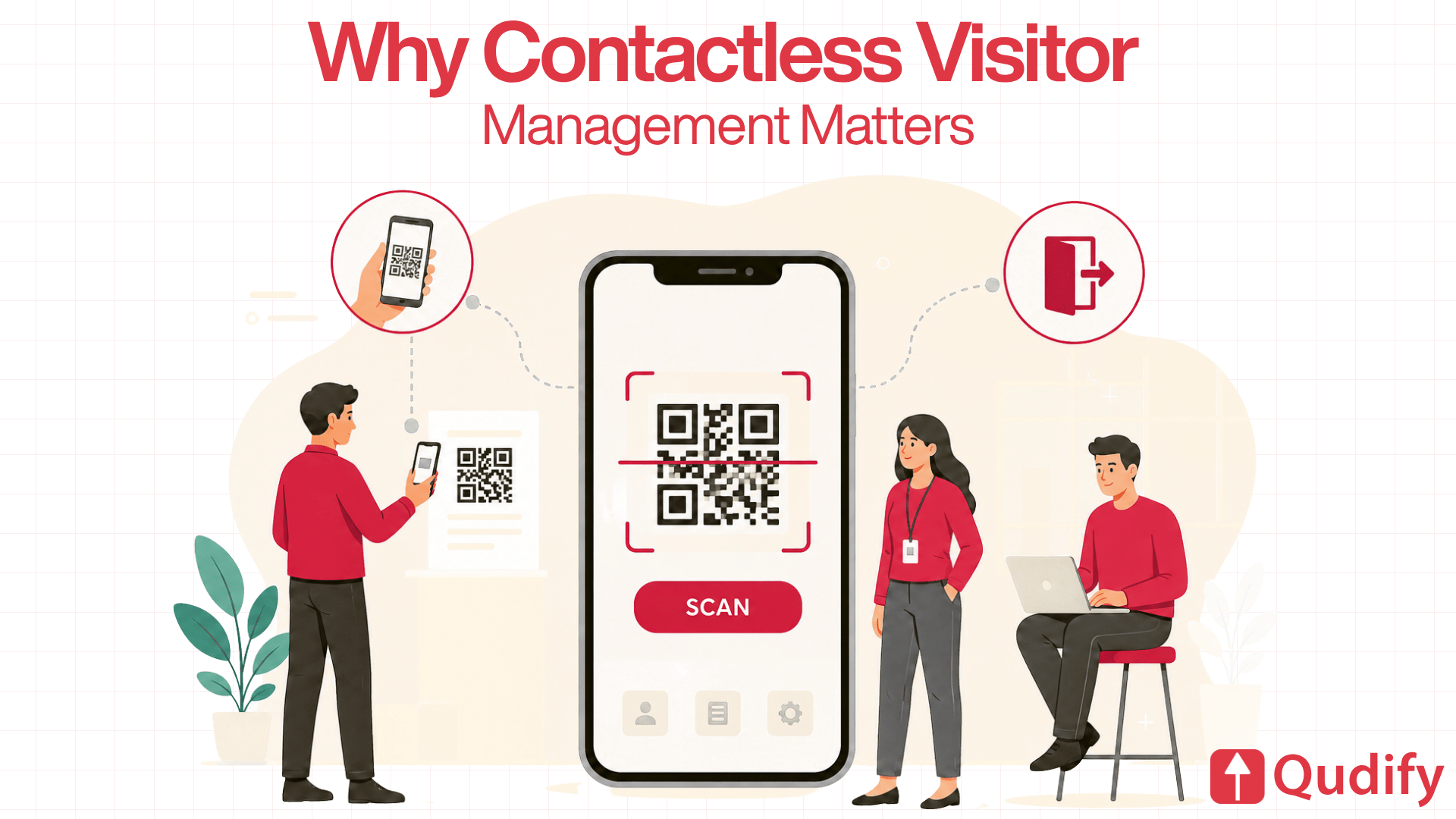
In short: A contactless visitor management system (VMS) checks visitors in and out with zero shared touchpoints no logbook, no communal pen, no shared tablet using nothing but a QR code and WhatsApp. In India, three things turned this from a nice-to-have into a near-default in 2026: the DPDP Act’s penalty regime activates on 13 May 2027 with no grace period, a paper register can’t prove consent or produce an audit trail, and most Indian offices now share a lobby with a dozen other tenants who need one system, not fifteen separate ones.
Key Takeaways
- A contactless VMS registers, verifies, and tracks visitors with no shared physical touchpoint at all; visitors use their own phone, never a communal tablet or sign-in sheet.
- The DPDP Act’s substantive obligations and penalty regime take effect on 13 May 2027. There’s no grace period after that, and the Data Protection Board of India is already active and hearing complaints today.
- A paper register can’t demonstrate lawful consent, keep one visitor’s details private from the next, or produce an audit trail. A purpose-built VMS can do all three by default.
- QR plus WhatsApp removes the single biggest adoption barrier in India: nothing to download, and passes arrive on a channel more than 500 million Indians already use every day.
- The same platform scales from a single office to a multi-tenant tower, a school or a factory floor, and extends naturally into meeting-room booking and digital complaint handling.
Walk into almost any modern office, commercial tower, school or factory in India today, and one thing has quietly disappeared: the dog-eared visitor register with its scratched-out entries and stack of laminated passes. In its place sits a QR code, a WhatsApp message and a quick scan from the visitor’s own phone.
This is not a cosmetic upgrade. It reflects a structural change in how Indian workplaces treat security, compliance and efficiency. Three forces now push contactless visitor management from a nice-to-have to a baseline requirement: a data-protection law that has finally moved from statute to an enforcement timeline, a commercial-property market dominated by shared, multi-tenant buildings, and steady pressure to cut front-desk cost and paper.
Qudify, a QR-first visitor management platform built by Qdesq Realtech, was designed around exactly this shift. This article explains why contactless visitor management matters now, and how a QR-and-WhatsApp approach addresses each pressure point.
What is a Contactless Visitor Management System?
A contactless visitor management system is a cloud-based platform that automates visitor registration, identity verification, check-in, check-out, and record-keeping without any shared physical touchpoint. Visitors use their own smartphone rather than a common tablet, sign-in sheet, or printed badge.
A standard VMS already replaces the paper logbook with a digital workflow. A contactless VMS goes one step further and removes the physical hardware people share at the door. At its core, a modern contactless platform such as Qudify handles:
- Pre-registration of expected visitors before they arrive
- Identity verification and KYC at the point of entry
- Contactless check-in and check-out via QR code or WhatsApp
- Real-time visitor logs and searchable audit trails
- Digital badge and pass issuance with no printing
- Centralised, cloud-based monitoring across multiple sites
Qudify’s design principle is simple: QR first. The only hardware every visitor already carries is a smartphone, so there is no reason to force an app download, a kiosk queue or a shared tablet.
Why Contactless Visitor Management Matters Now
The case rests on three drivers, plus two commercial tailwinds.
Driver | What changed | Why it matters |
Data-protection law | The DPDP Act, 2023 gained enforceable rules and a fixed compliance deadline (13 May 2027) | Visitor registers collect names, phone numbers and ID details, all personal data now squarely within the law |
Multi-tenant real estate | Shared towers and campuses now house many companies behind one entrance | Centralised, cloud-based tracking becomes essential where one lobby serves fifteen or twenty tenants |
Front-desk security | Manual verification cannot enforce blacklists, confirm identity or produce audit trails | Automated checks close gaps that a guard and a logbook were never equipped to handle |
Cost pressure | Businesses are trimming non-core overheads | Asset-light, cloud systems cut hardware and manual staffing at reception |
Sustainability goals | Paperless and ESG targets are now mainstream | QR check-ins remove logbooks and printed badges, reducing waste |
The DPDP Act has Reset the Rules for Visitor Data
This is the single biggest reason digital, consent-based visitor management stopped being optional.
What the Law Requires
Under India’s Digital Personal Data Protection (DPDP) Act, 2023, any organisation that collects a visitor’s name, phone number, photo, or ID copy is acting as a Data Fiduciary. In practice, that means:
- Consent must be free, specific, informed, and given through a clear affirmative action
- Consent must be captured before data collection begins, not after
- Records of consent must be auditable and verifiable
- Data must be stored securely and erased once the purpose it was collected for is served
The Timeline That Actually Matters
The draft version of this story often stops at “the Act was passed in 2023.” The important detail is what has happened since, because it puts a clock on compliance.
Date | What takes effect |
11 August 2023 | The DPDP Act receives Presidential assent |
13 November 2025 | The DPDP Rules, 2025 are notified; the Data Protection Board of India is established and becomes operational |
13 November 2026 (approx.) | Consent Manager registration provisions come into force |
13 May 2027 | All substantive obligations (consent, notice, security safeguards, breach reporting and data-principal rights) and the penalty regime take effect. No grace period follows |
In other words, the Board already exists, but the obligations that bite (and the fines that back them) switch on in May 2027. The eighteen-month runway to that date is preparation time, not a holiday. Warnings and guidance are expected through the interim; the hard deadline is fixed.
What Getting it Wrong can Cost
The Data Protection Board of India imposes penalties under Section 33 of the Act, with maximum amounts set out in the Schedule. Once the penalty regime is live, the ceilings most relevant to visitor data are:
Breach by a Data Fiduciary | Maximum penalty |
Failure to implement reasonable security safeguards (for example, a leaked visitor database) | Up to ₹250 crore |
Failure to notify the Board and affected individuals of a data breach | Up to ₹200 crore |
Breach of any other provision, including invalid or missing consent and notice failures | Up to ₹50 crore |
Penalties are assessed per breach and can be cumulative across a single investigation. A separate, much smaller penalty of up to ₹10,000 applies to an individual who misuses the system, but the ceilings that should concern an employer are the fiduciary-side figures above.
A paper register, a shared Excel sheet at the security desk or a generic tablet app cannot demonstrate compliant consent capture, and none of them keeps one visitor’s details from being read by the next person in the queue. This is where a purpose-built platform earns its place.
How a Contactless VMS Handles It
Qudify captures visitor consent digitally at the pre-registration stage, before any data is collected, and retains auditable consent records automatically. Because consent sits inside the check-in workflow rather than being bolted on afterwards, front-desk operations line up with DPDP expectations by default rather than by manual effort. Individual records stay private to the organisation, not exposed on an open page anyone can read.
Note: nothing here is legal advice. Confirm your specific obligations against the DPDP Act, 2023 and the DPDP Rules, 2025, and take counsel where needed.
Why the Paper Register Had to Go
Manual logs have caused quiet problems for years. They only became visible once compliance and security expectations caught up.
Problem with paper or manual systems | Contactless VMS solution |
Illegible handwriting and incomplete entries | Structured digital fields are mandatory before submission |
No way to verify who actually signed in | Digital consent and KYC-style verification |
Previous visitors’ details are visible to everyone | Private, individual digital records |
No live headcount during an emergency | Real-time occupancy dashboard |
Shared pens, registers and tablets | Zero shared touchpoints; visitors use their own phone |
Historical data is impossible to search quickly | Searchable, cloud-based logs |
No blacklist enforcement | Automated flagging of restricted individuals |
Recurring paper and printing costs | Fully digital, paperless workflow |
Two things are worth separating here. The front desk is now both a data-collection point and a physical access point, and each carries higher stakes than it did a few years ago.
On the data side, the stakes are measurable. Government figures show cyber-security incidents reported in India rose from roughly 10.3 lakh in 2022 to 22.7 lakh in 2024 (Press Information Bureau, 2025). Any personal data you collect at reception, and how you store and protect it, now sits inside that risk environment and inside the DPDP obligations described above.
On the physical side, the logic is straightforward. A guard cannot cross-check every face against a blacklist, a handwritten name can be false, and a paper log gives investigators nothing after an incident. A contactless system adds an active layer the front desk never had:
- Blacklist management, so restricted individuals are flagged and denied entry automatically
- Verified entry, so no one crosses the threshold without a validated digital pass
- Accurate check-in and check-out logs for both staff and visitors
- Scannable digital badges, so security can confirm a pass is genuine on the spot
- Long-term and vendor passes with defined validity periods for recurring contractors and delivery partners
This turns reception from a passive checkpoint into an automated security layer.
The QR and WhatsApp Advantage
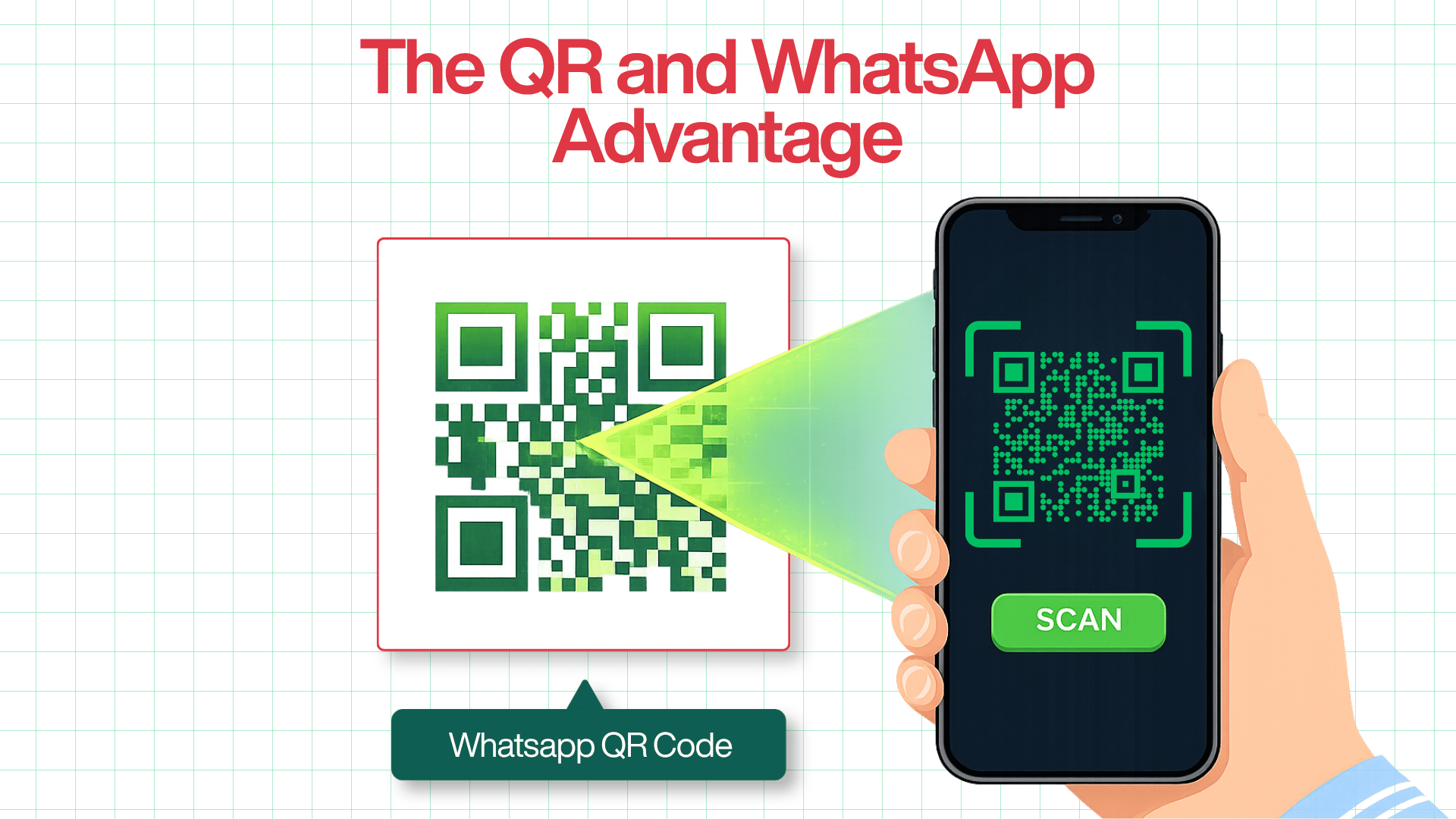
The most distinctive choice in a platform like Qudify is routing passes and check-in links through WhatsApp and a plain QR scan, rather than a dedicated app.
It matters because of a single number. WhatsApp has more than 500 million users in India, a figure Meta itself confirmed in late 2024, with independent estimates placing the audience even higher (DataReportal, Digital 2025). That near-universal familiarity removes the friction that has historically limited VMS adoption: people do not want to install an app to visit an office once. With a QR-and-WhatsApp flow, the visitor scans a code with their phone’s default camera, fills in details in the mobile browser, and receives a digital pass in their WhatsApp chat. There is nothing to download and no learning curve for staff or guests.
Speed follows from the same design. Manual sign-in usually takes several minutes per visitor once you add up handwriting, ID checks, and host confirmation, and it produces queues at peak hours. A QR or WhatsApp check-in compresses that to well under a minute. Shorter queues are not only a convenience; a crowded lobby in a busy commercial tower is itself a security concern, and a faster desk makes a better first impression on clients and auditors. Qudify reports that its approach reduces manual front-desk workforce cost by more than 50 per cent.
Real-time Visibility is a Life-Safety Feature
This point is easy to underrate. In a fire, an evacuation drill, or a lockdown, knowing exactly how many people are inside a building, and roughly where, is the difference between an orderly evacuation and chaos. A paper register left on a desk is useless the moment it is left behind.
A contactless VMS keeps a live occupancy count synced to the cloud, accessible to security and facilities teams from any device, with visibility across multiple sites. Qudify’s cloud architecture is built for centralised, real-time monitoring rather than siloed, location-by-location tracking.
That same architecture is what makes it work for India’s multi-tenant office boom. Commercial property has shifted decisively toward shared buildings: one tower, one lobby, fifteen or twenty separate companies. Historically, each tenant kept its own register, if any, and the building operator had no reliable cross-tenant view of who was inside. Qudify offers a VMS configured for commercial towers alongside its versions for corporate offices, schools and manufacturing sites. Office-wise admin access lets a single building operator run one centralised system while each tenant keeps its own admin controls and its own visitor data.
What a Modern Contactless VMS Includes
Here is a consolidated view of core capabilities, split by who uses them.
For visitors
Feature | What it does |
QR check-in and check-out | Scan and go, no app download |
WhatsApp-delivered passes | Digital pass sent straight to the visitor’s phone |
Pre-registration | Hosts pre-invite and pre-approve guests before arrival |
Health and compliance declarations | Optional forms for regulatory or safety needs |
Custom-branded experience | Personalised welcome screens carrying company branding |
For administrators
Feature | What it does |
Visitor logs and lists | Searchable, accurate records of all activity |
Blacklist management | Flag and restrict specific individuals automatically |
Employee pass management | Issue and manage staff passes digitally |
Office-wise admin access | Customise permissions across multiple sites |
Real-time analytics | Track visitor movement and space utilisation |
Custom registration forms | Adjust fields such as name, company and purpose of visit |
Manual check-in fallback | Available via computer or tablet when needed |
Long-term and vendor passes | Defined validity periods for recurring visitors |
Beyond the Front Desk
Qudify positions itself as a broader QR-first workplace suite rather than a single-purpose tool. Alongside visitor management, the same ecosystem covers meeting-room booking (QR-based interfaces to check availability and reserve rooms, cutting double-bookings) and a digital complaint box (a QR-driven way for employees or visitors to raise facility issues without paperwork or scattered email). The underlying thesis is consistent: a smartphone and a QR code can remove most of the paper-based friction still sitting in everyday office operations, not just at the entrance.
Who Needs Contactless Visitor Management?
Sector | Why it matters here |
Corporate offices | Client visits, vendor access and audit trails for compliance |
Commercial and multi-tenant towers | Centralised tracking across many independent tenants |
Manufacturing sites | Contractor and vendor access control, safety declarations |
Schools | Parent and guardian verification, child-safety accountability |
Regulated sectors (healthcare, government, BFSI) | Strict compliance reporting and ID verification |
MSMEs and small businesses | An affordable, asset-light entry point with no hardware project |
Qudify is designed to work across this whole spectrum, from a small business trying its first digital front desk to a regulated enterprise that needs detailed compliance reporting. The company reports more than 500 live sites and over 400 client organisations on the platform.
Making the Switch: Common Concerns
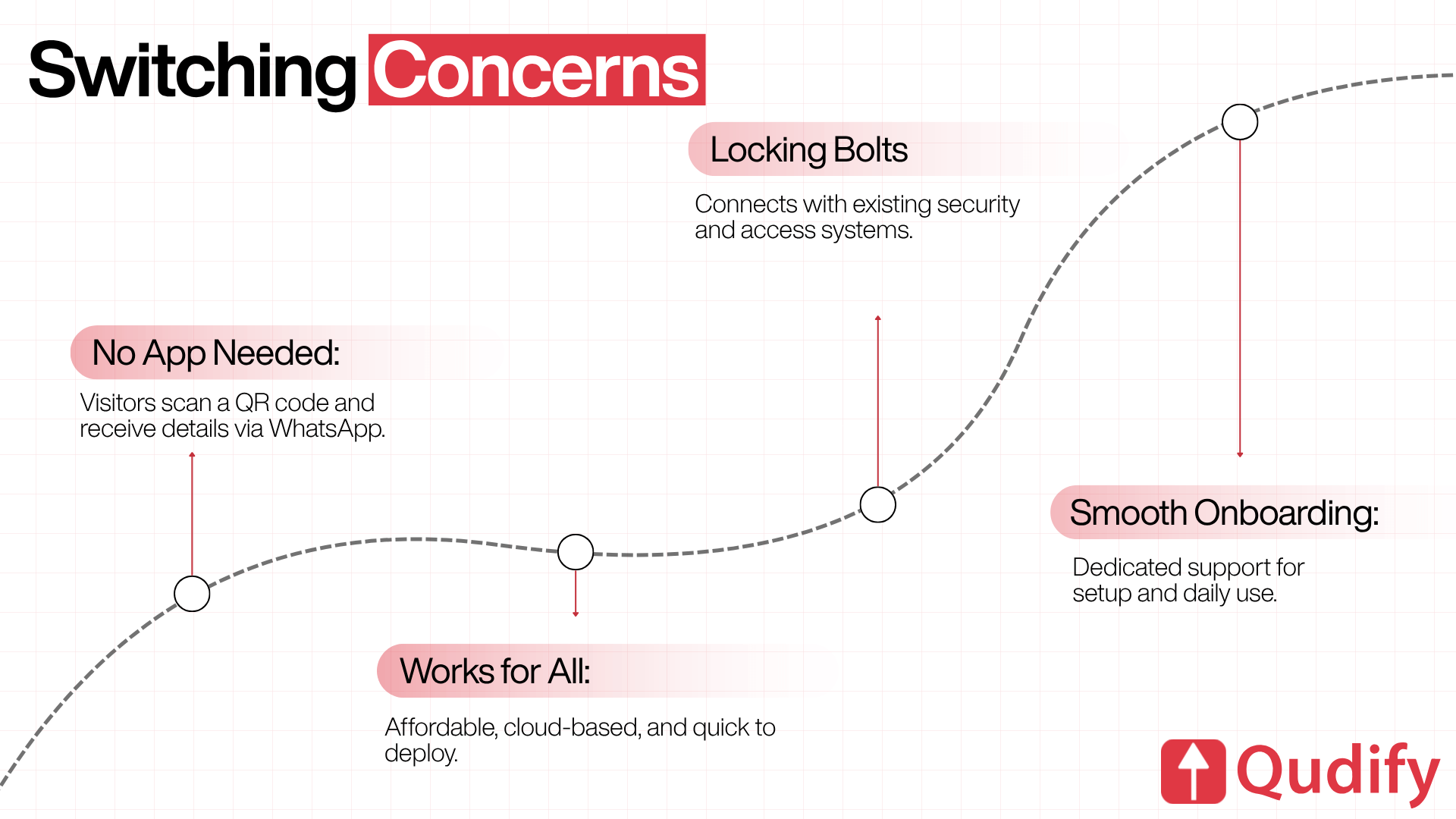
Moving off a paper register raises a few predictable questions. Modern platforms have largely engineered these away.
Do visitors need to download an app? No. That was the biggest barrier to early digital check-in. With a QR-native platform, visitors scan a code using their phone’s default camera, and pre-registration links, check-in prompts and passes arrive through WhatsApp.
Is it viable for a small business, or only for large towers? Both. Because the system is cloud-based and asset-light, it needs no kiosks, no local server and no proprietary hardware. Running on visitors’ own smartphones makes it an affordable, plug-and-play upgrade that a single office can deploy quickly, often within days, without an IT project.
Will it fit with our existing security setup? A contactless platform serves as the primary digital gate, handling verification, consent and logging before anyone crosses the threshold. As physical-security ecosystems mature, platforms in this category are increasingly able to integrate with existing access-control hardware, bridging digital approval and physical entry.
What about support during the transition? Reliable backing matters when you retire a legacy manual process. Qudify provides customer support to guide organisations through onboarding, configuration and day-to-day operation.
Contactless is Infrastructure, not a Trend
The argument for contactless visitor management has moved well past convenience. It now sits at the intersection of three hard requirements every Indian workplace faces: legal compliance under the DPDP Act, physical and data security at a point that handles both, and operational efficiency as commercial property grows more shared and more complex.
A QR-and-WhatsApp platform such as Qudify was built around that convergence, using tools nearly every Indian smartphone user already has to remove friction, cut cost and close gaps that paper registers were never equipped to handle. With the DPDP penalty regime switching on in May 2027, the question for any organisation still relying on a logbook and a guard’s memory is no longer whether to make the shift. It is how soon.
Frequently Asked Questions
What is a contactless visitor management system, and how does it work?
It is a cloud-based platform that registers, verifies and tracks visitors with no shared touchpoints. The flow is three steps: the visitor scans a QR code at the entrance with their own phone, enters their details and any required consent or safety forms on their device, and receives a digital pass while the host is notified instantly.
Is the DPDP Act already in force, and when do the penalties start?
The Act received assent in 2023, and the DPDP Rules, 2025 were notified on 13 November 2025, which also brought the Data Protection Board of India into being. The substantive obligations and the penalty regime take effect on 13 May 2027. The intervening period is meant for preparation, and there is no grace period after the deadline.
How does a contactless VMS help with DPDP compliance?
Collecting a visitor’s name, phone number, or photo makes your organisation a Data Fiduciary. A digital platform captures clear, affirmative consent before any data is collected, keeps each visitor’s record private, and maintains an auditable trail of that consent, which a paper register cannot do.
What is the maximum penalty for a visitor-data breach under the DPDP Act?
Once the penalty regime is live, the Schedule sets a ceiling of up to ₹250 crore for failure to implement reasonable security safeguards, up to ₹200 crore for failing to report a breach, and up to ₹50 crore for other breaches such as invalid or missing consent. Penalties are per breach and can be cumulative.
Do visitors or employees need to install an app?
No. Visitors scan a QR code with their phone’s default camera and receive passes through WhatsApp, a channel used by more than 500 million people in India, so there is nothing to download.
Can a digital system really improve on a security guard?
It adds what a guard cannot do manually: automatic blacklist checks, instant verification of pre-approved passes, tamper-resistant digital badges that security can scan, and a complete audit trail for any post-incident review. The guard’s physical presence and the system’s automated checks work together.
Is a QR-first VMS suitable for small businesses, or only large towers?
Both. It is asset-light and cloud-based, so a multi-tenant tower can run a unified system with per-tenant admin access, while a small business can deploy a secure, paperless check-in on existing hardware within days.
How does a contactless VMS help during an emergency?
It maintains a live occupancy dashboard synced to the cloud. Facilities and emergency-response teams can pull an accurate, real-time headcount of who is in the building, and where, from any device, which a paper register left on a desk cannot provide.
How quickly can a contactless VMS be deployed?
Because there is no hardware to install and no local server to maintain, a single-location rollout can typically go live within days rather than weeks.
Can the same platform do more than visitor management?
Yes. A QR-first suite such as Qudify also covers meeting-room booking, so employees can check availability and reserve rooms and avoid double-bookings, and digital complaint handling, so issues can be raised by scanning a code instead of chasing paperwork or email.