
Digital Complaint Management Systems: A Complete Guide
Key Takeaways
- A digital complaint management system captures, routes, tracks, and reports on complaints from employees, customers, or visitors, replacing paper boxes and email chains with one trustworthy channel.
- Traditional complaint boxes fail because they cannot offer anonymity, routing, tracking, or follow-up, so people stop using them.
- Silence is expensive. Most unhappy customers leave without a word, and a majority of employees hesitate to speak up for fear of retaliation.
- Anonymity drives reporting. Around 85 per cent of employees are more likely to report serious issues when an anonymous channel exists.
- QR codes remove friction, especially in India, where scanning is already a daily habit and no app download or extra hardware is needed.
- Compliance in India requires an Internal Committee for workplaces with ten or more employees under the POSH Act, and a digital system provides the confidential intake and records that support it.
- Qudify’s Feedback and Complaint Box is a QR-first, cloud-based tool built for Indian offices, hotels, schools, and buildings, handling both employee and customer feedback from a single platform.
Most complaints never reach the person who could fix them. A frustrated employee decides the risk is not worth it. A guest at your hotel smiles, settles the bill, and quietly books a competitor next time. A safety concern on the factory floor gets mentioned to a colleague near the water cooler and then forgotten by lunch. In each case, the complaint existed. What was missing was a reliable way to capture it, send it to the right hands, and prove it was resolved.
That gap is exactly what a digital complaint management system is built to close. This guide explains what these systems are, why the old suggestion box on the wall keeps letting people down, how QR-based tools work in practice, what the law in India expects of employers, and how to choose a platform that people will actually use. Qudify’s Feedback and Complaint Box is referenced throughout as a purpose-built example, because it was designed for precisely these problems in Indian workplaces.
Quick answer: A digital complaint management system is software that lets employees, customers, or visitors submit complaints and feedback online, then automatically routes each entry to the right person, tracks it to resolution, and reports on recurring patterns. It replaces paper boxes and scattered email chains with one trackable and often anonymous channel.
What Is a Digital Complaint Management System?
A digital complaint management system is a software platform that captures complaints and feedback from employees, customers, or visitors, routes each one automatically to the responsible person or team, tracks it through to resolution, and produces reports on volumes, response times, and recurring themes. It removes the paper, the guesswork, and the delay from the process.
Think of it as three jobs handled by one tool. First, capture: a simple form that anyone can fill in from a phone or laptop, with an option to stay anonymous. Second, routing and resolution: the complaint reaches the concerned authority in real time, with a status that moves from received to in progress to resolved. Third, insight: dashboards and automated reports that turn a pile of individual grievances into a pattern you can act on.
The category sits inside a broader software market that is growing steadily. Quality management software, which includes complaint handling as its largest segment, was valued at around USD 11.3 billion in 2023 and is projected to reach roughly USD 26.3 billion by 2032, a compound annual growth rate of about 9.8 per cent, according to DataHorizzon Research. Complaint handling leads the segment because regulators, customers, and employees all now expect issues to be logged and closed properly rather than lost in a drawer.
Digital complaint management system vs the traditional complaint box
The difference is not cosmetic. It changes who hears about a problem, how fast, and whether anyone can prove it was dealt with.
Dimension | Traditional complaint box | Digital complaint management system |
How people submit | Paper slip dropped into a physical box | QR scan or a link, from any device |
Anonymity | Handwriting can identify the writer, and the box can be watched | Genuine anonymous submission is possible |
Time to reach the right person | Days, and only when someone remembers to open the box | Instant, routed automatically to the concerned authority |
Tracking | None; slips get lost, damaged, or quietly binned | Full audit trail with a visible status |
Analytics | Manual and rarely done | Automated dashboards and scheduled reports |
Closing the loop | Rarely happens | Built-in acknowledgements and responses |
Compliance record | Hard to produce when asked | Timestamped, exportable records |
Hardware and cost | Printing, physical boxes, and staff hours | A software subscription, no special hardware |
Environmental impact | Paper waste | Paperless |
Why Traditional Complaint Boxes Fail Employees
Traditional complaint boxes fail because they are slow, easy to ignore, and impossible to trust. Handwritten slips can identify the writer; there is no proof a complaint was ever read, and follow-up almost never happens. The box becomes decoration, and people learn that speaking up leads nowhere.
The deeper problem is human, not logistical. People stay silent when they doubt anything will change or fear it will be held against them. The evidence here is consistent and, if anything, getting worse. A 2026 report from Radical Candor found that six in ten employees are afraid to speak up at work, and 45 per cent do not feel safe doing so, citing psychological safety as their top concern. A separate benchmark study by DecisionWise, covering more than 100,000 employees, found that 34 per cent do not speak up because they fear retribution. Research shared by the Institute of Business Ethics reported that 43 per cent of workers feared retaliation if they raised a concern, and only around two-thirds said their organisation even offered a confidential way to report.
A physical box does nothing to address any of that. It cannot promise anonymity, because someone has to physically retrieve and read the slips, often in full view of the office. It cannot promise action, because there is no record and no owner. Over time, this produces a quiet, corrosive result: the people with the most useful information stop sharing it.
The practical failures of a paper box, in short:
- No real anonymity. Colleagues can watch who approaches the box, and handwriting gives people away.
- No routing. A complaint about the canteen and a complaint about a manager land in the same slot, and both wait for whoever holds the key.
- No tracking. Nobody can tell whether a slip was read, actioned, or thrown out.
- No follow-up. The person who complained never hears back, so they assume nothing happened, and usually they are right.
- No data. Fifty slips over six months might reveal a clear pattern, but nobody is collating fifty slips by hand.
How a Digital Complaint Management System Works
A digital complaint management system works in four steps: a person submits a complaint through a form or QR code, the system logs it with a timestamp and reference, it routes the complaint to the right owner automatically, and everyone involved can track its status until it is marked resolved. Reports then surface trends across all complaints.
Here is the flow in a little more detail.
- Submission. The person scans a QR code placed on a wall, desk, receipt, or notice board, or opens a shared link. A short, mobile-friendly form appears. They pick a category, describe the issue, and choose whether to identify themselves or stay anonymous.
- Logging. The system records the complaint instantly, with a date, time, and unique reference. Nothing depends on someone remembering to check a box on Friday afternoon.
- Routing. Based on the category or location, the complaint is sent to the concerned authority. A maintenance issue reaches facilities, an HR matter reaches HR, a food-quality complaint reaches the cafe manager. Automated notifications mean the right person knows within minutes.
- Resolution and closing the loop. The owner updates the status as they work through it. Where the complainant has shared contact details, they receive a response, which is the single biggest driver of whether people trust the system enough to use it again.
- Reporting. Managers see dashboards showing how many complaints came in, how quickly they were resolved, and which themes keep repeating. That turns firefighting into prevention.
QR codes and the complaint box app for employees
Featured-snippet answer: A complaint box app for employees is a mobile-friendly, usually QR-based tool that replaces the physical suggestion box on the wall. Staff scan a code or open a link, raise a concern anonymously if they choose, and the complaint reaches HR or management instantly, with a clear trail showing whether it was resolved.
The reason QR codes work so well for this is that scanning is now second nature, especially in India. Roughly 86 per cent of smartphone users worldwide have scanned a QR code at least once, and in India the habit is close to universal thanks to UPI. According to figures from the National Payments Corporation of India, the country had crossed 700 million active UPI QR codes by late 2025, and the Reserve Bank of India reports that UPI now handles the large majority of India’s digital payment volume. When people already scan codes to pay the vegetable vendor and the taxi driver, scanning one to raise a workplace concern needs no training and no app download.
A QR-first approach also removes the hardware problem entirely. The only device required is the smartphone almost everyone already carries. This is the design philosophy behind Qudify, which builds QR-based workplace tools specifically so that offices and buildings do not have to buy or maintain extra equipment.
Core Features to Look For in a Complaint Management System
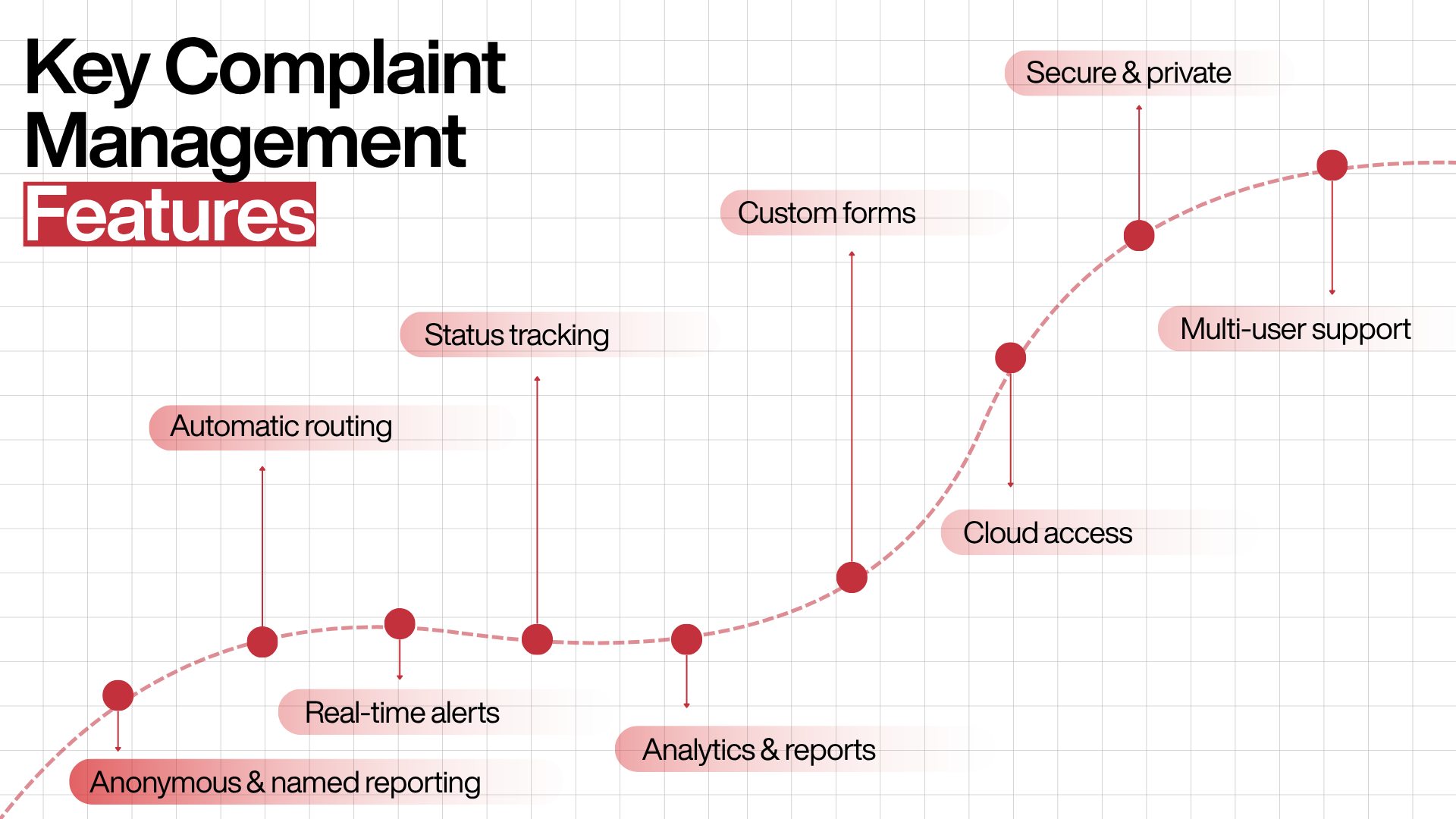
The best complaint management systems share a common set of capabilities. Look for anonymous submission, automatic routing, real-time notifications, status tracking, analytics and reporting, white-labelled and customisable forms, and cloud-based access. Together, these turn complaint handling from a chore into a reliable process.
When you are comparing platforms, weigh these against your actual needs:
- Anonymous and identified options: People must be able to choose. Forcing names suppresses reporting; forbidding them can hide serious issues. Give both.
- Automatic routing: Complaints should reach the correct owner by category or location without a person sorting them by hand.
- Real-time notifications and automated mailers: Owners and administrators should be alerted the moment something comes in, and acknowledgements should be automatic.
- Status tracking and audit trail: Every complaint needs a visible journey from received to resolved, with timestamps you can stand behind.
- Analytics and automated reports: Trend dashboards and scheduled reports are what separate a logging tool from a management tool.
- White-labelled, customisable forms: The submission page should carry your branding and ask the questions that matter to your organisation.
- Cloud-based access: No servers to maintain, and access from anywhere for distributed teams and multi-site operations.
- Data security and privacy: Because complaints often contain personal data, the platform should handle that data responsibly, which matters more than ever under India’s Digital Personal Data Protection Act, 2023.
- Multi-audience support: A system that handles both employees and external customers or visitors is more useful, and more cost-effective, than two separate tools.
Qudify’s Feedback and Complaint Box was built around this exact feature set: QR-based submissions, white-labelled and fully customisable forms, automated mailers, real-time recording and routing to the concerned authority, analytical insights, automated reports, and a cloud architecture that removes physical touchpoints altogether.
The Key Benefits of Going Digital
For employees: psychological safety and a real voice
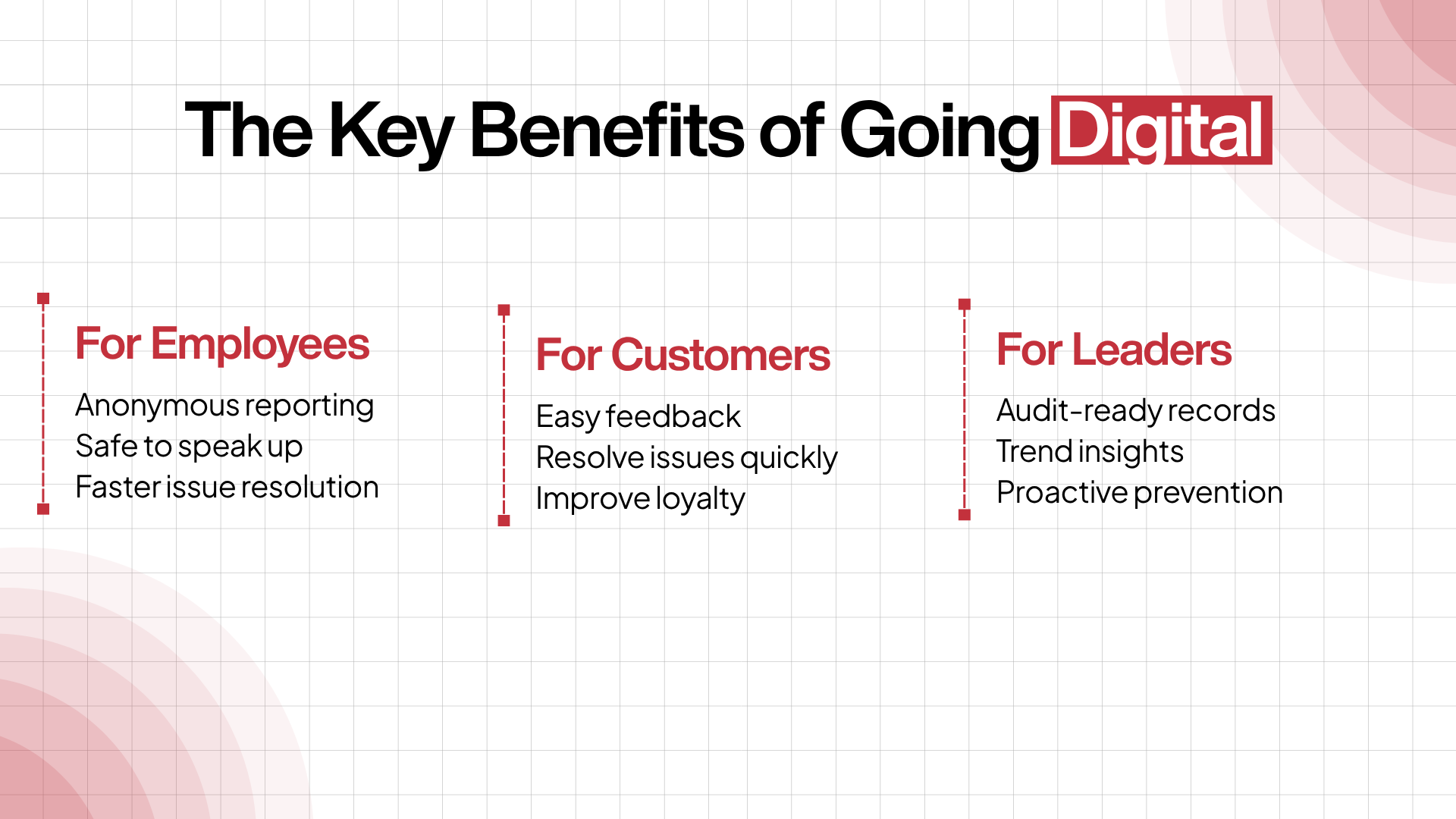
A digital complaint box gives employees something the paper version never could: a credible promise of anonymity and follow-up. That single change unlocks reporting. Survey work by AllVoices found that around 85 per cent of employees are more likely to report harassment when an anonymous channel exists, and that anonymous reporting was the number one measure employees believed would encourage more people to come forward.
The stakes are not abstract. When issues stay buried, they escalate. A law firm’s 2026 Trust @Work report found that about one-third of employees would be stopped from reporting misconduct by fear of retaliation or other consequences, even when they had witnessed something unethical or illegal. Every one of those unreported issues is a problem the organisation cannot fix because it does not know it exists.
For customers and visitors: catching problems before they walk out the door
Here is a fact that should reshape how any hotel, cafe, school, or coworking space thinks about feedback. Widely cited customer-experience research suggests that the large majority of unhappy customers never complain; they simply leave and do not return. One frequently quoted figure holds that for every customer who complains, roughly twenty-five others stay silent, and a dissatisfied customer typically tells nine to fifteen people about a bad experience.
A complaint that reaches you is therefore a gift, not a nuisance. It is a customer telling you exactly what to fix before they defect and before they warn their friends. There is a well-documented pattern in service research, the service recovery paradox, where customers whose problems are resolved quickly and well often end up more loyal than customers who never had a problem at all. A QR code on the table, the reception desk, or the receipt gives that unhappy customer an easy, low-friction way to speak up while you can still put things right.
For compliance and leadership: proof, patterns, and prevention
Leaders get two things from a digital system that a box cannot provide. The first is proof. Timestamped, exportable records show regulators, auditors, and courts that complaints were received and handled properly. The second is pattern recognition. When ten complaints in a quarter all point at the same shift, supplier, or process, the dashboard makes that obvious, and prevention becomes possible instead of endless reaction.
Digital Complaint Management and Compliance in India
In India, a complaint mechanism is not optional for many employers. Under the Sexual Harassment of Women at Workplace (Prevention, Prohibition and Redressal) Act, 2013, commonly called the POSH Act, every workplace with ten or more employees must constitute an Internal Committee to receive and address complaints of sexual harassment. This is a legal duty, and non-compliance carries a penalty.
The specifics matter for anyone choosing a system:
- The Internal Committee is mandatory for organisations with ten or more employees, and it must include a senior woman as Presiding Officer, at least two employee members, and one external member from an organisation working on women’s issues, with at least half the members being women.
- Timelines are strict. An inquiry must generally be completed within 90 days, and the employer must act on the committee’s recommendations within 60 days.
- Records and annual reporting are required. Employers must file an annual return with the District Officer covering complaints received, complaints disposed of, and complaints pending beyond 90 days, along with the awareness programmes conducted.
- Penalties apply. Failure to comply can attract a fine of up to ₹50,000, with repeat violations risking higher penalties or cancellation of the business licence, and confidentiality of the parties is legally protected throughout.
A digital complaint system does not replace the Internal Committee or the formal POSH inquiry, and it is important to be clear about that. What it does is provide the confidential intake and record-keeping layer that good compliance depends on. It gives employees an easy, discreet way to raise a concern, gives the committee a timestamped record, and makes annual reporting far less painful than reconstructing events from memory and paper.
One nuance worth knowing: strictly speaking, an anonymous complaint does not on its own trigger the formal POSH inquiry, which requires a written complaint from the aggrieved person. Most compliance experts recommend treating anonymous reports as valuable intelligence, investigating informally, and creating conditions for the person to come forward with confidence. A digital channel that supports both anonymous and identified submissions is well suited to this reality.
How to Choose the Right Complaint Management System
Choosing well comes down to matching the tool to your people and your obligations. Work through this checklist before committing:
- Will your people actually use it? If submitting a complaint is harder than staying silent, nothing else matters. Favour a QR or link-based tool that works in seconds on any phone.
- Does it offer genuine anonymity? Confirm that anonymous submissions are truly anonymous, not just unnamed entries that can be traced.
- Does it route automatically? Manual sorting reintroduces delay and human error. Routing by category and location should be built in.
- Can it close the loop? Acknowledgements and responses are what build trust. A tool that only collects, without any feedback to the complainant, will lose credibility.
- Does it report? You want trend dashboards and exportable records, not just a running list.
- Does it meet your compliance needs? For Indian employers, that means timestamped records, confidentiality, and data handling consistent with the Digital Personal Data Protection Act, 2023.
- One audience or two? If you need both employee and customer feedback, a single multi-audience platform saves money and effort.
- What is the total cost? Look past the subscription to hardware, setup, and maintenance. QR-first tools usually win here because the hardware is a phone people already own.
How to Roll Out a Complaint Box App for Employees
Rolling out a complaint box app for employees is straightforward, but adoption depends on trust. Follow these steps: configure and brand the form, place QR codes where people already are, tell staff clearly how anonymity works, assign owners for each complaint category, and, above all, respond to early complaints visibly so people see the system works.
- Set up and brand: Create your categories, customise the form, and apply your logo so the page feels official.
- Place the codes well: Put QR codes in visible, low-pressure spots: near exits, in break rooms, on notice boards, in washrooms, and at reception. Private locations encourage honest reporting.
- Communicate the promise: Explain, plainly, that anonymous submission is available and what happens to a complaint after it is sent. People use what they understand.
- Assign owners and response times: Decide who handles each category and set an internal target for first response. Ownership prevents complaints from stalling.
- Close the loop early and visibly: Resolve the first few complaints quickly and let staff see that action followed. Nothing builds a speak-up culture faster than evidence that speaking up works.
How Qudify's QR-Based Feedback and Complaint Box Works
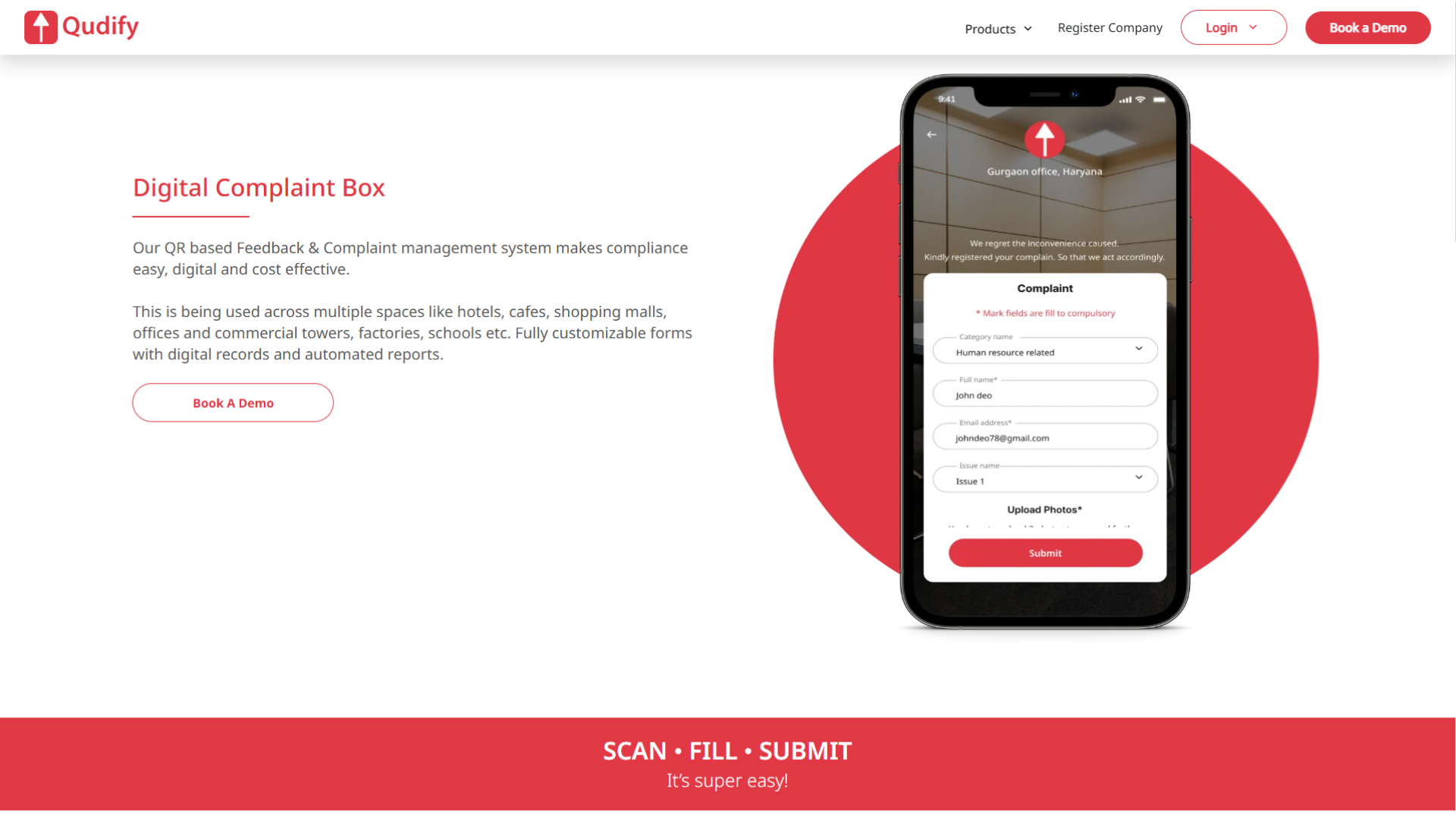
Qudify is an enterprise SaaS company, founded in 2022 and based in Gurgaon, that builds QR-first tools for workspaces. Alongside its visitor management and meeting-room booking products, it offers a Feedback and Complaint Box designed to make complaint handling digital, fast, and affordable for offices, coworking spaces, commercial buildings, hotels, schools, colleges, and cafes.
The way it works reflects everything covered above. A QR code is placed wherever feedback should be collected, on a wall, a desk, a receipt, or a notice board. Anyone, whether an employee or an external customer, scans it and submits a complaint or a piece of feedback through a white-labelled, customisable form, with the option to remain anonymous.
The system records the entry in real time and routes it to the concerned authority, sends automated notifications, and lets administrators track resolution and pull automated reports. Because everything is cloud-based and QR-driven, there is no hardware to buy and no paper to shred, which also supports the decarbonisation and sustainability goals many organisations now report on.
A few things make it a sensible starting point for Indian teams in particular:
- It fits how India already behaves. QR scanning is a daily habit here, so adoption does not require training.
- It serves internal and external audiences from one tool. The same platform captures employee grievances and customer or visitor feedback, which is efficient for hotels, schools, and coworking spaces that need both.
- It is built for compliance and record-keeping. Timestamped, routed, trackable complaints are exactly what an audit or an annual POSH return needs behind them.
- It removes cost and clutter. No physical boxes, no dedicated scanners, no server maintenance.
Qudify reports serving more than 400 clients across 500-plus live sites, which gives some sense of how the QR-first model performs across different building types. If you want to see the complaint workflow end to end, the Feedback and Complaint Box product page is the place to start, and you can book a demo from there.
Conclusion
The quiet complaint is the dangerous one. The employee who says nothing, the guest who leaves without a word, the safety issue that never reaches the safety team: these are the problems that grow in the dark. A digital complaint management system brings them into the light, quickly and with a record, by giving people a channel they trust and giving leaders the routing, tracking, and reporting that a paper box never could.
For organisations in India, the case is stronger still. QR scanning is already a daily reflex, compliance obligations are real, and a single QR-based platform can serve both employees and customers without a rupee spent on hardware. If you are ready to replace the box on the wall with something people will actually use, Qudify’s Feedback and Complaint Box is built for exactly that.
Book a demo and see the full complaint workflow, from scan to resolution, before you decide.
Frequently Asked Questions
What is a digital complaint management system?
It is software that lets people submit complaints or feedback online, then automatically routes each one to the right owner, tracks it to resolution, and reports on patterns. It replaces physical suggestion boxes and scattered emails with a single, trackable, and often anonymous channel.
What is a complaint box app for employees?
It is a mobile-friendly, usually QR-based tool that replaces the physical suggestion box. Employees scan a code or open a link, raise a concern anonymously if they wish, and the complaint reaches HR or management instantly, with a visible status showing whether it was resolved.
How is a digital complaint box different from a physical suggestion box?
A physical box relies on someone remembering to open it, offers no real anonymity, and leaves no record. A digital system routes complaints automatically, protects anonymity, tracks each one to resolution, and produces reports, so nothing is lost and follow-up is built in.
Can employees stay anonymous when raising a complaint?
Yes. A well-designed digital complaint system lets employees choose to submit anonymously or with their name. Genuine anonymity, where the submission cannot be traced, is the single biggest factor in encouraging people to report serious concerns.
Is a complaint management system mandatory in India?
Employers with ten or more employees must constitute an Internal Committee to handle sexual harassment complaints under the POSH Act, 2013. While the law specifies the committee rather than a particular software, a digital system provides the confidential intake and records that compliance depends on.
Are anonymous complaints legally valid under the POSH Act?
An anonymous complaint does not by itself trigger the formal POSH inquiry, which requires a written complaint from the aggrieved person. However, most compliance experts recommend treating anonymous reports as intelligence, investigating informally and encouraging the person to come forward, which a dual anonymous-and-identified channel supports well.
How do QR-based complaint boxes work?
A QR code is placed on a wall, desk, or receipt. A person scans it with their phone, which opens a short feedback form. They submit their complaint, the system logs and routes it to the right owner in real time, and administrators can track and report on it. No app download or special hardware is needed.
How quickly can complaints be resolved with a digital system?
Digital systems route complaints to the responsible person within minutes rather than the days a physical box takes. Actual resolution time depends on the issue and your internal targets, but automatic routing, notifications, and status tracking remove the delays caused by manual sorting.
Can a digital complaint box be used for customer feedback too?
Yes. Platforms like Qudify’s Feedback and Complaint Box handle both internal employee grievances and external customer or visitor feedback from one tool. This is especially useful for hotels, cafes, schools, and coworking spaces that need to hear from both audiences.
How does a complaint management system improve workplace culture?
It shows employees that raising concerns is safe and leads to action. When people can report anonymously and see issues resolved, trust and psychological safety grow, silence shrinks, and problems surface early enough to fix, all of which strengthen the culture over time.
Is complaint data secure in a digital system?
Reputable platforms use cloud security and controlled access to protect complaint data. Because complaints often contain personal information, choose a system that handles data responsibly and consistently with India’s Digital Personal Data Protection Act, 2023, and confirm how anonymity and access controls are enforced.
How much does a digital complaint management system cost?
Pricing is usually subscription-based and varies with organisation size and features. QR-first tools tend to cost less overall because they need no dedicated hardware. For exact figures, request a quote or demo from the provider; Qudify’s pricing can be discussed via a demo on its product page.