
Why Traditional Complaint Boxes Fail Employees
Key Takeaways
- Traditional complaint boxes fail because they lack anonymity, feedback, routing, tracking, and data, not because employees have nothing to say.
- Silence is the danger signal. The leading reasons people stay quiet are futility (56%) and fear of retaliation (36%), and around 90% of harassment goes formally unreported.
- The most sensitive complaints harassment, safety, ethics, and manager issues are the first to disappear when a channel feels unsafe.
- Digitising alone isn’t the fix. A form without routing, acknowledgement, and analytics is just a faster black hole.
- A real digital employee complaint system offers private intake (anonymous or named), automatic routing, status tracking, a full audit trail, and insight for leadership.
- Adoption is a trust problem before it’s a tech problem: communicate clearly, respond fast, and close the loop.
- Qudify’s QR-based Feedback & Complaint Box rebuilds the channel around trust, speed, visibility, and a compliance-ready record.
A locked box on the wall was never really built to hear people. It was built to look like listening.
Most companies still keep one because it feels responsible. But walk past it on any given Friday, and you’ll notice the same thing every HR lead eventually admits in private: it’s almost always empty, and the few slips inside are months old. That silence isn’t a sign that everything is fine. More often, it’s the loudest signal in the building, proof that people have concluded the channel isn’t worth using.
This piece breaks down why the traditional complaint box fails the people it’s supposed to protect, what a modern digital employee complaint system does differently, and how to choose and roll one out so employees actually trust it.
Why do traditional complaint boxes fail employees?
Traditional complaint boxes fail employees because they offer no real anonymity, no acknowledgement, and no follow-up. People can be seen dropping a note, handwriting is recognisable, submissions rarely reach the right person, and nothing visibly changes afterwards. Employees learn that speaking up carries risk for no result, so they stop.
The failure points are consistent across every industry and company size:
- No genuine anonymity: Walking up to a box in a corridor is a public act. Colleagues see it, and handwriting gives people away. Traliant’s research found that one in three employees would only report harassment if they could stay anonymous, so a visible box silences exactly the concerns that matter most.
- No feedback loop: Someone writes a note, drops it in, and hears nothing back. The most common reason people stay quiet is futility: 56% of workers who witnessed misconduct didn’t report it because they didn’t think it would make a difference.
- No routing or ownership: A paper slip doesn’t know who should act on it. As Qudify’s co-founder Akshat Tripathi has pointed out, with manual, paper-based capture, it often takes several days for a complaint to reach the right person, if it reaches them at all.
- No tracking or accountability: There’s no timestamp, no status, no audit trail, and no way to prove an issue was handled or to escalate it if it wasn’t.
- No data: You can’t spot patterns in a stack of anonymous paper. Recurring problems, hotspot departments, and resolution times all stay invisible to leadership.
- They exclude most of your workforce: A physical box only works when you’re standing next to it. Remote, hybrid, field, and shift staff are shut out, and in-office employees already report concerns at lower rates than remote workers.
The uncomfortable truth is that fewer complaints do not mean fewer problems. They usually mean people have given up on the channel.
The real cost of a channel nobody trusts
A dead complaint box isn’t neutral. It quietly teaches employees that raising concerns is pointless, and that lesson spreads through a team faster than any policy memo.
The scale of workplace silence is well documented. In one survey, 43% of employees worried that speaking up about misconduct would put their job at risk, and roughly a third who knew about wrongdoing said nothing. Fear compounds futility: alongside the 56% who cited pointlessness, 36% stayed silent specifically because they feared retaliation. The problem runs deep enough that the U.S. Equal Employment Opportunity Commission has noted around 90% of people who experience workplace harassment never take formal action, such as filing a complaint.
When concerns have nowhere safe to go, they don’t disappear. They resurface as disengagement, avoidable turnover, and the safety or conduct issues that surface later as legal exposure and reputational damage, usually at a far higher cost than an early, honest complaint would have carried.
What kinds of complaints go unheard?

The complaints most likely to go unreported are the sensitive, higher-stakes ones: harassment and discrimination, safety hazards, ethical or financial misconduct, and problems involving a direct manager. These carry the most personal risk to raise, which is why a channel that feels unsafe loses them first.
In practice, the concerns employees drop into a box (or, more often, decide not to) fall into a few recurring categories:
- Harassment and discrimination, including behaviour covered by formal frameworks such as India’s POSH Act. These are the reports where anonymity and trust matter most.
- Health and safety issues, from a faulty machine to a blocked fire exit time-sensitive by nature and dangerous when they sit in an unopened box for weeks.
- Facilities and workplace problems, like broken equipment, cleanliness, or temperature, which seem minor individually but signal larger operational gaps in aggregate.
- Pay, policy, and HR grievances, where employees often fear being seen as difficult.
- Ethics, fraud, and compliance concerns, which frequently need a confidential route and a clear audit trail.
- Interpersonal and culture issues, the slow-burning problems that rarely get reported but quietly drive good people out.
A single paper box treats all of these the same, routes none of them, and remembers nothing. That’s the core mismatch: different concerns need different owners, different urgency, and, in some cases, different levels of confidentiality.
What is a digital employee complaint system?
A digital employee complaint system is software that lets staff submit complaints or feedback from their own device, then automatically routes each submission to the right person, tracks its status, and reports on patterns over time. It replaces the physical box with a private channel, a defined workflow, and a visible resolution loop.
Here’s the part most vendors skip: moving the box online doesn’t fix anything on its own. A basic web form or shared inbox is still a black hole if there’s no routing, no acknowledgement, and no analytics behind it. The medium was never the real problem. The missing system was.
Because the booking action lives on the door, the system reflects reality instead of intentions, and that’s the whole point.
Complaint box vs. digital system: side-by-side
# | Traditional complaint box | Digital employee complaint system |
Anonymity | Public: you’re seen dropping a note | Private submission from your own phone |
Access | On-site only, one location | Anywhere, anytime via QR or link |
Routing | Manual; days to reach the right person | Auto-routed to the right owner instantly |
Acknowledgement | None | Automated confirmation and updates |
Tracking | No record, no status | Timestamped, trackable, auditable |
Insights | Impossible | Real-time dashboards and reports |
Paper & cost | Ongoing paper, printing, admin | Paperless and low-maintenance |
Anonymous vs. named reporting: which works better?
Anonymous reporting increases how many people speak up, especially about sensitive issues, but it makes investigation and follow-up harder. Named reporting is easier to act on but deters anyone who fears exposure. The strongest systems support both, letting employees choose confidentiality while still enabling a response.
There’s a genuine trade-off here that no honest system pretends away. Anonymity is what unlocks the reports people would otherwise bury: the manager problem, the harassment case, the safety issue nobody wants their name attached to. But a fully anonymous note can be hard to investigate, because you can’t ask a follow-up question or verify details.
The practical answer is choice. Give employees the option to submit confidentially or attach their identity, and let the workflow adapt: acknowledge every submission, allow anonymous two-way follow-up where possible, and route sensitive categories to the right owner automatically.
One important caveat for Indian organisations: under the POSH Act, 2013, formal sexual harassment complaints are expected to be filed by the aggrieved woman and handled through the Internal Committee, and employers are generally not obligated to act on anonymous complaints in the same way. Many organisations treat anonymous reports as code-of-conduct matters. A good digital system supports both paths without blurring them.
How Qudify fixes what the complaint box couldn't
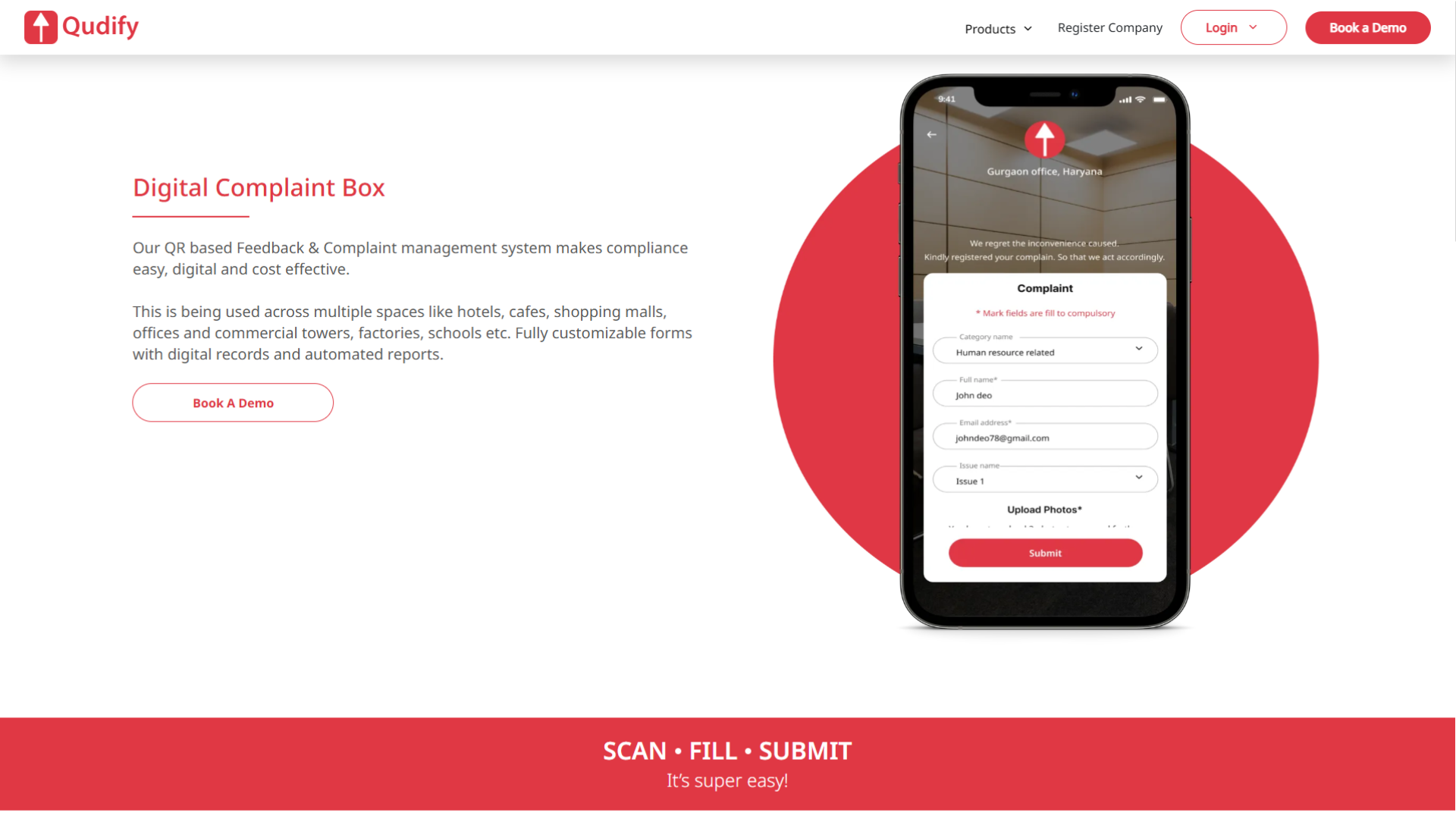
Qudify’s Feedback & Complaint Box was designed around the exact failure points above, not as a digital copy of the box, but as the system that should have sat behind it all along.
- Private, QR-based submission: Employees scan a QR code with the smartphone already in their pocket and submit from their own device. No app, no login, no queue, and no walking up to a box in front of colleagues. That single change removes the public exposure that silences most serious reports.
- Automatic routing and mailers: Every submission is recorded in real time and sent to the right owner, with automated email alerts, so nothing sits unnoticed for days.
- A visible resolution loop: Because each complaint is tracked and timestamped, issues can be acknowledged, assigned, and closed out. That follow-through is what turns a reporting channel into one people actually trust.
- Real-time dashboards and automated reports: Leadership finally sees patterns: recurring issues, problem areas, and how quickly things get resolved. That’s the difference between guessing and managing.
- White-labeled and fully customizable: Forms carry your branding and capture the fields your organisation needs, so the channel feels like part of your workplace rather than a bolt-on.
- Paperless by design: Removing physical touchpoints cuts paper, printing, and admin overhead while supporting sustainability goals, which is central to Qudify’s QR-first approach.
Consider a coworking operator that swaps the acrylic box at reception for a Qudify QR sticker on every floor. A member scans it from their desk to flag a broken AC unit. The complaint reaches facilities within seconds, the member gets an automated acknowledgement, and the operations lead can see on the dashboard that HVAC issues have spiked on the third floor three times this month. The box could never have told them that.
Qudify runs this model across offices, coworking spaces, commercial towers, hotels, and campuses, with its QR-first platform live across 500+ sites and 400+ clients. The aim is straightforward: make speaking up the easy, obvious choice, and make sure something happens when people do.
What to look for in a digital employee complaint system
Look for private or anonymous submission, automatic routing to the right owner, acknowledgement and status updates for the submitter, a complete audit trail, real-time analytics, customizable and white-labeled forms, and low-friction access such as a QR code or link that needs no app or login.
If you’re evaluating options, judge each one against the reasons the old box failed. A useful checklist:
- Frictionless, private access: Can an employee submit in under a minute, from their own phone, without downloading anything or being seen doing it?
- Confidentiality options: Does it support both anonymous and named submissions, and protect the submitter either way?
- Automatic routing: Are complaints sent straight to the right owner by category, rather than landing in one overloaded inbox?
- Acknowledgement and follow-up: Does the submitter get a confirmation and updates, so the channel doesn’t feel like a void?
- Audit trail: Is every submission timestamped, tracked, and stored for accountability and reporting?
- Analytics: Can leadership see trends, volumes, and resolution times, not just individual notes?
- Customisation and branding: Can forms be tailored to your categories and carry your identity?
- Cost and maintenance: Is it hardware-light and affordable enough to run across every location without ongoing admin?
Score any tool against those eight, and you’ll quickly separate a real system from a digital box with a nicer interface.
How to roll out a digital complaint system employees actually use
Adoption depends on trust, not technology. Launch with clear communication about how submissions are handled and who sees them, make access effortless, respond quickly, close the loop with every submitter, and share anonymised outcomes so people can see that speaking up leads to change.
The best software still fails if the culture around it repeats the old box’s mistakes. A rollout that earns trust usually follows the same pattern:
- Explain the process before the first submission: Tell employees exactly what happens to a complaint, how confidentiality works, and who reviews it. Uncertainty is what keeps people quiet.
- Put access everywhere: QR codes at entrances, desks, break rooms, and on the intranet mean the channel is never more than a scan away.
- Respond fast, every time: A quick acknowledgement signals the message landed with a human, not a void.
- Close the loop: Tell the submitter what was done, even when the answer is “we looked into it and here’s why nothing changed.” Silence after a report is the single most corrosive outcome.
- Share the wins: Publishing anonymised examples of issues that were fixed does more for participation than any launch email.
- Use the data: Review trends regularly and act on recurring themes. When employees see patterns being addressed, submissions rise instead of fading.
Digital complaint systems and compliance
A digital complaint system supports compliance by creating a timestamped, auditable record of every submission and its resolution. In India, that record helps employers and Internal Committees meet POSH Act documentation and annual-reporting duties, though it complements, and does not replace, the committee and formal process the law requires.
For Indian organisations, this matters more than it might first appear. The Sexual Harassment of Women at Workplace (Prevention, Prohibition and Redressal) Act, 2013 requires every workplace with 10 or more employees to constitute an Internal Committee, complete inquiries within defined timelines, and file an annual report with the District Officer detailing complaints received, disposed of, and pending beyond 90 days.
A paper box can’t help with any of that. It has no dates, no status, no searchable record. A digital system gives HR and the Internal Committee a clean, timestamped trail for every concern, which makes annual reporting and internal audits far less painful and helps demonstrate that a genuine redressal channel exists and is accessible. It doesn’t remove the legal obligations, and formal POSH complaints still follow the statutory route, but it removes the record-keeping chaos that trips up so many organisations.
The bottom line
The complaint box didn’t fail because your people had nothing to say. It failed because it asked them to take a risk and gave them nothing in return: no privacy, no answer, no proof anything happened. Employees are rational, so they stopped using a channel that never worked.
Fixing it isn’t about a nicer box. It’s about the system behind it: a private way in, a clear path to the right person, a visible result at the end, and a record you can stand behind. That’s what a digital employee complaint system is built to do, and what Qudify’s Feedback & Complaint Box delivers. If your box is gathering dust, treat it as your cue to book a demo and replace the box with a system worth trusting.
Frequently Asked Questions
Why don't employees use complaint boxes?
Because they don’t feel safe or effective. Employees can be seen using a physical box, handwriting isn’t anonymous, and submissions rarely lead to visible action. Once people conclude nothing will change, they stop bothering.
Are physical complaint boxes anonymous?
Not in practice. Even without a name on the slip, walking up to the box is a public act, handwriting is identifiable, and there’s no guarantee about who empties or reads it. That perceived exposure is enough to keep most people silent.
What is the difference between a suggestion box and a digital complaint system?
A suggestion box only collects. A digital complaint system collects, routes, tracks, acknowledges, and reports. The box ends when the note goes in; the system is built around what happens next.
What types of complaints do employees hesitate to report?
The sensitive, higher-risk ones: harassment and discrimination, safety hazards, ethical or financial misconduct, and problems involving a direct manager. These are exactly the concerns a channel needs to protect, and the first ones an untrusted box loses.
Is anonymous reporting better than named reporting?
Anonymous reporting gets more people to speak up, especially on sensitive issues, but it’s harder to investigate. Named reporting is easier to act on but discourages people who fear exposure. The best systems offer both and let the employee choose.
Does making a complaint box digital actually help?
Only if it adds a workflow. A plain online form fails for the same reasons a physical box does. The value comes from automatic routing, confirmation to the submitter, status tracking, and analytics, which is what a purpose-built system like Qudify provides.
How does a QR-based complaint system improve reporting?
It removes friction and exposure. Employees submit privately from their own phone, anywhere and anytime, without an app or login. Lower effort and more privacy lead to more honest, timely reports.
What features should a digital employee complaint system have?
Private or anonymous submission, automatic routing to the right owner, acknowledgements and status updates, a full audit trail, real-time dashboards, customizable and white-labeled forms, and low-friction QR or link access.
How do you get employees to actually use a complaint system?
Build trust before technology. Explain how submissions are handled, make access effortless, respond quickly, close the loop with every submitter, and share anonymised outcomes so people see that raising concerns leads to real change.
Can a digital complaint system help with POSH compliance in India?
It supports compliance by keeping a timestamped, auditable record that makes documentation and the POSH Act’s annual reporting easier for HR and the Internal Committee. It complements, rather than replaces, the committee and formal process the law requires.
Is a digital complaint box only for large enterprises?
No. QR-based systems are affordable and hardware-light; the only device needed is a smartphone employees already own, which makes them practical for MSMEs, coworking spaces, hotels, and campuses, not just large enterprises.