
Visitor Management System for Manufacturing Plants in India: The Complete 2026 Guide

Key Takeaways
- A visitor management system for a manufacturing plant tracks contractors, zones, vehicles, and materials in one gate workflow, not just a guest’s name at reception.
- India’s contract-labour registration threshold rose to 50 or more workers under the OSH Code, 2020, up from 20 under the repealed Contract Labour Act.
- Contract workers make up 40.2% of India’s formal manufacturing workforce (FY22 ASI data), and the FY23 figure rose further to 40.7%.
- India recorded 660 deaths from 742 factory and machine accidents in 2024, roughly 89 deaths per 100 accidents, a rate steady since 2018.
- Zone-based access control is a compliance requirement, not a feature, in pharma, chemical, and automotive R&D environments.
- Visitor logs now fall under India’s DPDP Rules, 2025, requiring specific consent, defined retention, and breach notification.
- Manufacturing VMS pricing in India runs roughly ₹1,500 to ₹25,000+ per location per month, with hardware and integration usually billed separately.
A manufacturing visitor management system (VMS) does everything an office VMS does, plus the contractor, zone, and material tracking a factory gate can’t function without. It captures who’s arriving, notifies the host, and logs entry and exit, but it’s built for a gate that handles contractors on multi-day work orders, transporters moving material, auditors inspecting a specific zone, and shift changes that push hundreds of people through the same door in under an hour.
It needs contractor document tracking, zone-based access control, material and vehicle logging, and audit-ready compliance records, because India’s occupier-liability law and its new data protection rules both put real weight on getting this right. Pricing runs from around ₹1,500 a month for basic QR check-in up to ₹25,000+ per location for biometric, multi-zone deployments, with hardware and integration usually billed separately.
What Is a Visitor Management System (VMS)?
A VMS replaces a facility’s paper sign-in register with a digital system that makes check-ins faster, searchable, and auditable. It gives security teams real-time visibility into who is entering and leaving, while keeping accurate visitor records.
s in current workplace data explain why room booking software integration has moved onto IT (information technology) and workplace roadmaps.
The Basic Problem It Solves
Picture a factory gate at 7 a.m. The night shift is filing out as the morning shift files in. Three transport trucks are queued to unload raw material. A contractor’s team has arrived for a scheduled equipment shutdown. An auditor is standing at the gate with no appointment logged anywhere.
A single guard with a paper register cannot answer, with any real confidence, the one question that matters most if something goes wrong in the next hour: who, exactly, is inside the plant right now. A VMS exists specifically to answer that question reliably, at any moment, without someone flipping through a logbook.
How a Manufacturing VMS Differs From an Office VMS
An office VMS is built around a single repeatable flow: a guest arrives, a host is notified, a badge is issued, the guest leaves. A factory floor adds variables an office never faces:
- A contractor arriving for a shutdown is both a person to authenticate and a user of tools and equipment that need their own gate-pass record; both have to be handled in one workflow.
- A transporter isn’t just a visitor; they’re delivering material that has to be logged against a specific goods-receipt note.
- An auditor inspecting a GMP-controlled zone needs a different level of access than a vendor dropping off stationery at the admin block.
This is the single biggest reason a generic sign-in kiosk falls short on a factory floor: it treats every entrant as the same category of person, when a manufacturing site fundamentally has several categories that all need different handling within the same gate workflow. Qudify’s guide to the different types of visitor management systems covers the office-side baseline this guide builds on top of.
Where the VMS Category Is Heading
This isn’t a niche software category chasing a small problem. The global visitor management system market is forecast to reach $3.4 billion by 2031, growing at a 12.8% compound annual rate from 2025, and Lucintel’s market analysis names chemical & petrochemical, oil & gas, and automotive among the specific verticals driving that growth, alongside BFSI and healthcare. (Estimates vary by research firm; the direction of travel is consistent even where the headline number differs.)
That’s a direct signal that industrial and manufacturing sites, not just corporate lobbies, represent a real and growing share of where this technology is being adopted. The direction of that growth matters for a plant deciding what to buy today: the market is moving away from hardware-heavy kiosks toward cloud-based, mobile-first check-in, driven by tighter data-privacy rules, a preference for touchless systems, and a push to integrate visitor data with access control rather than keeping it as an isolated log.
Why Manufacturing Plants Need a VMS More Than Offices Do
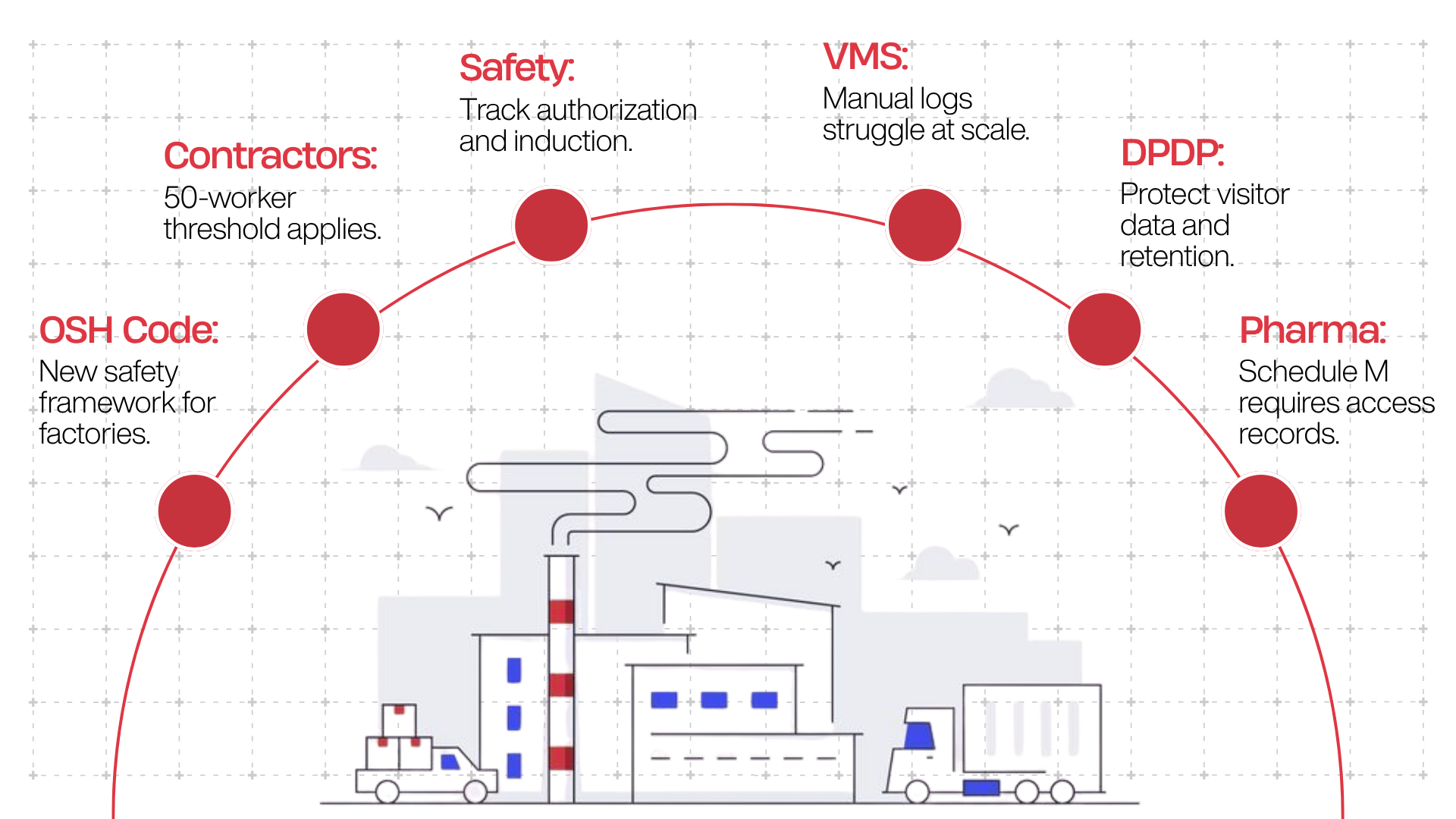
Four compounding reasons: legal liability, physical risk, gate volume and contractor mix, and data protection law.
Legal Liability Is Shifting Frameworks, Not Disappearing
For decades, the Factories Act, 1948 governed this territory. Section 7A made the occupier of a factory statutorily responsible for the health, safety, and welfare of everyone working there, a duty that extended to contract workers on-site, not just direct employees.
That framework is now mid-transition. The Occupational Safety, Health and Working Conditions Code, 2020 came into force on 21 November 2025, consolidating the Factories Act and twelve other labour statutes into a single code, with the Central Rules notified on 8 May 2026. Most states are progressively finalizing their own state-level rules through 2026.
The paperwork side has also moved online. Establishments now register and file returns through the government’s Shram Suvidha Portal, the unified system the OSH Code’s Central Rules lean on for single-window registration and inspection reporting.
One change here deserves attention because it directly affects contractor-heavy plants. The threshold for mandatory contract-labour applicability has moved from 20 workers (or 50 in some states) under the now-repealed Contract Labour Act to a uniform 50 or more contract workers under the OSH Code, with a single common establishment registration replacing the earlier separate Form I filing. A plant that sat just above the old threshold may now sit below the new one or vice versa, in states that had already raised their own limit, which changes what registration and record-keeping obligations actually apply to that specific site.
Whichever framework technically governs on a given date in a given state, the underlying obligation doesn’t change: demonstrating who was authorized to be in a specific area, and whether they completed the required safety orientation, is precisely the evidence regulators and courts look for when assigning liability after an incident.
The Physical Risk Is Real and Severe
Workers on a manufacturing floor operate around heavy machinery, hazardous chemicals, and high-voltage equipment every day, and the numbers behind that risk are hard to look past.
National Crime Records Bureau (NCRB) data shows India recorded 742 factory and machine accidents in 2024, resulting in 660 deaths nearly 89 deaths for every 100 recorded accidents. That fatality rate has stayed consistently high since 2018, even as the raw number of accidents has fallen by more than half since 2010. Fewer incidents are being reported overall, but the ones that do happen are increasingly severe.
Set against numbers like these, an unverified visitor wandering into the wrong zone stops being a minor security lapse and becomes a scenario with genuine injury potential to the visitor and to the trained workers around them who assumed everyone in that zone had the same safety orientation they did.
Manual Systems Can't Handle the Volume or the Contractor Mix
Large manufacturing plants in India, particularly Tier-1 automotive component suppliers, active pharmaceutical ingredient (API) manufacturers, and chemical processing units routinely process 200 to 500-plus gate entries a day across contractors, vendors, transporters, and staff. A single guard with a paper register cannot verify identity, check safety-induction status, and record entry and exit times at that volume without errors, delays, or both.
That volume is compounded by exactly who’s walking through the gate. Contract workers now make up 40.2% of India’s formal manufacturing workforce: 5.4 million of 13.6 million workers across 249,987 factories in FY22, per Annual Survey of Industries (ASI) data, up from 38.4% before the pandemic. The following year’s ASI figure climbed further to 40.7%. A plant isn’t tracking a handful of occasional guests; it’s tracking a workforce where two in five people on-site on any given day are contractors whose documentation, induction status, and authorized scope all need to be current and instantly checkable at the gate.
Gate traffic also doesn’t arrive evenly through the day. A plant running three shifts sees two overlapping crunches: the outgoing shift exiting while the incoming shift arrives, plus a similar spike for contractors whose work orders are tied to shift boundaries. During those windows, a single manual checkpoint becomes the plant’s real throughput bottleneck, and the pressure to “wave people through” to keep the line moving is exactly when identity checks and safety-induction verification get skipped.
DPDP Rules Now Cover Visitor Data Directly
Every visitor check-in captures personal data: a name, a phone number, a government ID, sometimes a photograph, and that data now sits squarely inside India’s data protection law. The Digital Personal Data Protection Rules, 2025 were notified by MeitY on 13–14 November 2025, with obligations rolling out on a phased timeline: some procedural provisions took effect immediately, while the substantive consent, notice, and security-safeguard requirements activate in phases through to mid-2027.
For a manufacturing plant, this carries direct operational consequences:
- Consent has to be specific and informed, not buried in a blanket sign-in form.
- Retention periods need a defined policy instead of indefinite storage on a server nobody audits.
- Breach-notification timelines now apply to a visitor log the same way they’d apply to any other personal-data breach.
No formal “DPDP-certified” badge exists for VMS vendors as of this writing, so the honest way to judge a system is on its concrete controls: consent capture, retention settings, and audit logs rather than a certification claim that doesn’t yet exist to be made.
The Compliance Framework at a Glance
Six obligations govern gate and visitor operations in Indian manufacturing today, spanning both the outgoing Factories Act and the incoming OSH Code.
Requirement | Source | What It Means for Gate & Visitor Operations |
Occupier’s/employer’s duty of care | Factories Act §7A; carried forward under the OSH Code | The establishment must ensure the health and safety of all workers, including contractors, “so far as is reasonably practicable” |
Information, instruction, and training | Both frameworks | Visitors and contractors need documented safety instruction before entering hazardous areas |
Safe access and egress | Both frameworks | Zones and routes must be tracked to confirm only authorized individuals use them |
Written safety policy | Both frameworks | The plant’s safety statement should be reflected in how the VMS gates entry, not just posted on a noticeboard |
Registration and single-window compliance | OSH Code (Central Rules, 2026) | Establishments register via the Shram Suvidha Portal; a plant’s VMS records support the accident-reporting and audit trail this implies |
Occupier’s/employer’s personal liability | Both frameworks | In the event of an incident, the person in charge can face prosecution; accurate visitor and contractor records are a direct legal safeguard |
Schedule M Adds a Pharma-Specific Layer
Regulated sub-sectors carry additional obligations on top of this baseline. Pharmaceutical manufacturers must maintain records of everyone who accesses a manufacturing area under Schedule M, and the compliance clock on this one has run out.
The revised Schedule M was notified in December 2023 and became effective for large manufacturers from 1 January 2025. The MSME deadline was extended to 31 December 2025, and CDSCO has since directed state regulators to begin risk-based inspections from January 2026, with no blanket further extension.
For a pharma plant’s gate specifically, this means every entry into a GMP-controlled zone needs a timestamped record with host authorization, and every regulatory inspector visit needs a log of exactly which areas were accessed. Given that CDSCO inspections can arrive with little notice, a plant that can produce this data instantly rather than reconstructing it from paper has a measurable compliance advantage.
Core Features a Manufacturing-Grade VMS Must Have
Seven capabilities a generic sign-in kiosk doesn’t have.
Feature | Why It Matters |
Contractor and vendor lifecycle management | Tracks licence validity, insurance, and induction status against a profile; no re-collecting documents every visit |
Safety induction and compliance acknowledgment | Timestamped record of PPE requirements and hazard awareness, completed before entry |
Zone-based access control | Different passes for GMP zones, hazardous areas, or restricted R&D; not one badge for every door |
Material and vehicle gate pass integration | Transporter and delivery movement logged in the same workflow as personnel |
Blacklist/watchlist management | A terminated contractor or flagged vendor is denied automatically, not caught by a guard’s memory |
Real-time muster and evacuation lists | An accurate on-site list generated in seconds, not reconstructed from paper |
CCTV/surveillance integration | Entry logs cross-referenced against footage during an incident investigation |
Contractor and Vendor Lifecycle Management
Given that contract workers make up over 40% of India’s formal manufacturing workforce, this is the single biggest feature gap between office and manufacturing VMS platforms. Plants typically have dozens of contractors on-site simultaneously, each working under a different scope of work: an electrical maintenance crew, a housekeeping vendor, and a shutdown team from an equipment OEM, all present on the same day under three separate contracts.
Tracking who’s present, what they’re authorized to do, and whether their safety induction is current isn’t optional best practice under Indian labour law; it’s the actual mechanism by which a plant demonstrates it met its duty of care.
A well-built system attaches documents directly to a contractor’s profile safety-induction certificates, ID proof, work permits, insurance validity so a guard sees document status before issuing entry rather than digging through a separate paper file. Expired documentation should block a badge automatically, rather than depending on a guard remembering to check an expiry date buried on page three of a folder.
For recurring vendors and long-term contractors, time-bound passes with defined validity windows remove the need to re-register the same person on every visit while keeping access auditable. A housekeeping contractor on a six-month rolling contract gets a pass that expires with the contract, not one that has to be manually revoked by someone remembering to do so.
Zone-Based Access Control
A pharma plant has GMP-controlled zones. A chemical plant has hazardous process areas where an untrained visitor is a genuine safety risk. An automotive plant has R&D sections where unauthorized access is as much an intellectual-property concern as a physical one.
A manufacturing VMS has to configure clearance at this granularity, with different digital passes tied to a visitor’s or contractor’s authorized scope, rather than one badge that opens every door on the site. This also guards against a subtler risk that’s easy to overlook: industrial espionage and unauthorized access to proprietary processes or machinery, a rising concern as manufacturing IP becomes more valuable and more digitally documented.
Qudify’s guide to integrating access control with a visitor management system walks through how this gets wired up alongside existing door hardware.
Material, Vehicle, and Delivery Logging
A plant gate isn’t only a checkpoint for people; it’s also the entry and exit point for raw material, finished goods, and every vehicle moving them. Treating personnel check-in and material movement as two separate, disconnected processes is one of the more common gaps in factory security, because it forces security staff to manually cross-reference a visitor log against a separate gate-pass register during a shift, exactly when speed matters most.
A manufacturing-ready VMS folds a transporter’s vehicle number, the driver’s identity, and the delivery note into the same gate-entry record as the person driving it. So when a security or logistics team needs to reconstruct a day’s inbound material movement for a quality hold or a discrepancy investigation, that reconstruction takes minutes instead of cross-referencing two separate paper trails kept by two different departments.
Choosing the Right Access Method for Each Zone
Most Indian manufacturing sites use a mix of access methods rather than one universal system.
Access Method | Best Suited For | Trade-Off |
QR code + mobile check-in | Main gate, high-volume daily contractor and vendor traffic | No hardware cost; depends on visitors having a smartphone |
Kiosk with ID scan and badge printing | Reception areas, formal visitor/auditor entry points | Higher upfront cost; needs device maintenance |
Biometric (fingerprint/face) + access control integration | Hazardous process areas, GMP zones, R&D sections | Strongest identity verification; highest cost and most infrastructure |
Pre-registered digital passes | Scheduled auditor or inspector visits | Requires advance coordination; smooths high-stakes visits |
For most Indian manufacturing sites, the practical pattern is a QR-and-mobile system handling the bulk of contractor and vendor traffic at the main gate; it needs no dedicated hardware and scales easily, with biometric or access-control-integrated checkpoints layered on top only at genuinely high-risk zones.
When QR-and-Mobile Isn't Enough
A QR-and-smartphone check-in quietly assumes two things that don’t hold everywhere on an Indian industrial site: reliable mobile connectivity, and a zone where using a phone is actually safe.
Many manufacturing facilities sit in industrial estates or semi-rural locations with patchy mobile coverage, and a gate check-in that depends entirely on a live data connection will fail exactly when the plant is busiest. A workable deployment needs a local or offline-capable fallback: a kiosk or gate-side device that can queue and sync check-ins once connectivity returns.
The bigger constraint isn’t connectivity at all, though it’s physical safety. Chemical, petrochemical, and oil-and-gas plants routinely have ATEX-classified hazardous zones, where flammable gases or dust are present, and an ordinary smartphone is itself a potential ignition source. Inside these zones, visitors and contractors simply cannot use a personal phone to scan a QR code. The practical answer is to complete check-in and zone authorization at a safe staging point before the hazardous boundary, with physical badges or supervised biometric checkpoints handling the actual entry into the classified zone.
Designing for India's Actual Contractor Workforce
Regional-language support and a low-friction notification channel are core requirements, not nice-to-haves.
Why English-First Design Fails on the Shop Floor
An office VMS can usually assume its visitors are comfortable filling out an English-language form on a smartphone. A manufacturing plant cannot make that assumption about its contractor and daily-wage workforce, and treating this as a minor UX detail rather than a core requirement is one of the more common reasons digital check-in adoption quietly stalls on the shop floor.
Regional-language support isn’t optional: Hindi plus the locally dominant regional language should be a baseline, not an add-on. Icon-led, minimal-text flows perform noticeably better for low-literacy users than a dense text form ever will, and for a recurring workforce, letting a guard assist with a contractor’s first registration and then issuing a simple, reusable pass removes the daily friction of a self-service form that assumes a fluency the workforce doesn’t have.
Why the Notification Channel Matters More Than It Seems
WhatsApp’s India user base runs to several hundred million people its largest national market anywhere and a dedicated visitor app, requiring a separate download and account, simply cannot match among a transient contractor and vendor population that moves between sites constantly.
A contractor scans a QR code and receives a digital pass without installing anything; a host gets an instant WhatsApp notification the moment someone checks in, removing the delay of a guard radioing a supervisor across a noisy plant floor. For a workforce that skews toward daily-wage contractors and transporters, this lower-friction channel is often the exact difference between a system that gets used consistently and one that gets quietly bypassed the moment a shift gets busy.
Rolling Out a VMS Without Disrupting Plant Operations
Switching a manufacturing gate from paper to digital carries real operational risk if it’s done carelessly; a plant can’t afford a security gap or a contractor bottleneck during the transition. A phased approach works far better than a single cutover:
- Start with the main gate, not every entry point. Digitize the highest-traffic checkpoint first, run it alongside the existing paper process for a week or two, and resolve workflow issues a guard’s phone that can’t hold a charge through a shift, a contractor category the forms don’t cover before extending to secondary gates.
- Onboard existing long-term contractors first. Getting their documentation and time-bound passes into the system before full launch avoids a chaotic first week of fresh registrations competing with day-to-day gate traffic.
- Train security staff on exception handling, not just the happy path. What happens when a contractor’s phone has no signal, or a visitor’s ID doesn’t match their pre-registration? A guard shown only the ideal-case flow will default to waving people through the moment reality doesn’t match the demo.
- Run a mock evacuation drill early, and set a firm paper-register cutoff date. Testing the muster list under real conditions surfaces zone-tagging gaps a contractor logged to the wrong zone, a visitor whose exit was never recorded while they’re still easy to fix. A firm cutoff prevents the two systems running in uneasy parallel indefinitely.
Common Mistakes Plants Make
- Choosing an office-grade VMS because it’s cheaper, then discovering it has no contractor-lifecycle tracking exactly when a regulated-industry audit demands document-level proof of induction and licensing.
- Treating safety induction as a one-time checkbox rather than a periodically renewed record, so a contractor whose induction lapsed eight months into a year-long engagement keeps getting waved through on a record that’s no longer current.
- Issuing identical access to every visitor type, collapsing the zone boundaries that hazardous or GMP areas legally require.
- Sizing the system for average daily traffic rather than the peak 30-to-45-minute shift-change window when the bulk of the day’s entries actually happen.
- Assuming a visitor log sits outside DPDP simply because it’s operational rather than customer-facing is an assumption usually corrected during an audit, not before one.
What a Manufacturing VMS Costs in India
Pricing scales with contractor-management depth, zone count, and hardware, not just headcount.
Tier | Typical Price Range | What’s Included |
Basic QR/mobile check-in | ₹1,500 – ₹5,000/location/month | Digital sign-in, visitor logs, host notifications suited to low-risk administrative gates |
Mid-tier with contractor management | ₹5,000 – ₹12,000/location/month | Contractor document tracking, safety-induction logging, blacklist management, custom forms |
Enterprise/multi-zone with biometric or access-control integration | ₹12,000 – ₹25,000+/location/month, or custom | Zone-based access, biometric checkpoints, HRMS and access-control integration, multi-site admin |
Indian VMS pricing is typically quoted per location per month, with the total cost shaped far more by hardware, integrations, and the number of zones needing separate access control than by the base software subscription itself.
Cost Factors That Catch Buyers Off Guard
- Hardware is usually billed separately from the subscription line item; a kiosk or biometric reader is a capital cost the software quote doesn’t include.
- Per-zone pricing scales fast, so a five-zone plant pays materially more than a single-gate office would on the same tier, since each zone typically needs its own access-control configuration and sometimes its own device.
- Integration costs for connecting a VMS to existing access-control or HRMS systems are often quoted as a separate one-time fee that doesn’t surface until the implementation phase, well after the initial pricing conversation.
Comparing VMS Approaches Before You Commit
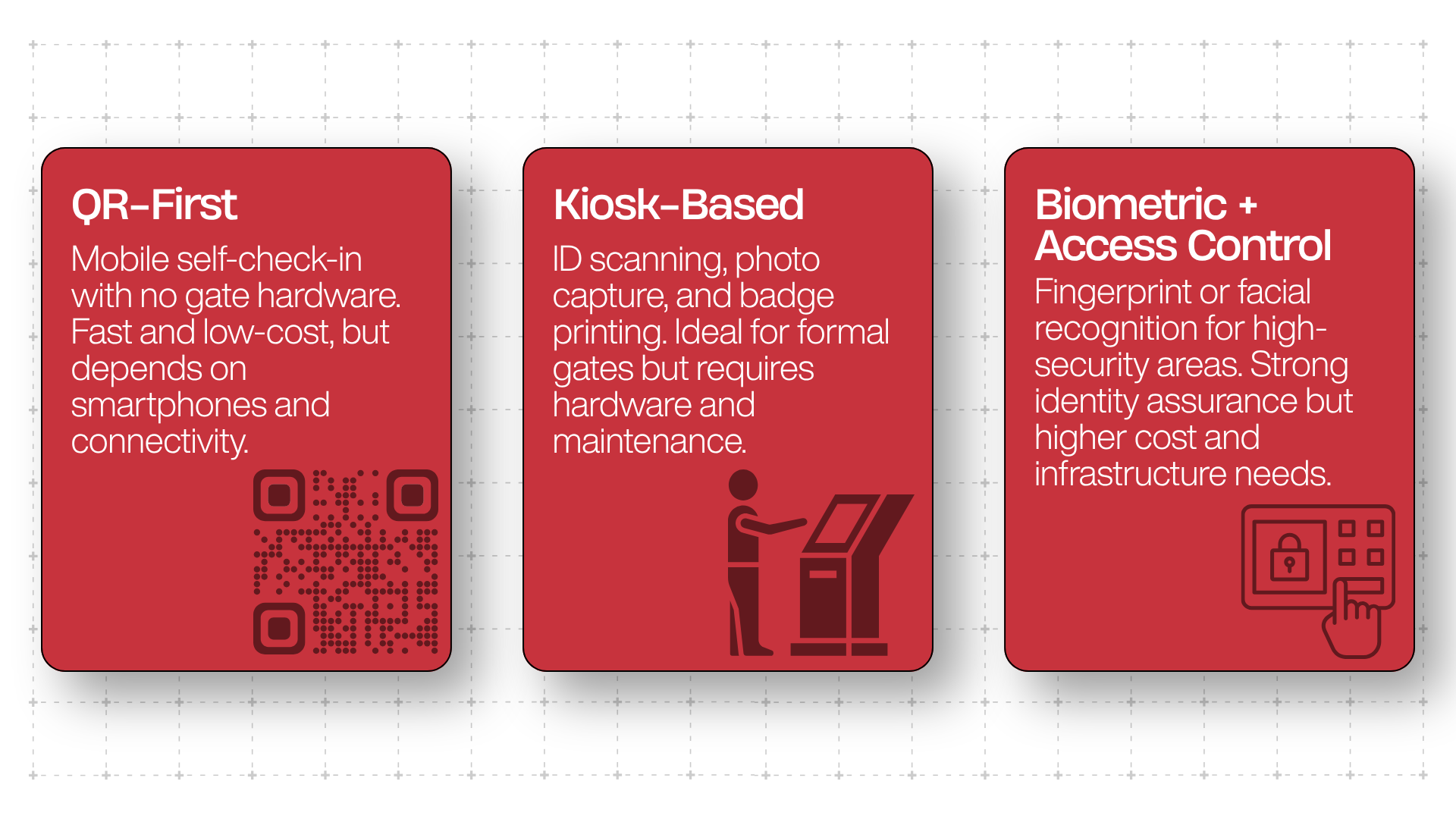
QR-first suits high-volume, lower-risk gates; kiosk-based suits formal reception points; biometric suits hazardous or restricted zones. Most Indian plants need all three, layered by zone.
- QR-First (Mobile Check-In): The visitor or contractor scans a code on their own phone; no hardware sits at the gate. This is the right default for high-volume, lower-risk entry points, where speed and zero hardware maintenance matter more than the strongest possible identity assurance. The trade-off is dependence on a working smartphone and a live data connection, which breaks down exactly in the connectivity-poor industrial estates many Indian plants sit in, and it can’t be used at all inside ATEX-classified hazardous zones.
- Kiosk-Based (ID Scan + Badge Printing): A dedicated device at the gate scans an ID, captures a photo, and prints a physical badge. This suits formal reception points and scheduled auditor visits, where a printed, wearable badge is expected. The cost is real: every kiosk is hardware that needs power, maintenance, occasional replacement, and IT support. Multiply that across five gates on a large site, and total cost of ownership looks very different from what the software subscription alone suggests.
- Biometric + Access Control Integration: Fingerprint or facial recognition tied directly into door hardware gives the strongest identity assurance available and is close to mandatory for GMP-controlled zones, hazardous process areas, and R&D sections. It’s also the most expensive and infrastructure-heavy option, and deploying it at every gate, including the low-risk administrative entrance, is over-engineering most plants end up paying for without needing.
The practical pattern most Indian plants converge on: QR-first for the main gate and general contractor/vendor traffic, with kiosk or biometric checkpoints layered on only at the specific zones that carry elevated risk. Qudify’s head-to-head comparison of leading visitor management platforms in India runs this same framework against specific named vendors, a more useful next step than comparing feature lists in the abstract.
Multi-Plant Groups: Centralized vs. Site-Level Control
Keep day-to-day administration at the plant level; roll compliance data up at the group level.
Manufacturing groups running more than one facility face a coordination problem a single-site business never has to solve: how much visitor and contractor control should sit at the corporate level versus the individual plant. Push everything to corporate, and a plant manager can’t add an urgent same-day contractor without waiting on a central admin two states away. Push everything to the plant level, and a group compliance team loses visibility into whether every site is actually enforcing its zone rules consistently.
This matters most for groups operating a mix of facility types under one umbrella, since a pharma unit, a chemical plant, and a standard assembly line each carry different risk profiles even though they report to the same corporate function. A one-size-fits-all zone policy set centrally rarely fits all three well: a pharma unit needs GMP-zone logging that a standard assembly line has no reason to configure, so forcing every site through an identical central template either over-builds the low-risk sites or under-builds the regulated one.
A Practical Checklist Before You Choose
Weigh a VMS against nine specific operating conditions before comparing feature lists:
- Does it treat contractors as a distinct category with document attachment and time-bound validity, rather than folding them into a generic “visitor” record?
- Can access be configured by zone rather than by building down to a specific hazardous area or GMP room?
- Does it integrate with your existing access-control and HR systems, or will it sit as an isolated silo someone has to manually reconcile against payroll and door hardware?
- Can it produce audit-ready reports without manual compilation, on the timeline a CDSCO or labour inspector actually gives you?
- Does it fit your gate’s real traffic pattern, tested against your actual shift-change volume, not a vendor’s demo environment?
- Does its data handling align with DPDP requirements around consent and retention?
- Has it been tested at the volume your plant actually sees, or only at a smaller reference deployment?
- Does it work when connectivity drops, or in zones where phones can’t be used?
- Is the check-in flow genuinely usable by your actual workforce, in the language they speak day to day, not just the language the sales deck was presented in?
How Qudify Fits Manufacturing Plant Requirements
Everything above is the compliance framework, feature checklist, and rollout plan a manufacturing plant works through before choosing a system. Qudify, built by Qdesq Realtech, is one way that groundwork turns into a working gate not a substitute for the zone-mapping or contractor-policy decisions covered above, but the layer that executes them daily.
Qudify takes a hardware-free, QR-and-WhatsApp approach that maps onto the specific pain points this guide covers: visitors and contractors scan a code on their own phone, hosts get instant WhatsApp alerts, and there’s no kiosk bottleneck during the shift-change crunches flagged above as the real throughput risk on a factory floor.
For the contractor-lifecycle gap this guide calls out as the biggest difference between office and manufacturing VMS platforms, Qudify’s contractor and vendor check-in workflow captures identity and visit-purpose details, supports custom forms by visitor type (auditor, contractor, transporter), and attaches digital NDAs or policy acknowledgments at check-in itself, covering the safety-induction record regulated plants need on file before entry, not after. Its types of visitor management systems guide covers wiring this into existing door hardware for the GMP, hazardous, and R&D zone restrictions treated here as non-negotiable.
For multi-plant groups weighing the centralized-vs-site-level trade-off, Qudify’s office-wise admin structure runs group-level oversight while each plant keeps its own local administration and visitor data. Automatic blacklist management addresses the watchlist gap flagged above as a common failure point, and time-bound passes remove the re-registration friction called out in the contractor-workforce section. Qudify also integrates with HROne HRMS and Sentinels Security, closing the “isolated silo” risk the checklist warns about.
Final Verdict
A visitor management system for a manufacturing plant has to do more than replace a paper register. It needs to manage contractors as a distinct, document-tracked category, enforce access by zone rather than by building, log material and vehicle movement alongside personnel, and produce audit-ready compliance records on demand, all while handling gate volumes that run into hundreds of entries a day and a workforce where two in five people on-site are contractors rather than direct employees.
The OSH Code’s occupier duty and India’s newly enforceable DPDP Rules both raise the practical stakes of getting this right, and a manual register simply cannot meet either obligation at scale. For most Indian plants, a QR-based, hardware-light system handling the bulk of daily contractor and vendor traffic with tighter, higher-security checkpoints layered on only where hazardous or restricted zones genuinely require them offers the most workable balance of speed, cost, and compliance.
Frequently Asked Questions
Is a visitor management system legally required in Indian manufacturing plants?
No law names “VMS” as mandatory by name, but the underlying obligation is real. The Factories Act, 1948, long required the occupier to ensure health and safety for everyone on the premises, including contractors. Its successor, the OSH Code, 2020, came into force on 21 November 2025 and carries that duty forward. A VMS is the practical way most plants meet the resulting record-keeping and access-control expectations.
What contract-labour threshold applies to manufacturing plants under the new OSH Code?
Fifty or more contract workers, uniformly across India, replacing the earlier 20-worker threshold under the now-repealed Contract Labour Act (which some states had already raised to 50). A single common establishment registration now covers this obligation, replacing the earlier separate Form I filing.
How is a manufacturing VMS different from a standard office visitor system?
An office VMS mainly registers guests and notifies a host. A manufacturing VMS additionally tracks contractor documentation (licences, insurance, induction status), enforces access by zone rather than by building, and logs material or vehicle movement alongside personnel.
What is zone-based access control, and why does it matter for factories?
Zone-based access control means a visitor’s or contractor’s digital pass grants entry only to the specific areas they’re authorized for a GMP zone, a hazardous process area, or an R&D section rather than the whole facility. Different areas carry different safety and confidentiality risks that a single universal badge can’t reflect.
What share of India's manufacturing workforce is made up of contractors?
40.2% as of FY22 ASI data (5.4 million of 13.6 million formal manufacturing workers), rising to 40.7% in FY23, the highest shares on record and up from 38.4% before the pandemic. That trend is why contractor-lifecycle tracking has become the core feature separating manufacturing-grade VMS platforms from office-grade ones.
Do contractors need to complete safety induction every time they visit a plant?
Most regulated plants require periodic renewal rather than a single one-time completion, particularly for long-term contractors whose certification can lapse over a multi-month engagement. A VMS that tracks induction status against a contractor’s profile makes this renewal auditable.
How does the DPDP framework affect visitor data collected at a factory gate?
Visitor check-in data names, phone numbers, and government-ID details falls under the DPDP Rules, 2025, which require clear consent notices, defined retention periods, and breach-notification procedures. The substantive obligations phase in through to mid-2027, but the direction is fixed: a visitor log is personal data and has to be treated as such.
Can a VMS track vehicles and material deliveries, not just people?
Yes. Manufacturing-grade systems typically extend the same gate-entry workflow to cover transporter and vehicle movement, since a delivery usually involves both a person and the material or equipment they’re bringing in, avoiding the reconciliation problem of maintaining separate, disconnected logs.
How much does a visitor management system cost for a manufacturing plant in India?
Basic QR-based check-in starts around ₹1,500–₹5,000 per location per month. Mid-tier systems with contractor document tracking typically run ₹5,000–₹12,000. Enterprise deployments with biometric checkpoints and multi-zone access control range from ₹12,000–₹25,000+ per location per month, or move to custom enterprise pricing.
Can a QR-code VMS work in areas with poor mobile coverage or where phones aren't allowed?
Not directly inside those zones. A QR-and-mobile system needs either a local, offline-capable fallback for poor-connectivity areas, or a staging-point handoff for zones such as ATEX-classified hazardous areas where check-in and authorization happen at a safe point before the restricted zone, with badges or supervised biometric checkpoints handling entry into the zone itself.