
Qudify vs Envoy vs Vizitor: Which Visitor Management System Fits Your Office? (2026)
Key Takeaways
- Envoy’s public page now lists only Basic (free), Premium at $362 per location, monthly billed annually, and custom Enterprise. Standard disappeared.
- Envoy does offer QR check-in with no iPad. It sits behind Premium, so the hardware-free comparison is tier-dependent, not vendor-dependent.
- Vizitor publishes ISO 27001 certification. Envoy’s legal compliance page substantiates SOC 2 Type 2, GDPR and CPRA, but not ISO 27001.
- Vendor industry pages list frameworks the product helps you meet. Legal compliance pages list what the vendor actually holds. Read the second one.
- Every platform caps entries. Envoy Basic allows 100 monthly; Vizitor Starter 300; Vizitor Premium 1,000. Check caps before comparing headline prices.
- WhatsApp host alerts are no longer a single-vendor feature. Vizitor notifies hosts by email, SMS, and WhatsApp alongside Qudify’s WhatsApp-first flow.
- Qudify publishes no pricing. Envoy and Vizitor both do. Budget-led shortlists will feel that gap before a demo call.
- Under India’s DPDP Act, your office is the Data Fiduciary, not the vendor. Board penalty powers begin November 2026.
Nobody compares these three because they look identical. They compare them because the front desk turned into a purchasing decision with a real number attached, and the number moves by an order of magnitude depending on which box you tick.
Here is that spread, verified this week. Envoy’s public pricing page lists Premium at $362 per location per month, billed annually. Vizitor lists Premium at ₹3,200 per location per month, billed annually. Qudify does not publish pricing at all. Same category, wildly different commercial models, and the feature you assumed was included is frequently two tiers up.
This comparison works through what actually separates them in 2026: what each tier really includes, how much hardware you are committing to, what the entry caps do to your effective cost, how the compliance claims hold up when you read the legal page instead of the marketing page, and what India’s DPDP timeline now demands of the buyer. Two of the three changed materially in the last year, and one widely repeated claim about Envoy’s compliance turns out not to survive contact with Envoy’s own legal documentation.
Written for whoever is building the shortlist: office and facilities managers, IT and security leads, and founders signing the invoice.
What a Visitor Management System Has to Do
A visitor management system replaces the paper register with a structured check-in: it captures visitor details, notifies the host automatically, keeps a searchable and exportable log, and depending on the platform, issues a pass, captures an NDA signature, verifies an ID, or screens the visitor against a watchlist before they reach the lobby.
All three platforms here clear that baseline. Qudify’s guide to the types of visitor management systems maps the wider category if you are still deciding on a form factor. The differences that decide a purchase show up in five places:
- Tier gating. Which of the features you assumed were standard are actually two tiers up.
- Volume caps. How many check-ins your plan allows before it stops working.
- Hardware dependency. What you buy, mount, maintain and eventually replace.
- Verifiable compliance. What the vendor holds, as distinct from what its product helps you meet.
- Cost behaviour at scale. What happens to the invoice at location two, five and ten.
Everything below traces back to those five.
The Three Platforms: Qudify vs Envoy vs Vizitor
What is Qudify?
Qudify is a QR-first workplace SaaS platform built by Qdesq Realtech Pvt Ltd in Gurugram, Haryana. Its design premise is that the only hardware a check-in needs is the smartphone the visitor already carries. Visitors scan a QR code at the entrance, complete a short form in their mobile browser with no app download, and the host is notified, commonly over WhatsApp. Check-out is another scan.
Verified capabilities: QR check-in and check-out, digital pass generation and verification, static and per-visit dynamic QR codes, pre-invites by email or WhatsApp, WhatsApp-based host approvals, KYC and Government-ID verification, custom branding, per-visitor-type forms, digital NDAs and policies, graphical analytics on a single monitoring screen, and office-wise admin permissions for multi-location and multi-tenant setups. It integrates with Google, Microsoft, Slack, and access-control systems, plus HROne (HRMS) and Sentinels (security). Alongside visitor management, it sells QR-based meeting room and desk booking, a variant built for commercial towers, and digital complaint management.
What is Envoy?
Envoy is the category’s enterprise incumbent, and its architecture assumes a staffed, equipped reception. The default is a dedicated iPad at the entrance; Envoy’s own hardware guidance recommends an iPad running iOS 10 or later, an iPad stand, and a badge printer if you intend to issue badges. Hosts are notified by email, the Envoy mobile app, and at paid tiers by SMS, Slack, and Microsoft Teams.
Envoy’s strength is depth and breadth. Badge printing with expiring and per-visitor-type badge designs, legal document workflows with pre-arrival signing, SAML single sign-on, SCIM provisioning, watchlist and ID scanning at Enterprise, access-control and guest Wi-Fi integrations, and a full workplace platform sold as separate modules: Reservations for desks, rooms and parking, Screens for digital signage, Deliveries, and Response for threat and emergency management. It also sells a dedicated multi-tenant visitor management product, which matters if you assumed multi-tenant was a gap in its lineup.
The structural catch is that Envoy’s module prices exclude a platform fee. Its pricing page states that every plan starts with the platform layer, and lists module prices with the note that they exclude that fee. Any Envoy quote should be read as modules plus platform, not modules alone.
What is Vizitor?
Vizitor is built by AIVizitor Labs Pvt. Ltd. in India and has repositioned hard enough that any comparison relying on 2024-era write-ups will describe a product that no longer exists. It runs on any major Android tablet or iPad, advertises setup in roughly 30 minutes with no proprietary hardware, and charges no setup or installation fee.
Verified capabilities across tiers: QR-code check-in, offline check-in, photo capture on entry, e-badges, custom forms and branding, pre-registration with invite links, automatic check-out, real-time visitor log, analytics and CSV export, and host notification by email, SMS and WhatsApp. Premium adds NDA and legal-document signing, physical badge printing, OTP verification, multi-location management and emergency evacuation. Enterprise adds blacklisting, overstay and outstay alerts, custom badge design, and the platform’s third-party integrations.
Vizitor also sells separate products for mailroom, space management, attendance, meeting room booking, queue management, ticketing and contractor management, which makes it the broadest module spread of the three on paper.
One correction worth making precisely, because the draft version of this article got it wrong and so do most competing comparisons: Vizitor’s integrations are not broadly available. Slack and Google directory appear on its pricing matrix at Enterprise only. A buyer on Starter or Premium should not assume directory sync.
Comparison Table
Verified against each vendor’s own pricing, billing and legal pages, 31 August 2026. “Native” means built into the product; “tier-gated” means available only from the stated tier up; “separate module” means licensed and billed on its own.
Qudify | Envoy | Vizitor | |
Vendor/origin | Qdesq Realtech, Gurugram, India | Envoy Inc., United States | AIVizitor Labs, India |
Built for | Indian offices, multi-tenant towers, regulated sites wanting phone-based check-in | Large, multi-site, compliance-driven enterprises | Cost-led SMEs and mid-market wanting one affordable workplace tool |
Published pricing | None; quote-based | Yes, per location | Yes, per location, in INR/USD/EUR/GBP |
Entry paid tier (annual) | Not published | Premium $362/location/month | Starter ₹1,600/location/month (USD view lists $36) |
Free option | Not published | Basic, genuinely free, 1 location | Free trial; pricing page shows no free tier despite marketing wording |
Monthly entry cap | Not published | Basic 100; Premium and Enterprise unlimited | Starter 300; Premium 1,000; Enterprise unlimited |
Primary check-in | QR on visitor’s own phone, no app | iPad kiosk by default | QR or tablet kiosk (iOS/Android) |
QR check-in without a kiosk | Native, core flow | Tier-gated, Premium and up | Native, all tiers |
Host alerts | WhatsApp-first, plus standard channels | Email and mobile app at Basic; SMS, Slack, Teams tier-gated | Email, SMS and WhatsApp |
Physical badge printing | Not core; digital passes instead | Tier-gated, Premium and up | Tier-gated, Premium and up |
Digital NDA capture | Native | Tier-gated, Premium and up | Tier-gated, Premium and up |
ID verification | KYC and Government-ID | ID scanning tier-gated at Enterprise, 500 scans/year included | Government-ID scan via tablet camera; OTP at Premium |
Watchlist/blocklist | Not published | Tier-gated, Enterprise | Tier-gated, Enterprise |
Facial recognition | Not published | Auto sign-in for returning visitors, Enterprise | Offered as a separate product page |
SSO / directory sync | Google and Microsoft integrations | SAML SSO and directory, Premium and up; SCIM at Enterprise | Google directory, Enterprise only |
Access-control integration | Native integration | Tier-gated, Enterprise | Not listed on pricing matrix |
Meeting-room booking | Native, QR-based | Separate module, Reservations, $5/bookable resource/month | Separate product |
Other modules | Desk booking, complaint management, tower variant | Screens $12/device; Deliveries $250/location; Response $2/user | Mailroom, attendance, queue, ticketing, contractor mgmt |
Vendor-held certifications | Not published | SOC 2 Type 2; GDPR (as processor); CPRA | ISO 27001 (annual audit); GDPR; VAPT tested |
Encryption disclosed | Not published in detail | Not itemised on legal page | AES-256 at rest, TLS 1.2 in transit |
Hardware needed for core flow | None; display a QR code | iPad, stand, badge printer typically per location | A tablet; QR flow reduces dependence |
Prices shift often. Confirm on each vendor’s pricing page before deciding. Envoy module prices exclude its platform fee.
Pricing and What It Actually Costs
Sticker price misleads in this category unless you add hardware, read the caps, and check which tier holds the feature you need.
Envoy
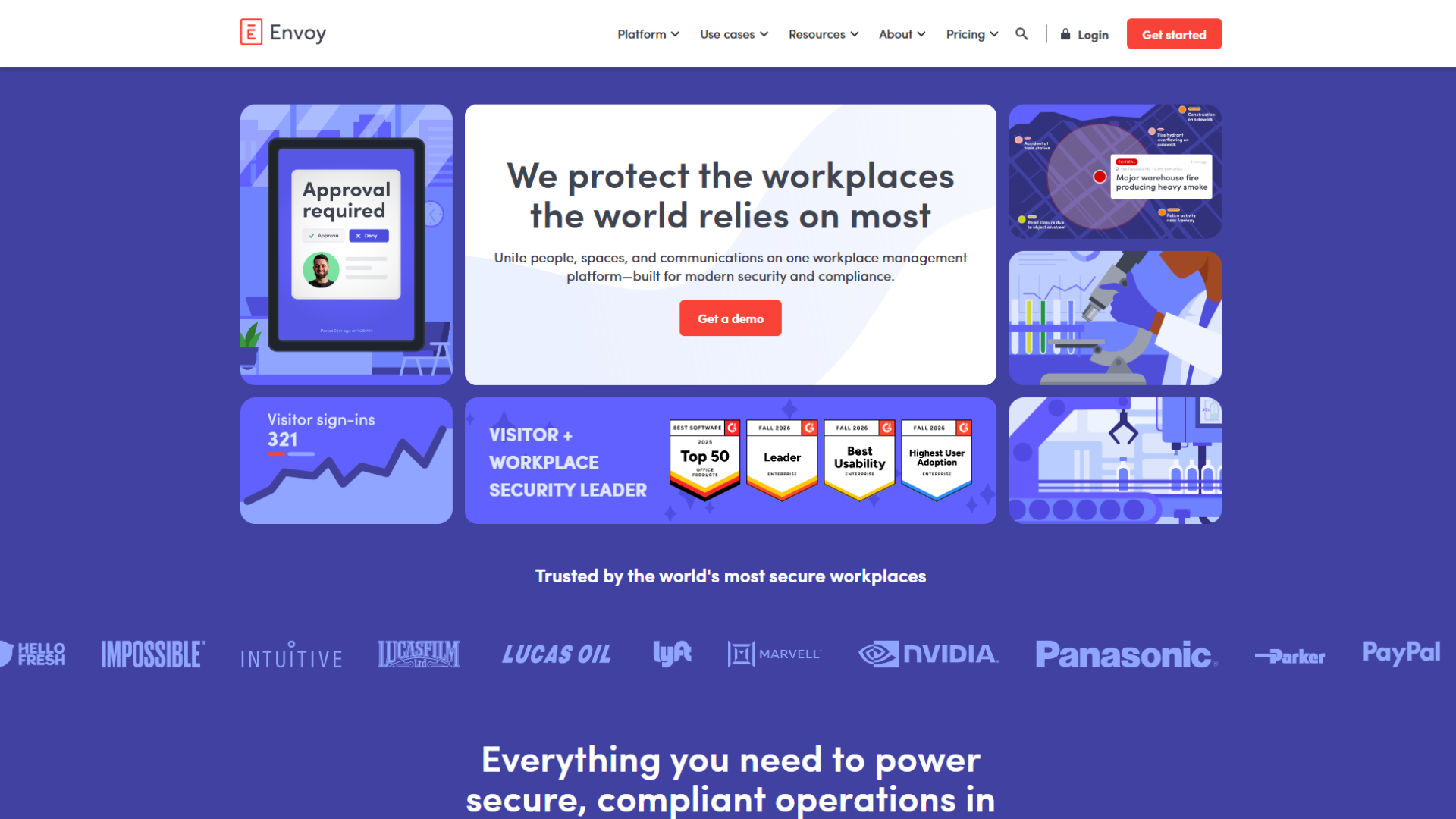
Envoy’s public pricing page currently lists three Visitors tiers, and the middle one has quietly vanished.
Tier | Price (billed annually) | Entry cap | Notable inclusions |
Basic | Free | 100 entries/month | Host notifications, real-time log, custom fields, 1 location, up to 50 employees |
Premium | $362/location/month | Unlimited | Badge printing, legal documents, visitor photos, branding, Virtual Front Desk, analytics, SAML SSO, SMS, QR check-in without an iPad, multi-location |
Enterprise | Custom | Unlimited | Blocklist scanning, ID scanning (500/year), access control, guest Wi-Fi, facial recognition, SCIM, multiple printers, emergency notifications to visitors |
A Standard tier at roughly $109 per location per month still appears in Envoy’s billing documentation, which describes a 500-visitor monthly cap and badge printing on Standard. It is not on the public pricing page. Buyers should treat Standard as available on request rather than assume it, and should be aware that if it cannot be obtained, Premium at $362 is the cheapest publicly listed tier that includes badge printing and NDA capture.
Three cost mechanics that catch people out. Envoy bills per location, and a location can be a separate entrance in the same building. All locations on an account must sit on the same plan and billing cycle. And module prices exclude the platform fee. At $362, three reception points cost $13,032 per location-year in aggregate before hardware or platform fees.
Vizitor
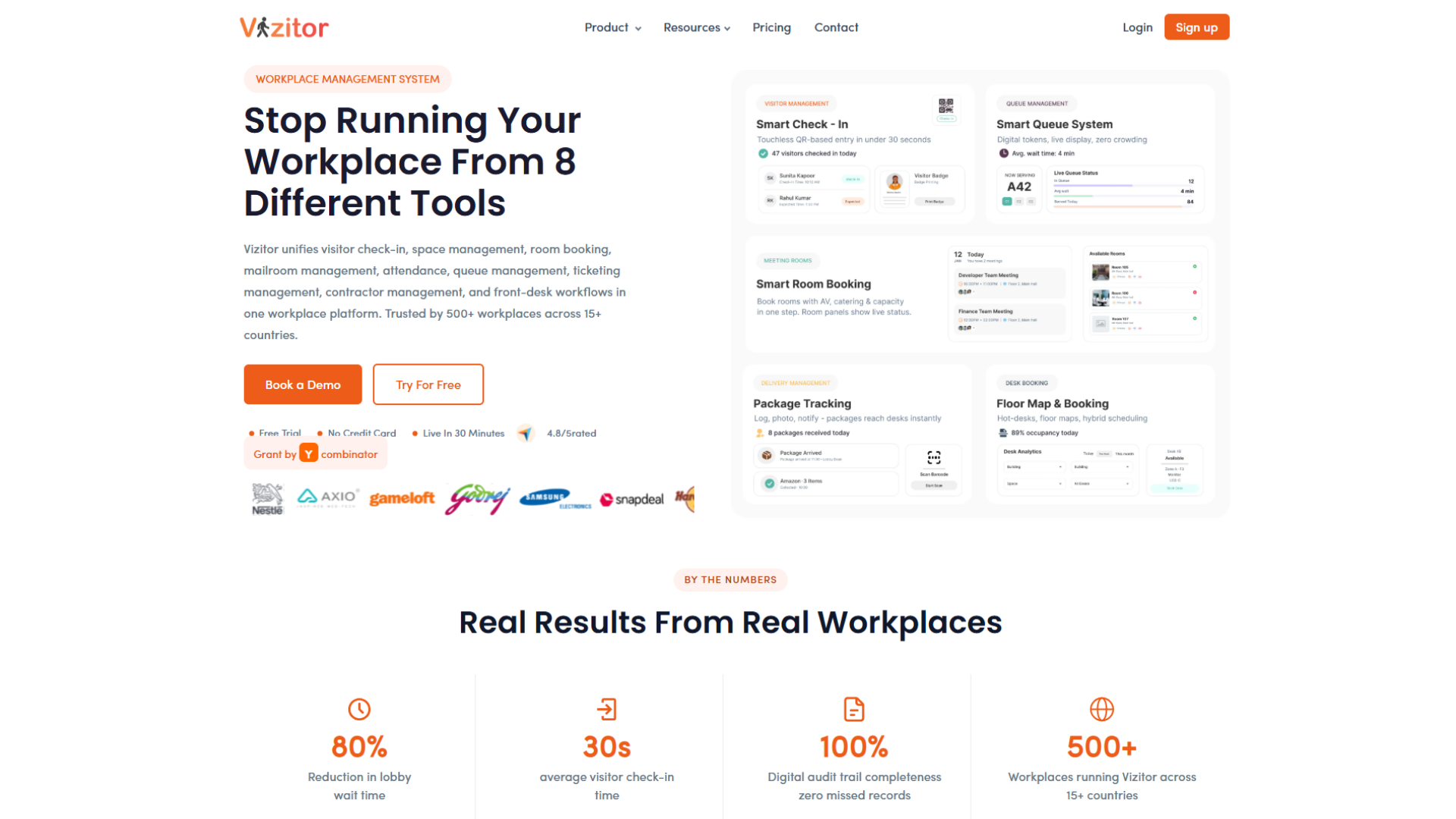
Vizitor’s pricing page defaults to INR and offers a currency toggle. The two views are not straight conversions, and Indian buyers should look at the rupee view specifically.
Tier | INR (billed annually) | Entry cap | Employees | Locations |
Starter | ₹1,600/location/month | 300 check-ins | Up to 50 | Single |
Premium | ₹3,200/location/month | 1,000 check-ins | Up to 200 | Multiple |
Enterprise | Custom | Unlimited | Unlimited | Unlimited |
Vizitor’s USD marketing lists the same tiers at $36 and $72. At $72 per location per month, Premium works out around $864 per location-year, roughly a fifth of Envoy Premium’s $4,344. Against the rupee price of ₹38,400 per location-year, the gap is wider still.
One caveat to state plainly, because Vizitor’s own pages are inconsistent: its marketing landing page advertises a “Free Plan” with a QR e-pass, while the pricing page shows no free tier and the FAQ describes the free option as a trial with full access. Treat free as a trial until Vizitor confirms otherwise in writing.
Qudify
Qudify prices on subscription and quotes for the deployment. That is a genuine transparency gap against two competitors who publish, and a budget-led shortlist will notice it.
What is verifiable is the cost structure rather than the number. With no required iPad, stand or badge printer for the core QR and WhatsApp flow, hardware procurement, maintenance and the replacement cycle drop out of the calculation. Envoy’s own guidance is that each location typically needs its own iPad, stand and printer; industry cost guides put per-site hardware anywhere from a few hundred to over a thousand dollars, plus consumables. For a ten-site rollout, that is the difference between distributing ten QR codes and procuring ten hardware sets. Ask for a quote scoped to your location count and expected monthly volume, and ask what happens to price at location eleven.
Check-In and Hardware: A Correction Most Comparisons Miss
The tidy story is that Envoy needs iPads and the Indian challengers do not. That story is now wrong, and it is worth being precise about why.
Envoy’s Premium tier explicitly includes signing in by scanning a QR code with no iPad required. So Envoy supports hardware-free check-in. What it does not do is offer that at the free tier, which means the hardware question is really a tier question: you can run Envoy without a kiosk if you are paying $362 per location per month.
Vizitor sits in the middle. It runs a QR touchless flow on all tiers, but its own FAQ answers the hardware question with “just a tablet,” and its ID scanning uses the tablet camera. Vizitor reduces hardware dependence rather than eliminating it.
Qudify is the only one of the three where the core flow assumes no shared device at all: a printed QR code at the entrance, and every visitor uses their own phone.
What this means in practice. For a high-traffic entrance, the number that matters is not whether a kiosk exists but how many visitors can check in at once. Phone-based flows scale with the number of visitors. Kiosk flows scale with the number of kiosks you bought. Envoy allows unlimited paired iPads per location to address exactly this, which works but multiplies hardware.
One caveat applies to every phone-first system, including Qudify’s. Not every visitor arrives with a charged phone, mobile data, or the confidence to work a QR flow unassisted. In government, healthcare, and elderly-heavy settings, a staffed desk is the kinder fallback. Ask any QR-first vendor how assisted check-in works at the desk, and if the answer is vague, that is your answer. Qudify’s walkthrough of QR check-in for office managers covers how static and per-visit dynamic codes differ in practice.
The India Layer: DPDP Is Now a Buying Criterion
For Indian buyers, this section outranks every feature comparison above, and the timeline has tightened since most articles on this topic were written.
India’s Digital Personal Data Protection Rules were notified in November 2025, activating the DPDP Act 2023 on a staged schedule:
Phase | From | What changes |
Phase 1 | November 2025 | Data Protection Board of India constituted; definitions operative; complaints possible |
Phase 2 | November 2026 | Board gains power to inquire and levy penalties; Consent Manager registration opens |
Phase 3 | May 2027 | Full compliance required: notice, consent, data-principal rights, retention, transfers, breach obligations |
Two implications for anyone signing a VMS contract this quarter.
First, Phase 2 is roughly ten weeks away. The Board’s penalty powers arrive in November 2026, six months before the full-compliance date. A system procured now should already be capturing consent properly rather than being retrofitted in 2027.
Second, and this is the part vendors rarely volunteer: under the DPDP Act, your office is the Data Fiduciary. The software vendor is a processor. Legal responsibility for lawful consent, retention limits, and deletion sits with you. The structure mirrors Envoy’s GDPR disclosure exactly, where Envoy identifies itself as processor and the customer as controller. Buying a compliant-sounding tool does not transfer the obligation.
Practically, that means four things belong on your evaluation checklist regardless of which platform wins: consent captured at or before the point of collection, configurable retention with actual deletion, exportable audit trails, and breach-notification support, since the Act requires notification within 72 hours with no materiality threshold. Maximum penalties reach ₹250 crore per instance for failure to take reasonable security safeguards. If you run a school, note separately that data of anyone under 18 requires verifiable parental consent.
No “DPDP-certified” vendor label exists, whatever a marketing page implies. Qudify’s fact-checked comparison of visitor management systems in India goes deeper on what readiness looks like in practice, and on why contactless check-in became close to a default in Indian offices.
Analytics, Admin and Multi-Location Control
The administrator’s question is what value you extract from visitor data after check-in.
Qudify centres its admin experience on a single real-time screen with graphical analytics and live occupancy across connected locations, plus office-wise permissions. That design suits a facilities team overseeing several sites, and it is the specific reason multi-tenant towers adopt it: one system for fifteen tenants instead of fifteen systems.
Envoy goes furthest at scale, with global views across locations, the ability to copy settings to new locations, location grouping, globally managed sign-in flows, and an activity log of setting changes at Enterprise. Visitor data can also sit alongside Reservations and Deliveries data if you have bought those modules. Note that visitor analytics itself is tier-gated: Envoy Basic does not include it.
Visitor reporting is broad across its modules and export-ready, with per-location retention and check-in rules configurable independently, which is a real advantage for organisations operating across jurisdictions with different data laws.
Whichever you pick, confirm the same four things: real-time visibility across all sites from one screen, exportable logs for audits and drills, host-response tracking so you know whether alerts get acted on, and historical trends for staffing and space planning.
How to Choose
Work through these before the demo. The answers usually point at one platform faster than a feature grid will.
- Monthly visitor volume: Then check it against the cap, not the price. Envoy Basic stops at 100 entries; Vizitor Starter at 300. Exceeding a cap on Envoy Basic locks admins out of the dashboard until the month resets.
- Location count now, and in two years: Every platform here bills per location. A tool that is comfortable at one site can become the largest line item at ten.
- Which features you actually need, and which tier holds them: Badge printing, NDA capture, SSO, watchlist and ID scanning are gated differently by each vendor. Build your shortlist from the tier that contains your must-haves, not the entry price.
- Hardware appetite: Do you want to own, mount, maintain and replace kiosks and printers, or keep reception device-free? Budget consumables, not just capital.
- Notification channel. In India, WhatsApp alerts clear visitors faster than email that sits unread. Qudify and Vizitor both support it. Elsewhere, Teams or SMS may fit better.
- The certificate your procurement process actually asks for. SOC 2 and ISO 27001 are not interchangeable. Find out which one your questionnaire names before you shortlist on “enterprise-grade.”
- Data residency and retention. Ask where data is stored, whether it is encrypted at rest and in transit, and whether retention periods are configurable with real deletion.
- DPDP obligations. Confirm consent capture, retention controls and audit export, and accept that your organisation carries the Data Fiduciary obligation.
- Assisted check-in. If your visitors skew older, less digitally confident, or arrive in groups, ask specifically how someone without a working phone gets in.
- Integration depth. Only matters if you will actually use it. If you are not running SSO today, do not pay for a tier that exists to provide it.
A short pilot at one location, run through a real morning rush, surfaces friction no sales demo will. It remains the single most useful step before committing.
Which Platform Fits Which Business
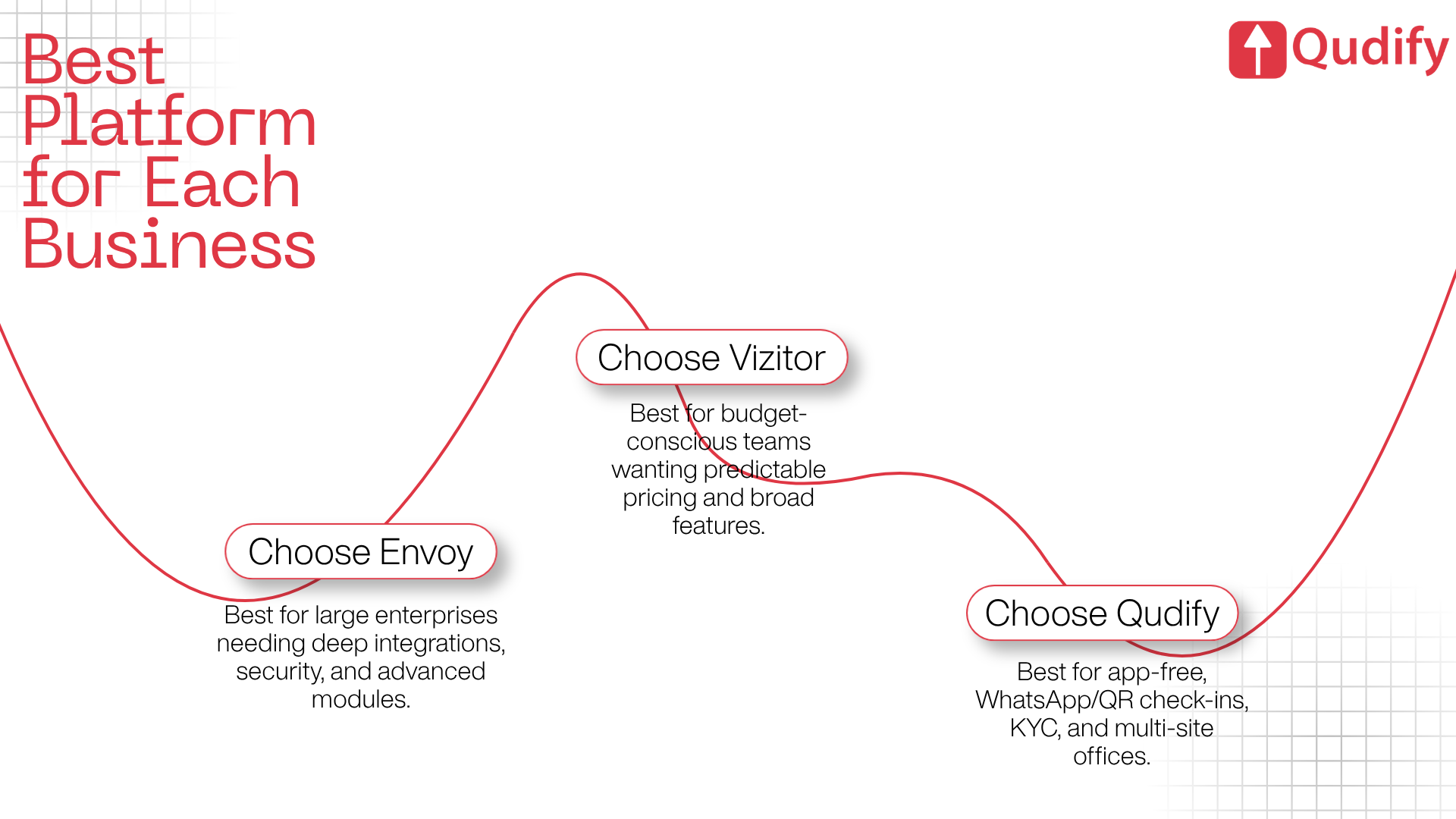
Choose Envoy if you are a large or multinational enterprise whose procurement process names SOC 2, your stack already runs on directory sync, SSO and e-signature tools, you need watchlist screening or ID scanning, and your budget absorbs per-location subscription plus hardware plus platform fee at scale. Nothing else here matches its integration depth or its module breadth across desks, rooms, parking, signage, deliveries and emergency response. It is built for that buyer and priced for them.
Choose Vizitor if budget leads the decision and you want published, predictable per-location pricing. Its ISO 27001 certification, AES-256 encryption and VAPT testing are unusually well documented for its price point; its INR pricing is materially friendlier for Indian buyers than its dollar list, and its module spread across mailroom, attendance, queue, ticketing and contractor management is the broadest of the three. Watch the check-in caps and remember that integrations are Enterprise-only.
Choose Qudify if you want contactless, app-free check-in with no reception hardware in the core flow, your visitors are comfortable with WhatsApp and QR codes, you need KYC or Government-ID verification, and you are running a multi-tenant tower or several sites where per-location onboarding needs to stay simple. It is the only one of the three whose visitor flow assumes no shared device at all, and room booking sits in the same platform rather than a separately licensed module. Explore the Qudify visitor management platform and its meeting room and desk booking product to see both flows.
The Verdict
There is no universal winner here, and any article claiming one is selling something.
Envoy earns its premium at the top of the market. Its module breadth, integration ecosystem, and SOC 2 Type 2 report are real, and for a regulated multinational those are decisive. The honest caveats are that the entry paid tier is now $362 per location per month with Standard off the public page, that module pricing excludes a platform fee, and that several frameworks its industry pages associate with the product are enablement rather than vendor certification.
Vizitor is the value leader and deserves more credit than the category gives it. Published pricing, an ISO 27001 certificate, documented encryption and penetration testing, and a genuine QR flow on every tier make it a serious SME choice rather than a budget compromise. Its limits are the check-in caps and Enterprise-gated integrations.
Qudify’s ground is specific and defensible rather than universal: Indian and multi-tenant workplaces that want WhatsApp-native, contactless check-in with KYC and Government-ID verification, no reception hardware to own, and room booking in the same system, without paying for enterprise machinery they will not use. Its weaknesses are equally specific. It publishes neither pricing nor a formal security certification, and buyers for whom either is non-negotiable should press on both before shortlisting.
It sits closest to Vizitor in approach. The choice between them usually comes down to emphasis: Qudify’s phone-only flow, KYC verification and tower focus against Vizitor’s published pricing, ISO certification and wider module spread. Weigh both against how your front desk actually runs at 9:30 on a Monday.
Frequently Asked Questions
Which is better, Qudify, Envoy or Vizitor?
It depends on constraints. Envoy suits large regulated enterprises needing SOC 2, deep integrations and watchlist screening, at $362 per location monthly. Vizitor suits budget-led SMEs wanting published pricing and ISO 27001. Qudify suits Indian offices and multi-tenant towers wanting phone-only QR and WhatsApp check-in with KYC verification and no reception hardware.
How much does Envoy visitor management cost?
Envoy’s public pricing page lists Basic free with 100 entries per month, Premium at $362 per location per month billed annually, and custom Enterprise pricing. A Standard tier near $109 appears in Envoy’s billing documentation with a 500-visitor monthly cap but is not publicly listed. Module prices exclude Envoy’s platform fee, and hardware is additional.
Do visitor management systems require an iPad or kiosk?
Not necessarily, but it varies by tier. Envoy’s default setup uses an iPad, stand, and badge printer, though its Premium tier includes QR sign-in with no iPad required. Vizitor runs QR check-in on every tier but describes a tablet as its hardware baseline. Qudify’s core flow runs entirely on the visitor’s own phone.
Is Vizitor really free?
Vizitor’s marketing pages advertise a free plan, but its pricing page lists only Starter, Premium, and Enterprise, and its FAQ describes the free option as a trial with full access and no credit card required. Treat it as a trial and confirm the terms in writing before relying on a permanently free tier.
Which visitor management system has the best security certifications?
They differ rather than rank. Envoy’s legal compliance page substantiates SOC 2 Type 2, GDPR as a data processor, and CPRA. Vizitor publishes ISO 27001 certification with annual independent audits, plus VAPT testing and AES-256 encryption. Neither claims the other’s certification, so match the certificate to what your procurement questionnaire actually names.
Who is responsible for DPDP compliance, the office or the software vendor?
The office. Under India’s DPDP Act, the deploying organisation is the Data Fiduciary and the software vendor is a processor, so legal responsibility for consent, retention and deletion stays with you. Board penalty powers begin November 2026, and full compliance is required from May 2027. No “DPDP-certified” vendor label exists.
Which visitor management system is best for Indian offices?
Prioritise WhatsApp host alerts, QR check-in without an app download, Government-ID or KYC verification, and configurable retention supporting your DPDP obligations. Qudify and Vizitor are both India-built and meet these criteria; Qudify leans into WhatsApp approvals and multi-tenant towers, while Vizitor offers published INR pricing that undercuts its own dollar rate.
Is a hardware-free visitor management system less secure than a kiosk?
Not inherently. Security depends on how visitor data is stored, encrypted, retained, and monitored rather than on the check-in device. Removing a shared kiosk removes one exposure surface, while shifting attention to mobile data handling. Ask any vendor where data is stored and whether it is encrypted both in transit and at rest.