
How Digitising Visitor Logs Improves Security and Compliance
Key Takeaways
- A paper visitor book is a live data-protection weakness, not a formality. Because previous entries remain visible, it violates the confidentiality principle shared by all major privacy laws.
- Digitising turns a liability into evidence. A digital log records identity, time, host approval, consent, and deletion of the exact things an auditor asks to see.
- The stakes are real and rising. IBM’s 2025 Cost of a Data Breach Report put the global average breach at USD 4.44 million, with human error behind 26% of breaches. Under India’s DPDP Act, failing to keep reasonable security safeguards can draw penalties of up to ₹250 crore per instance.
- One digital system satisfies many frameworks at once. Encryption, access control, retention limits, consent capture and a tamper-resistant audit trail map cleanly onto DPDP, GDPR, HIPAA, ISO 27001, SOC 2 and sector rules.
- Going paper does not remove your obligations. Both DPDP and GDPR are technology-neutral and apply to manual records too. The real choice is compliant digital versus non-compliant paper.
If your reception still runs on a paper sign-in book, you are looking at the single most overlooked data-protection gap in the building. Not the firewall. Not the laptops. The open book on the front desk, where every arriving visitor can read the name, company and phone number of everyone who signed in before them.
That is not a filing inconvenience. It is a repeated exposure of personal data, dozens of times a day, and it sits squarely inside the same privacy laws that govern your CRM and your HR system. India’s Digital Personal Data Protection (DPDP) Act, the EU’s GDPR, HIPAA, ISO 27001 and SOC 2 all treat controlled, protected access records as a genuine security control and a visible logbook fails that control by design.
The good news is that this is one of the fastest compliance wins available to any organisation. Digitising the visitor log doesn’t just make check-in quicker; it changes what the log is. A paper book proves almost nothing to an auditor. A digital record proves who was on-site, when, who approved them, what they consented to, and when their data was removed. That shift from an unverifiable artefact to a defensible audit trail is the whole argument for going digital, and it’s what this guide walks through.
The Compliance Blind Spot at the Front Desk
Most organisations spend heavily on endpoint protection and identity management, then hand every visitor a shared pen and an open register. The moment someone writes their name, company, host and arrival time, you are collecting and storing personal data, and every obligation that applies to your digital systems applies to that page.
Physical entry is also where a surprising share of security incidents begin. Auditors reviewing physical-access controls repeatedly flag missing or ambiguous sign-in records, and under ISO 27001 visitor logs are one of the most common sources of findings. The front door is a control, and regulators increasingly treat it as one.
Under India’s DPDP Act specifically, the exposure is easy to see. When the next visitor glances at the open book and reads the details of everyone before them, that is an unauthorised disclosure of personal data. The law doesn’t care that the medium is paper; it cares that personal data was left accessible to people with no right to see it.
What a Data Breach Actually Costs
Compliance spending is ultimately risk spending, so it helps to ground the “why” in numbers.
According to IBM’s 2025 Cost of a Data Breach Report, the 20th edition of the benchmark study, conducted independently by the Ponemon Institute across roughly 600 breached organisations, the global average cost of a breach was USD 4.44 million in 2025. That figure fell 9% year on year (the first decline in five years, driven largely by faster AI-assisted detection), yet the picture is uneven: the average US breach hit a record USD 10.22 million, India was among the minority of countries where costs actually rose, and healthcare remained the costliest sector for the 14th consecutive year at USD 7.42 million.
Two findings are directly relevant to visitor management. First, human error accounted for 26% of breaches; the category in which a manual, pen-and-paper process lives. Second, organisations still took an average of 241 days to identify and contain a breach, even at a nine-year low. When an incident involves a physical intrusion or an insider, the first question investigators ask is simple: who was in the building, and when? A paper logbook answers slowly, incompletely and unverifiably. A digital log answers in seconds, with a timestamped record.
These are industry-wide averages, not a forecast for any single organisation; treat them as directional context for the risk a weak physical-access control carries.
The regulatory downside is just as concrete. Under GDPR (General Data Protection Regulation), serious infringements can draw fines of up to €20 million or 4% of global annual turnover, whichever is higher. Under India’s DPDP Act, the Schedule sets the highest penalty up to ₹250 crore (roughly USD 30 million) per instance, for failing to implement reasonable security safeguards to prevent a personal data breach, and the law provides no cure period before penalties apply. A logbook that leaves personal data in plain sight is not the kind of processing that reads well in an investigation.
Seven Ways a Paper Logbook Fails an Audit

The paper book feels low-tech and therefore low-risk. It is neither. Here is where it breaks down against modern data-protection standards.
# | Failure mode | Why it fails compliance |
1 | Exposed data | Every visitor can read the names, companies and arrival times of those before them a repeated exposure event, often many times a day. |
2 | No access control | Anyone who walks past reception, or picks the book up, can read or photograph the whole record. There is no “authorised personnel only.” |
3 | No enforceable retention | Old books pile up in drawers indefinitely, breaching the principle that data be kept no longer than necessary. |
4 | No selective deletion | If a visitor asks to have their data erased, you cannot remove one entry without destroying the whole page. |
5 | Weak or absent consent | It is difficult to reliably present a privacy notice and capture explicit consent on a paper sheet. |
6 | No audit trail | You cannot prove when a record was created, who viewed it, or when it was destroyed exactly what an auditor asks for. |
7 | Physical loss and theft | A book can be lost, photographed or stolen, handing an outsider the details of everyone who signed it. |
The exposure problem is well documented. When the visitor-management vendor Proxyclick (now Eptura Visitor) surveyed 2,000 office workers across the US and UK, roughly six in ten admitted to reading the names of visitors who had signed in before them. That is a confidentiality failure built into the format; “discreet strips” and peel-off labels don’t fully fix it.
And going paper does not put you out of scope. Both DPDP and GDPR are deliberately technology-neutral; protection applies to manual processing as much as to automated systems. The choice isn’t “regulated digital versus unregulated paper.” It’s “compliant digital versus non-compliant paper.”
The Threats a Paper Log can't Catch
Compliance frameworks demand visitor records because uncontrolled physical entry is a live attack vector, not for paperwork’s sake. A paper book is blind to three of the most common threats.
Tailgating:
An unauthorised person simply follows an authorised one through a secured door. A signature in a book does nothing to deter this. A digital VMS paired with a visible digital pass and an instant host notification makes an unbadged, unlogged person conspicuous rather than invisible.
Impersonation:
A paper log accepts whatever name a visitor writes and has no way to confirm it. Digital check-in can require pre-approval, issue a verifiable pass, and confirm the visit against an expected-guest list the difference between recording a claim and verifying it.
Insider incidents and after-the-fact investigation:
When something goes missing, the investigation hinges on reconstructing who was present. A paper book offers a smudged, potentially altered page. A digital log gives an exact, exportable sequence of who entered, when, who approved them and when they left.
There is a safety dimension too. Because a digital system holds a live on-site roster, it doubles as a real-time headcount during a fire drill or genuine emergency, where a paper book is always hours out of date. Compliance, security and duty of care point the same direction.
What the Major Frameworks Expect at the Door
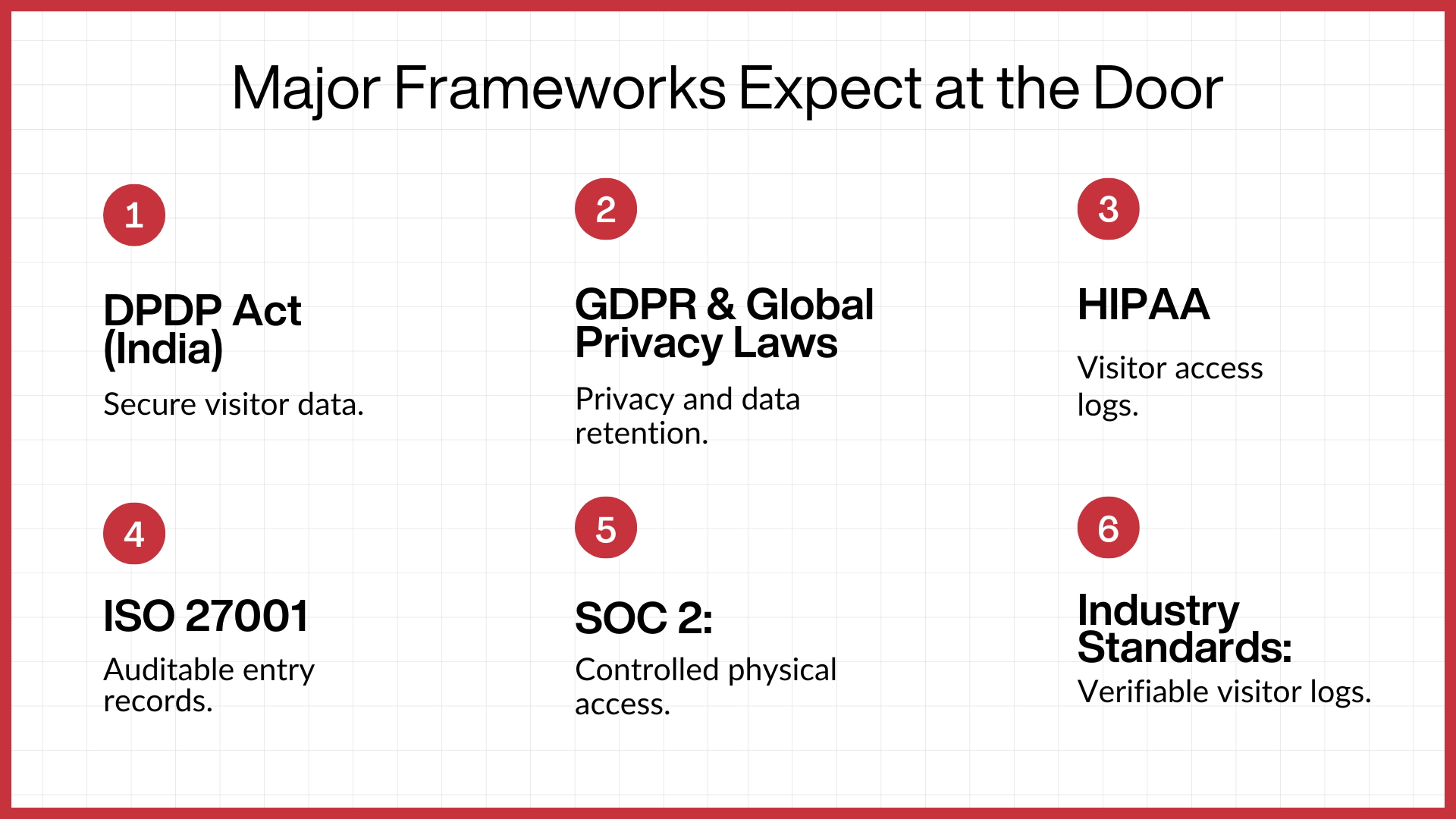
Different regulations use different language, but they converge on the same demand: know who is in your facility, control and record their access, protect that record, and be able to produce it on request.
Here is how that plays out framework by framework, starting with the one that matters most for Indian organisations.
DPDP Act, 2023 (India)
The DPDP Act is India’s first comprehensive data-protection law, and it treats visitor data like any other personal data. Section 8(5) requires every Data Fiduciary to implement reasonable security safeguards to prevent personal data breaches, and the DPDP Rules 2025 (notified 13 November 2025) spell out a baseline that “shall include” measures such as encryption, access controls, and retention of access and processing logs for at least one year. Section 12 gives individuals the right to erasure, and Rule 14 requires erasure requests to be addressed within 90 days.
A shared paper register struggles against all of this. It has no access control, no enforceable retention, no way to delete one person’s entry, and no audit trail to demonstrate the safeguards you claim. The Act also applies extra-territorially and makes the Data Fiduciary liable even when a processor causes the breach, so “our security vendor handles it” is not a defence. With full substantive compliance due by 13 May 2027 and no grace period once penalties apply, closing the front-desk gap now is a sensible early move.
GDPR (and CCPA, LGPD, PIPEDA)
GDPR sets principles that apply directly to visitor data. Article 5(1)(f) the integrity and confidentiality principle requires personal data to be processed with appropriate security, including protection against unauthorised access, which a shared logbook cannot meet. The same article’s storage-limitation principle says data must not be kept longer than necessary. Article 17 gives individuals the right to erasure, and organisations must generally respond within one month.
A digital VMS addresses each principle in turn: private, one-at-a-time entry so no visitor sees another’s details; encrypted storage restricted to authorised staff; consent capture against a privacy notice; and a searchable record that makes access, rectification and erasure requests straightforward. Note that “GDPR-compliant” is not a badge a product can simply wear; compliance depends on how you configure retention, consent and access. A good platform gives you the switches; your data-protection policy decides how they’re set.
HIPAA (US Healthcare)
For US healthcare entities and the many Indian IT, BPO and GCC teams that handle US patient data, visitor logging is part of the HIPAA Security Rule’s physical safeguards. The Facility Access Controls standard (45 CFR § 164.310(a)(1)) requires policies that limit physical access to systems housing electronic protected health information, and the Access Control and Validation Procedures specification (§ 164.310(a)(2)(iii)) explicitly names visitor control. The Audit Controls standard (§ 164.312(b)) requires mechanisms to record and examine activity in systems that use ePHI — the same logging mindset a digital visitor trail extends to the physical door. HIPAA also carries a long documentation obligation: access records should generally be retained for at least six years (§ 164.316(b)(2)).
ISO 27001:2022: Annex A 7.2, Physical Entry
ISO 27001 is where the “log everyone” expectation is most explicit. Annex A control 7.2 (Physical Entry) requires organisations to secure entry points so only authorised people reach areas holding information assets, and to record entry and exit for staff, contractors and visitors alike. Auditors increasingly favour digital logs over paper precisely because paper exposes previous entries. What an auditor wants is a timestamped, tamper-resistant record that maps every access event to a named person, a specific area and approval evidence a paper book cannot produce. (ISO standards are copyrighted, so this is paraphrased from public implementation guidance, not the standard’s text.)
SOC 2: The Physical Access Criterion
For SaaS and technology companies chasing enterprise deals, SOC 2 is often the gating requirement. Its Trust Services Criteria include physical access controls (commonly referenced around criterion CC6.4), under which an auditor expects physical access to facilities and sensitive areas to be restricted to authorised personnel and logged. A digital visitor log gives your assessor exportable evidence instead of a box of sign-in sheets.
Sector-Specific Regimes
Several industry regimes make verifiable visitor records effectively mandatory. In manufacturing and supply chain, customs-trade programmes such as C-TPAT expect documented control over who enters facilities and how they’re verified. In food and beverage, FSMA rules push facilities to control and document site access as part of intentional-adulteration defence. In defence and aerospace, ITAR requires controlling and recording access to controlled-technology areas. In payments, PCI DSS Requirement 9 calls for restricting and logging physical access to cardholder-data environments and distinguishing visitors from personnel. The common thread: every one of these wants an auditable, retrievable access record.
Framework-to-Capability Summary
Framework | What it expects at the door | Digital VMS capability that supports it |
DPDP Act (India) | Reasonable safeguards, access control, log retention (≥1 yr), erasure within 90 days | Private entry, encryption, access-controlled records, consent capture, search-and-delete |
GDPR / CCPA / LGPD | Confidentiality, data minimisation, retention limits, right to erasure | Private entry, encryption, auto-purge on schedule, consent capture, searchable records |
HIPAA | Visitor control, access validation, audit controls, 6-year record retention | Verified check-in, host approval, retention rules, exportable logs |
ISO 27001 A.7.2 | Record entry/exit; digital preferred; tamper-resistant evidence | Timestamped logs mapped to person, area and host |
SOC 2 (CC6.4) | Restrict and log physical access to sensitive areas | Access-controlled records, exportable audit evidence |
C-TPAT / FSMA / ITAR / PCI DSS | Documented, retrievable site-access control | Verified visitors, digital passes, retrievable per-visit records |
How Digitisation Actually Improves Compliance
“Go digital” is only useful if you know which control each capability satisfies. The compliance gains follow structurally from how digital records work.
A tamper-resistant audit trail is the single biggest shift. Every check-in, check-out and record change is timestamped and logged, turning “we think we’re compliant” into “here is the evidence”, exactly what DPDP’s accountability model, HIPAA audit controls, ISO 27001 and SOC 2 all reward.
Access control over the record itself means visitor data is encrypted and visible only to authorised staff, not to the next person in the queue. That directly satisfies the confidentiality principle a shared book violates by design.
Retention and deletion you can enforce replaces the forgotten stack of old books. You keep visitor personal data only as long as the purpose requires, and delete on request without shredding a whole page the practical answer to storage-limitation rules and to erasure rights under both GDPR and DPDP.
Built-in consent and privacy notices let you show a visitor how their data will be used and capture explicit consent at check-in transparency that is a core principle under both GDPR and DPDP, and impractical to do reliably on paper.
Data minimisation by visitor type lets a courier give only a name while a contractor entering a secure area provides more, instead of one over-collecting form for everyone. Collecting less is itself a compliance benefit.
A real-time on-site roster means you know at any moment who is in the building, useful for security, and valuable in an emergency, where a live headcount beats a book that lags reality by hours.
Two Worked Scenarios
Principles land better as situations. Here are two, from very different sectors, showing the compliance logic is universal.
An enterprise office handling client data
Picture an Indian IT services firm whose office hosts a steady stream of client visitors, and whose contracts carry both DPDP obligations and, for its European clients, GDPR ones. With a paper book at reception, every arriving visitor can read who came before them a disclosure that sits badly under both regimes and a client’s later erasure request can’t be honoured without destroying other people’s records. Swap in a digital VMS and the same firm gets private one-at-a-time check-in, consent captured at sign-in, and a searchable log where a single visitor’s data can be found and deleted inside the DPDP 90-day window. Same visitors, a defensible record instead of a liability.
A contract-manufacturing plant
The plant serves customers who impose supply-chain security expectations, and it hosts a constant flow of contractors and couriers. A paper book can’t confirm identity, can’t distinguish an expected contractor from a stranger, and can’t tell the plant manager who is on-site if the evacuation alarm sounds. A digital VMS pre-registers expected visitors, issues time-limited digital passes, notifies the host on arrival, and keeps a live on-site roster supporting both the customer’s security requirements and the plant’s duty-of-care obligations from one record.
The through-line: whether the driver is client privacy or supply-chain security, the compliant answer is the same: a verifiable, access-controlled, retrievable digital record.
The Market Has Already Moved
If you’re weighing whether digital visitor management is a passing trend, the market data is clear: it’s a structural shift, and compliance is the engine.
Analyst estimates vary by scope, but all point steeply upward. Precedence Research values the global visitor-management-system market at about USD 2.35 billion in 2025, growing to roughly USD 9.90 billion by 2035 at a 14.2% CAGR; other firms using narrower definitions size the 2025 market closer to USD 1.7–2.1 billion. What’s consistent across them is the direction and the driver: double-digit growth, with cloud-based, software-led platforms dominating and the security-and-compliance feature category among the fastest-growing. India is repeatedly named as one of the fastest-growing regions, as enterprises and MSMEs leapfrog paper registers straight to cloud-based, mobile-first check-in.
Buyers aren’t adopting visitor management for novelty. They’re adopting it because regulators, auditors, insurers and enterprise customers now expect a digital access record and because static logbooks can’t handle dynamic, hybrid-work visitor flows.
Where Qudify Fits
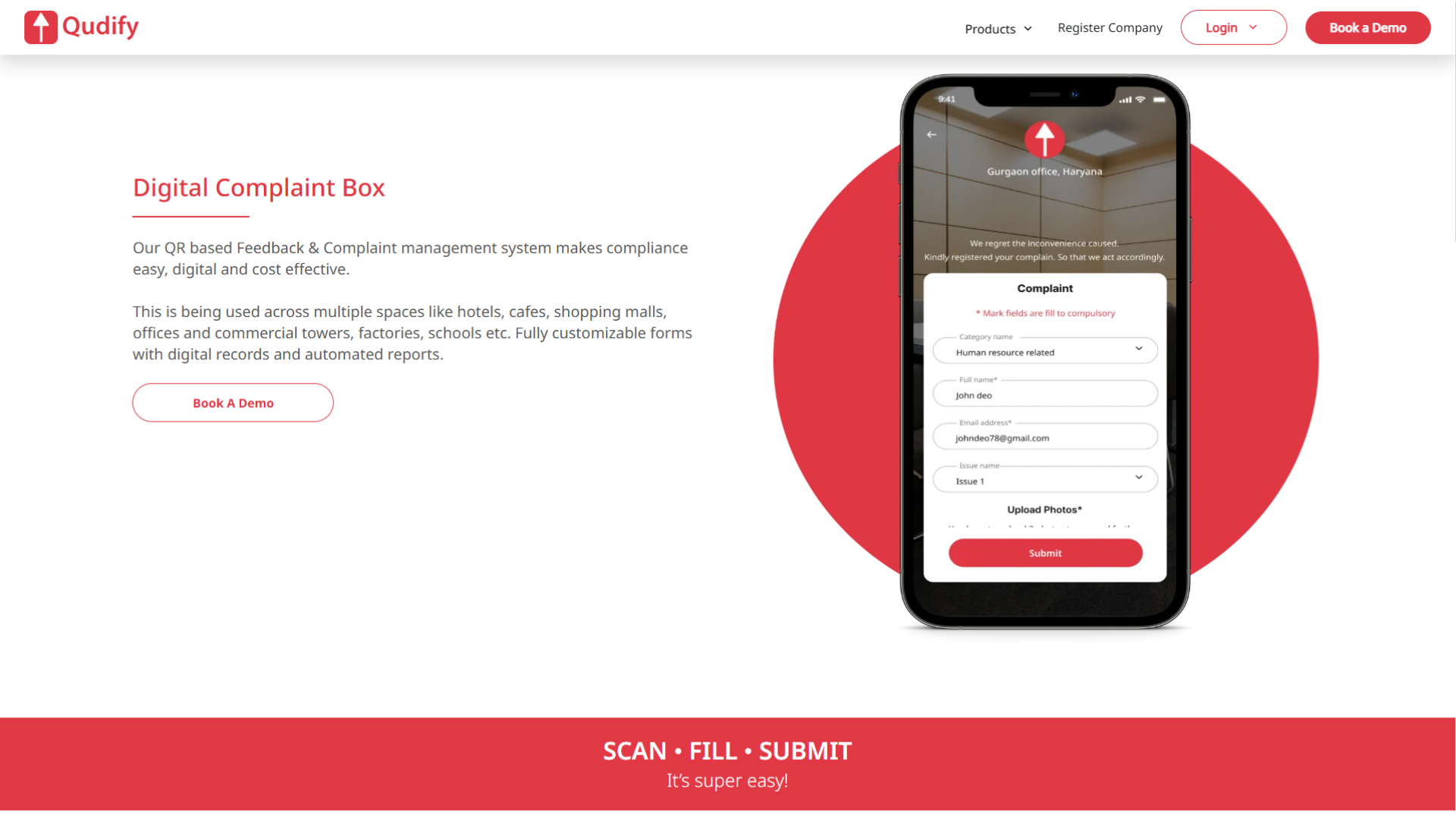
Qudify is a cloud-based, QR-first visitor management system built by QDESQ Realtech, designed to replace paper registers for enterprises and MSMEs with a particular focus on Indian workplaces and their DPDP obligations. Its design philosophy is deliberately asset-light: the only hardware a visitor needs is the smartphone already in their pocket.
In practice, that means the fundamentals a compliant visitor record depends on are built into the product:
- Contactless, QR- and WhatsApp-based check-in, with a manual tablet or desktop option at reception so no visitor writes their details where the next one can read them.
- Customisable check-in and pre-registration forms, so you collect only the fields a given visit actually needs, supporting data minimisation.
- Digital visitor passes with defined validity, plus pre-invites for expected guests, VIP passes, and long-term passes for staff and vendors.
- Real-time host notifications the moment a visitor arrives, and centralised, real-time monitoring across single or multiple sites from one dashboard.
- A detailed, timestamped visitor history with check-in and check-out times, duration and notes, with cloud-based reports available for security and compliance reviews.
- Encryption and secure cloud storage, so records aren’t exposed to physical loss the way a book is.
- DPDP-aligned consent management, capturing visitor consent at sign-in as part of a defensible record.
The design goal is straightforward: a Qudify visitor record should be the thing you hand to a reviewer with confidence, rather than the gap they find. As always, how you configure retention, consent and access and how you document those choices, is what turns any platform into a compliant one, so set them to match your own legal advice. If you want to close the paper-logbook gap, you can see how Qudify handles visitor management.
How to Digitise without Disrupting Reception
Switching from paper doesn’t require a disruptive rip-and-replace. A pragmatic rollout looks like this.
Start by mapping your obligations: list the frameworks you’re actually subject to (DPDP, GDPR, HIPAA, ISO 27001, SOC 2, sector rules). That tells you what your visitor record must capture and how long to keep it. Then audit your current check-in form and remove any field you don’t need; home addresses or ID numbers for routine visits are over-collection is itself a risk.
Next, define visitor categories and retention: couriers, interview candidates, contractors and VIPs have different data and retention needs. Set a defensible default and document your exceptions. Configure consent and privacy notices so visitors can read and acknowledge how their data is used, and set access roles deciding who can view, export, and delete visitor data, logging those actions.
Then pilot at one entrance for a couple of weeks, gather feedback, and scale. Train front-desk and security staff, because most audit failures start with people rather than technology: familiar-face shortcuts, unescorted visitors, propped doors. Finally, document everything: your retention policy, consent flows, and access-control decisions are your compliance evidence.
Common Mistakes to Avoid
Even teams that go digital can undercut the benefit.
The biggest is treating “digital” as automatically “compliant.” The system gives you the controls; leaving retention set to “forever” or consent switched off recreates the paper problem in a database. Close behind is over-collecting data; asking every visitor for more than the visit requires raises both risk and liability, so trim the form.
Watch the edges, too. Logging the main entrance while a loading bay stays open is a classic finding; controls must cover every access point. If a third party processes your visitor data, don’t skip the data-processing agreement specifying security measures, sub-processors and breach notification under DPDP in particular; you remain liable for your processor’s failures. And don’t forget staff culture: technology can’t stop a receptionist waving through a familiar face, so pair the platform with training. Before you need it for real, run the audit query yourself: “who was on-site on this date, in this area?” and if it’s slow or incomplete, fix it now.
Frequently Asked Questions
Is a paper visitor book illegal under GDPR or India's DPDP Act?
Not automatically, but it is very hard to keep compliant. Because it exposes previous visitors’ data, resists selective deletion and lacks a real audit trail, a typical open logbook falls short of the confidentiality, storage-limitation and erasure expectations both laws share and both apply to manual records, so going paper doesn’t remove your obligations.
How long should we keep visitor records?
There is no single universal figure; you keep personal data only as long as its purpose requires. A 90-day window is a common, defensible default for routine business visitors. But some regimes set minimums that override this: India’s DPDP Rules require certain access and processing logs to be kept for at least a year, and HIPAA-related access records generally need six years. Erasure requests, meanwhile, must be answered within about one month under GDPR and within 90 days under DPDP.
Which regulations actually require visitor logs?
HIPAA names visitor control within its facility-access safeguards; ISO 27001 Annex A 7.2 expects recorded entry and exit; SOC 2 (around CC6.4) expects physical access to be restricted and logged; and C-TPAT, FSMA, ITAR and PCI DSS all require documented, retrievable site-access control. Privacy laws such as DPDP and GDPR then govern how any of those records are handled.
Does digitising make us compliant, or just faster?
Both, but the compliance gain is structural. A digital log delivers the specific things regulators ask for: encryption, access control, enforceable retention, consent capture and a tamper-resistant audit trail that a paper book cannot provide, however carefully it is kept. The caveat: “digital” isn’t automatically “compliant.” You still have to configure and document retention, consent and access.
Can a digital VMS help in an emergency, not just an audit?
Yes. Because it holds a live record of who is on-site, it gives you an accurate real-time headcount during an evacuation, something a paper book, always out of date, cannot.
What makes Qudify suited to Indian businesses?
It’s built QR-first and asset-light for Indian offices, schools, commercial towers and manufacturing sites: contactless QR- and WhatsApp-based check-in, cloud dashboards across multiple sites, customisable forms, digital passes, real-time host alerts, and DPDP-aligned consent capture the fundamentals of a compliant visitor record without the hardware overhead.