

Key Takeaways
- Digital check-in removes paper logs, printed badges, and signed agreements in one move, the single most recurring source of waste at the front desk.
- A busy site can churn through tens of thousands of non-recyclable single-use badges a year. Digital credentialing stops that completely.
- Real-time occupancy data from a Visitor Management System (VMS) lets HVAC and lighting respond to who’s actually in the building, not who was scheduled to be, and that gap is where most energy gets wasted.
- Pre-registration workflows catch scheduling errors and surface virtual alternatives before anyone gets in a car, cutting avoidable visitor travel.
- Vendor check-in can double as a sustainability checkpoint, turning reception from a passive sign-in desk into a supply chain governance point.
- Structured visit data feeds straight into ESG reports and carbon accounting, so you’re reporting measurements instead of estimates.
- Implementation is light. Most organisations run a cloud-based VMS on tablets or kiosks they already own, integrated with the access control they already have.
Every corporate office has a part of the building that sustainability teams never think to audit. It’s the reception desk.
It doesn’t look like a carbon problem. No machinery, no industrial process, nothing you can see venting into the sky. Just a logbook, a stack of printed badges, a laminator running in the corner, and someone re-typing names into a spreadsheet nobody will open again.
And yet that desk, and every routine attached to it, quietly produces waste, burns energy, and runs on analogue habits in a building full of digital systems that could do better.
A visitor management system (VMS) is what closes that gap. At its simplest, it’s a digital platform that automates how a workplace registers, screens, badges, and tracks everyone who walks in. Integrate it properly with the building’s other systems, though, and it stops being an admin tool and starts behaving like a sustainability instrument one with measurable effects on your environmental footprint.
This isn’t about a green gesture for the annual report. It’s about the operational choices that happen at the front door hundreds of times a day, across every site you run, that either pile up waste or quietly eliminate it. A VMS pushes that balance hard toward elimination.
What Is a Visitor Management System? (Definition)
A visitor management system is a digital platform that replaces paper-based front-desk processes with automated, cloud-based workflows for visitor registration, identity verification, badge issuance, host notification, access control, and visit logging.
In practice, that means self-service kiosks, mobile pre-registration, QR code check-in, and integrations with your calendar, access control, HR directory, and building management systems. The result is a structured, searchable, auditable record of everyone who enters in place of the paper logbook most organisations are still living with.
For sustainability, the interesting part is what a VMS removes: physical materials, manual processes, energy-blind occupancy guesswork, and the data gaps that quietly sabotage environmental reporting.
The Hidden Environmental Cost of the Traditional Front Desk

It’s worth being specific about the scale before arguing for the fix.
A mid-sized office handling 80 to 100 visitors a day generates several streams of recurring waste through its manual visitor process alone: paper sign-in sheets, single-use printed badges, NDA and agreement forms, printed welcome packs, the adhesive backing paper from badge sheets (rarely recyclable), and the thermal label rolls and ink cartridges that keep the badge printer fed.
Then there’s the energy side, which is harder to see but bigger. Without reliable data on who is in the building and when, facilities teams have nothing to calibrate against. So they run HVAC and lighting at full tilt for rooms that were booked but barely used. They condition floors for headcounts that never showed up. These aren’t theoretical inefficiencies; they’re the predictable result of running a building on the calendar instead of on reality.
The International Energy Agency puts buildings at roughly 40% of global energy consumption and around a third of energy-related CO₂ emissions. A meaningful slice of that comes from systems running where and when nobody needs them. Visitor data won’t solve that on its own, but it’s one of the inputs that makes solving it possible.
And there’s the reporting problem. Most sustainability audits can’t account for visitor-related consumption at all, because the data is locked in handwritten logs, scattered spreadsheets, and forms that get shredded. For organisations under growing pressure to produce credible ESG disclosures, that’s not a footnote; it’s a genuine reporting risk.
The front desk isn’t where sustainability programmes are born. But it’s often where they quietly spring a leak.
6 Ways a Visitor Management System Reduces an Office’s Carbon Footprint
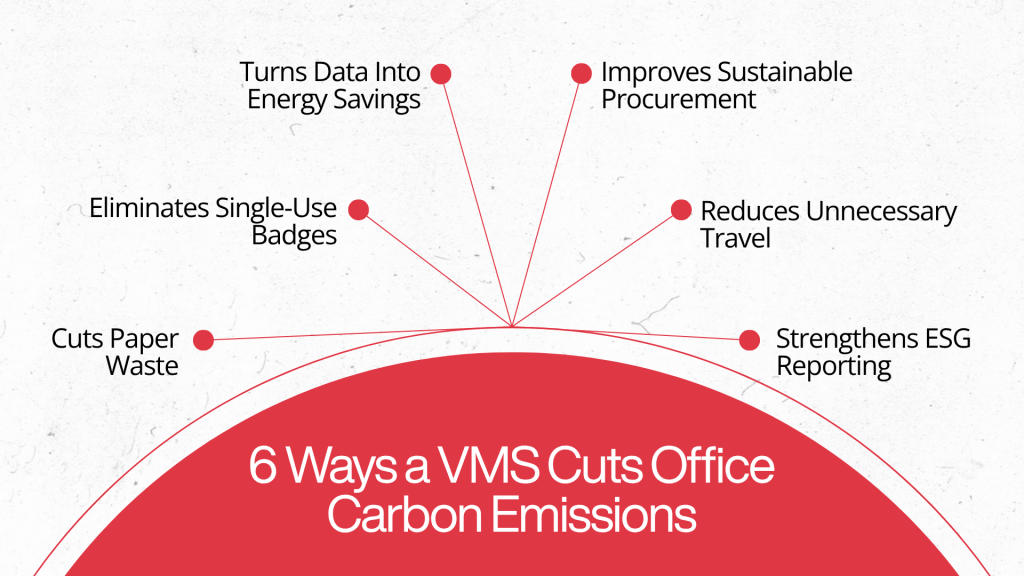
How a VMS reduces paper waste: it replaces every paper touchpoint in the front-desk workflow sign-in logs, printed badges, physical agreements, welcome materials with electronic equivalents that produce no physical waste.
Paper is resource-intensive, easy to wave away and worth taking seriously. Pulp and paper is one of the largest industrial consumers of energy and freshwater on the planet. Making it emits greenhouse gases, relies on chemical inputs that pollute water, and depends on forestry that carries an ecological cost even when it’s well managed. Every ream has a carbon footprint baked in before anyone writes on it.
In a traditional visitor workflow, paper turns up at nearly every step:
- Sign-in logs filled out by hand, filed for compliance, then thrown away.
- Visitor badges printed on single-use thermal stock with adhesive backing, and that backing paper doesn’t survive standard recycling.
- NDAs and safety agreements printed, signed, then filed or shredded.
- Welcome materials: parking instructions, floor maps, agendas, wifi codes, all printed and handed over.
- Shift-handover notes and daily rosters printed and left on the desk.
A digital VMS retires all of it. Visitors pre-register online and sign agreements before they arrive. Check-in runs through a QR code, app, or kiosk with nothing changing hands. Hosts get notified by email or chat. Welcome details arrive digitally. The visit record lives in a searchable database, not a filing cabinet.
Organisations that go fully paperless at reception report sharp drops in front-desk paper use against their old baseline. For high-traffic sites headquarters, manufacturing campuses, hospitals the paper and badge stock eliminated over a year across several locations adds up to something you can actually weigh.
The neat part, commercially, is that the environmental and financial cases point the same way. Cutting paper, badges, label rolls, cartridges, storage, and disposal trims cost exactly as it trims impact. Going paperless at the front desk isn’t a trade-off. It’s a win on every line.
2. It Ends the Single-Use Badge Problem
How a VMS reduces badge waste: digital credentials, QR codes, mobile passes, and reusable cards replace the single-use physical badges that most facilities send to landfill by the tens of thousands each year.
The badge problem earns its own section because the numbers surprise nearly everyone who sits down and does the arithmetic.
Take a plausible case: a campus with one main entrance, 150 visitors a day, five days a week, across a 250-day working year. That’s 37,500 badges from a single site in a single year. Run ten, twenty, or fifty locations and the figure stops being trivia.
Those badges’ thermal label stock with pressure-sensitive adhesive doesn’t go through municipal recycling. The adhesive and thermal coating contaminate the paper fibre stream, so they end up in landfill, and so does the backing paper from every sheet. Behind each one sits a manufacturing chain: the plastic in the stock, the coating chemistry, the ink, the freight that moved the raw materials and the finished product.
Modern systems solve this in several proven ways:
- QR code passes are the cleanest fix. The visitor gets a unique code by email or SMS at pre-registration and scans it on arrival. No physical badge; the digital record is both the credential and the log.
- Reusable card pools suit sites where a physical credential is genuinely needed for access or wayfinding. The VMS assigns a card from the pool at check-in and logs its return at check-out. The same card gets cleaned and handed out again, indefinitely.
- Smartphone access lets visitors use their own phone as the credential over NFC or Bluetooth, dropping physical media entirely while keeping a full audit trail.
- Facial recognition check-in is increasingly used in high-security or high-frequency settings, letting verified repeat visitors in with no credential beyond a face registered once.
The upstream saving counts too. A badge that’s never printed is a small cut to manufacturing demand, raw material extraction, freight, and disposal. Tiny on its own. Real in aggregate.
3. It Turns Occupancy Data Into Energy Savings
How a VMS reduces energy consumption: by producing accurate, real-time occupancy data, it lets building systems match HVAC, lighting, and other loads to actual use instead of conditioning and lighting space nobody’s in.
This is the highest-impact benefit on the list, and reliably the one organisations overlook when they shortlist these tools.
The root issue with how most buildings handle energy is simple: they run on schedules, not data. HVAC is programmed for business hours. Lights stay on in a meeting room for the length of the booking. Reception is conditioned for peak occupancy whether or not peak ever arrives. None of it knows that the 40-seat seminar in the east wing drew 18 people, or that the contractor crew booked for 10 am cancelled the night before.
That’s not a technology failure. It’s a data failure. Building systems can’t respond to reality they can’t see.
A VMS gives them that visibility.
When every visitor pre-registers, checks in on arrival, and is logged out at departure, the facilities team and, through integration, the building management system itself gets real-time occupancy at zone, floor, or room level. That opens up:
- Demand-driven HVAC. Climate control scales to confirmed headcount, not the optimistic estimate. If 30 of 50 expected visitors don’t show, nothing needs to be conditioned for 50.
- Occupancy-responsive lighting. Smart lighting tied to VMS data brings zones up only when presence is confirmed and drops them to standby, or off once check-out is logged.
- Pre-conditioning for confirmed arrivals. Instead of running full HVAC from opening, the building can pre-condition specific areas against the pre-registered schedule, energy where and when it’s actually needed.
- Smarter front-of-house control. Lobbies and reception get chronically over-conditioned because they’re treated as always-on. Occupancy data gives a basis for managing them dynamically.
Research on smart-building interventions consistently finds that occupancy-based HVAC and lighting can meaningfully cut energy use, with the biggest savings in large commercial buildings exactly where the gap between scheduled and actual occupancy is widest. Visitor data is one of the inputs that makes that tuning possible.
And if you’re chasing a green building certification LEED, BREEAM, WELL demonstrating occupancy-driven energy management is a recognised route to credits in the energy efficiency and smart building categories.
4. It Reduces Unnecessary Visitor Travel
How a VMS reduces travel emissions: pre-registration, automated host notifications, and links to virtual meeting tools help you work out when an in-person visit is genuinely necessary and cut the trips that aren’t.
This one needs a caveat up front: a VMS doesn’t reduce travel by itself. What it does is create the conditions and the data to make better calls about when someone actually needs to be on site.
Think about who walks through a typical office in a given week:
- Vendors running routine status or compliance reviews
- Candidates in for first-round screening interviews
- Contractors doing inspections that have a remote equivalent
- Partner reps attending planning syncs
- Service providers doing periodic check-ins with nothing hands-on involved
Plenty of these happen not because being there adds value, but because nobody’s ever built a process to ask whether it does. The visitor books the meeting, drives over, parks, waits in reception, and drives home time and emissions spent because that’s the default.
A structured pre-registration process introduces natural checkpoints. Does the host confirm availability before the visit locks in? Is a virtual option offered in the booking flow? Are first-time vendor visits flagged for a quick “does this need to be in person?” before approval?
The data does the rest. Which vendors visit most often? How long do they typically stay? Which visits get followed by another in-person meeting days later? Which could comfortably have been a video call?
Road travel is a significant chunk of many organisations’ Scope 3 footprint. Being able to show that converting even a fraction of routine check-ins and screening interviews to virtual produced a measurable cut is worth something environmentally and in the report.
Pre-registration also kills off the most pointless category of travel: the trips caused by errors. The visitor who turns up at the wrong building. The meeting cancelled but never communicated. The host off sick who didn’t update anyone. Those journeys emit carbon and produce nothing. Automated host notification and pre-arrival confirmation clear out most of them.
5. It Strengthens Sustainable Procurement and Supply Chain Governance
How a VMS supports supply chain sustainability: it can capture and verify vendor sustainability credentials, enforce environmental policy at check-in, and generate auditable records of contractor activity, turning reception into an active governance point over the partners coming through your doors.
This is the least obvious benefit here, and for organisations serious about Scope 3 and ESG governance, possibly the most strategically useful.
Quick context: Scope 3 emissions are the indirect ones across your value chain the suppliers, vendors, and contractors behind your operations, plus the travel your people take. For most large organisations, Scope 3 dwarfs Scope 1 and 2 combined. It’s also the hardest to measure, report, and control.
The suppliers and contractors who physically visit your site are a tangible, trackable slice of that exposure. And reception, the point every one of them has to pass through, is the natural place to govern them.
A VMS set up with this in mind can:
- Require credentials at pre-registration. Ask contractors to submit current environmental certifications, ISO 14001, say, as part of the pre-registration flow, with the system flagging gaps before anyone reaches the desk rather than after.
- Document policy acceptance. Require vendors to read and acknowledge your environmental procurement policy as a condition of entry, creating a timestamped record that beats an email attachment nobody confirms opening.
- Track visit frequency and purpose. Let procurement see which suppliers visit most, what for, and whether the pattern matches contracted scope the kind of evidence those vendor performance conversations usually lack.
- Build audit trails for ESG verification. When third-party auditors want proof of supply chain governance, the visitor log shows who was on site, on what terms, against which standards.
Reception has historically been a passive checkpoint: sign in, grab a badge, move on. In a workplace that takes sustainability seriously, it can be a good deal more deliberate than that.
6. It Makes ESG Reporting Accurate and Credible
How a VMS improves ESG reporting: it produces the structured, auditable, timestamped data you need to bring visitor activity into your environmental reports and carbon accounting, replacing estimates with measurements.
Sustainability reporting has grown up fast. The Global Reporting Initiative (GRI), the Task Force on Climate-related Financial Disclosures (TCFD), and CDP all expect disclosures that are specific, consistent, and verifiable. The EU’s Corporate Sustainability Reporting Directive (CSRD), phased in from the 2024 financial year, extends mandatory reporting to a large share of European businesses and their international supply chains. Everywhere, the direction is the same: more disclosure, more rigour, more accountability.
In that climate, the quality of the data under a report matters. Estimates that can’t be traced to a source draw scrutiny from auditors, investors, and ESG analysts. Categories marked “not measured” get noticed.
The front desk usually falls squarely into that gap. Visitor-related consumption paper, materials, and the energy tied to visitor presence tend to be either unreported or estimated from generic benchmarks with no site-specific basis.
A VMS closes the gap several ways:
- Volume and frequency data give sustainability teams a precise, site-level basis for calculating visitor-related consumption: total annual visitors per location, peak periods, average visit duration numbers that otherwise rest on guesswork.
- Paperless process documentation lets you report a specific, verifiable reduction in paper-based steps, with a defined implementation date and a documented baseline. That’s the kind of evidenced action that holds up.
- Occupancy data for energy calculations lets you size the savings from demand-driven building management at site level and attribute them to specific changes, including the VMS rollout.
- Integration with sustainability platforms pushes VMS data straight into environmental management systems, ERP, and reporting tools, cutting the manual collection and transcription errors that erode data quality.
- Cleaner Scope 1 and 2 disaggregation becomes possible when you can split building energy into occupant-driven and visitor-driven components the granularity that supports more sophisticated carbon accounting.
Moving from estimated to measured data isn’t cosmetic. It changes how credible your environmental claims are, how reliable your reduction targets look, and how you stand with auditors, investors, and customers who increasingly read past the headline pledge to the evidence underneath.
Digital Visitor Management vs. Traditional Paper-Based Systems: At a Glance
| Factor | Paper-Based System | Digital VMS |
| Paper consumption | High daily logs, printed forms, welcome packs | Near zero fully electronic workflows |
| Badge waste | Single-use sticker badges to landfill | QR codes, mobile passes, or reusable credentials |
| Energy efficiency | No occupancy data; BMS runs on assumptions | Real-time occupancy feeds building management |
| Travel emissions | No visibility or pre-screening | Pre-registration filters and virtual meeting integration |
| Supply chain compliance | Manual, inconsistent, no audit trail | Automated certification checks, documented policy acceptance |
| ESG reportability | Estimated, low confidence, data gaps | Structured measurements, high accuracy, auditable |
| Carbon accounting | Not feasible from visitor data alone | Direct input to Scope 1, 2, and 3 calculations |
How to Implement a Sustainability-Focused Visitor Management System: A Practical Roadmap
Going from a paper process to a digital, sustainability-integrated one isn’t a multi-year programme. The organisations that pull it off tend to follow the same sequence.
Step 1: Audit the current process. Walk your existing visitor workflow and write down every paper touchpoint: sign-in, badging, agreements, welcome materials, the notes the receptionist keeps. That’s your baseline, and it shows you where the biggest wins are.
Step 2: Decide what you want to measure. Pick the metrics before the platform. Paper eliminated, badges kept out of landfill, energy saved through occupancy integration, ESG data coverage each one needs a documented baseline to be reportable later.
Step 3: Choose for integration depth, not feature lists. The sustainability value compounds when the VMS connects to your BMS, access control, HR directory, calendar, and reporting tools. Evaluate platforms on what they plug into, not just what they do on their own.
Step 4: Go paper-free by default, not by exception. Configure digital workflows from day one: ‘pre-registration, electronic agreements, QR check-in, digital welcome comms. Resist the “print as backup” option. It quietly reintroduces inconsistency into both your process and your data.
Step 5: Wire occupancy data into the building. Set up the feed from the VMS to the BMS with your facilities team. Even a basic integration that simply makes live occupancy visible to FM unlocks real energy management.
Step 6: Measure and report. Use the structured data to populate ESG disclosures, internal dashboards, and reports. Take the results to leadership. Make the environmental case visible; the evidence now exists, so use it.
What Good Looks Like in Practice: How Qudify Approaches This
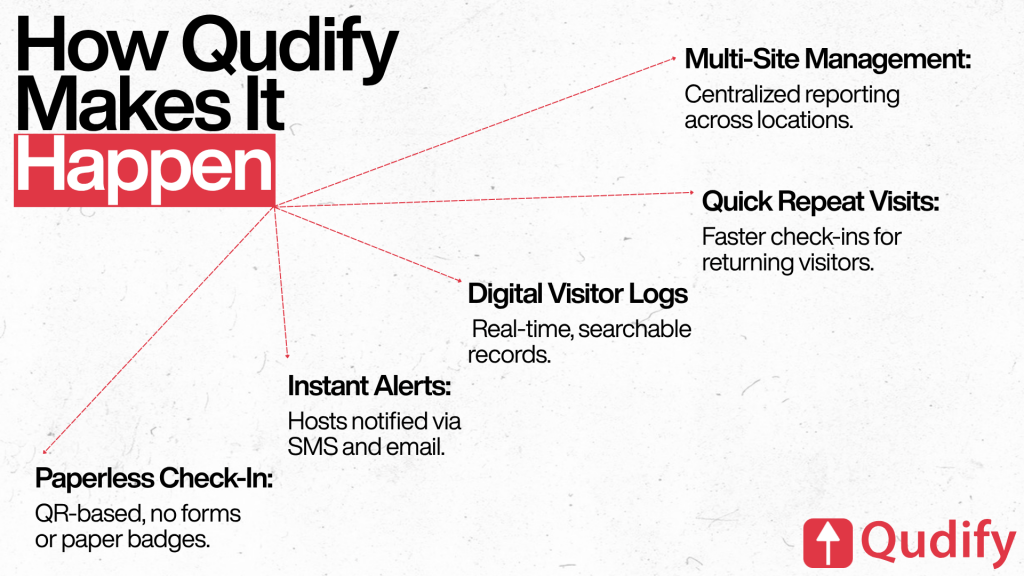
Understanding what a sustainability-focused VMS should do is one thing. Seeing it in a real product is another.
Qudify is a cloud-based visitor management platform built for modern workplaces. It’s worth mentioning here not as the only option, but because how it’s designed mirrors a lot of what this article describes: paperless by default, occupancy-aware, and built to produce the kind of structured data sustainability teams actually use.
A few things stand out if you’re an operations or facilities lead weighing your options:
- The check-in workflow is paper-free by design. Visitors pre-register through a web portal, get a QR code, and check in with no forms or printed badges changing hands. Paperless isn’t an add-on; it’s the baseline, and there’s no “print as backup” path in the default flow, which matters for both data consistency and waste.
- Host notifications are automated and instant. One of the more underrated sustainability wins of a good VMS is fewer no-shows and wasted journeys. When hosts are alerted the moment a visitor arrives, and pre-registration confirms the details in advance, far fewer people travel only to find the meeting moved or the host unavailable. Qudify handles this with automated SMS and email built into check-in.
- The visitor log is structured and searchable. For reporting, it’s not enough that data is recorded; it has to be usable. Qudify keeps a real-time, exportable log that gives facilities teams the occupancy data for energy analysis and the documented records for ESG reporting.
- Repeat visitor management cuts friction without adding paper. For contractors, vendors, and regulars, returning-visitor profiles mean faster repeat check-ins and compliance documents agreements, certifications, acknowledgements completed once rather than every time. For supply chain governance, that ties policy acceptance to a verified identity instead of an unsigned paper form.
- It’s built for multi-site operations. Organisations tracking sustainability across several offices need consistent data across all of them. Qudify supports multi-location deployment with centralised reporting, so you can measure environmental performance at portfolio level, not just site by site.
The point isn’t to crown Qudify the only route to sustainable visitor management. It’s to make the principles concrete: none of this is theoretical. It’s implementable today, with tools already in production, without a big infrastructure spend or a disruptive rollout.
If your current process still runs on a logbook, a badge printer, or a spreadsheet nobody reviews, the distance between where you are and where you could be is shorter than it looks.
The Bottom Line: Sustainability Starts at the Front Door
Most sustainability programmes start where the big numbers are: fleet, manufacturing, data centres, supply chains. That’s sensible. But if you want environmental responsibility genuinely built into how the organisation runs, you can’t leave the front desk out.
Reception is where hundreds of small environmental decisions get made every day. A sheet of paper signed and binned. A badge printed and peeled. An HVAC system conditioning a floor for 40 people because 40 were expected, even though 22 turned up. Individually trivial. Aggregated across sites, teams, and years, anything but.
A visitor management system cuts your office’s carbon footprint by making the better choice the default, not through willpower or policy, but through digital workflows that simply don’t generate the waste the manual ones do. It supplies the occupancy data buildings need to run energy intelligently. It creates the records ESG reporting demands. It gives procurement the visibility to manage supply chain sustainability at the point of entry.
For operations leaders, facility managers, and sustainability officers under real pressure to show measurable progress without breaking business continuity, this is one of the most practical first moves available. No capital project, no drawn-out procurement, no transformation. Just a commitment to doing the everyday things the check-in, the badge, the building in a way that reflects what the organisation says it stands for.
The best sustainability programmes aren’t the ones with the boldest targets. They’re the ones where the gap between what an organisation says and what it does is smallest. Starting at the front door is a practical way to close it.
Frequently Asked Questions
A: Sustainability is rarely the main reason organisations buy one; security, compliance, and operational efficiency usually lead. But the environmental case is substantial and quantifiable: paper elimination, badge waste reduction, occupancy-driven energy savings, and better ESG data all add real value. If you have formal carbon targets or reporting obligations, those outcomes make the business case noticeably stronger.
A: It depends on traffic and how many paper steps your current process has. High-traffic sites headquarters, manufacturing, healthcare generate the most. A fully digital VMS removes sign-in logs, printed badges, physical agreements, and welcome materials. At 100 visitors a day across a 250-day year, badge materials alone come to 25,000 single-use items annually, before you count the forms and documentation.
A: Yes. Leading platforms offer API integrations with building management systems (BMS) and smart-building platforms, so occupancy data from check-in and check-out feeds straight into HVAC, lighting, and access control for demand-driven energy management. If you’re pursuing LEED, BREEAM, or WELL, that integration supports several credits tied to energy performance and occupancy monitoring.
A: LEED, BREEAM, and WELL all include criteria around occupancy monitoring, energy management, waste reduction, and indoor environment quality. VMS data contributes evidence across several of these, particularly where auditors want documented occupancy data, waste reduction records, and smart-building integration. If you’re going for certification, raise VMS data integration with your consultant during planning.
A: Scope 3, especially business travel, supplier travel, and supply chain activity, is among the hardest to measure accurately. A VMS helps by documenting the frequency, purpose, and duration of vendor and contractor visits, giving you data to support travel-related emission estimates. It also surfaces the high-frequency routine visits that could shift to virtual, which is a direct reduction pathway for supplier travel emissions.
A: No. Modern cloud-based platforms deploy with minimal investment. A kiosk, tablet, or standard web portal handles check-in, and integration with existing access control, calendar, and HR systems runs through standard APIs. The real work is usually change management: moving reception staff, tenants, and regular visitors onto digital workflows rather than anything technical.