
Key Takeaways
- Paper logbooks are a compliance liability. Under India’s DPDP Act 2023, collecting visitor data without digital consent can attract fines up to ₹250 crore.
- A VMS cuts check-in time from 3–8 minutes to under 60 seconds, reducing front-desk bottlenecks while delivering a noticeably more professional first impression.
- Real-time occupancy data is a life-safety requirement, not a convenience. In an evacuation, a live headcount can be the difference between safety and chaos.
- India’s hybrid and multi-tenant office boom makes centralised visitor tracking essential. One entrance, fifteen companies, zero accountability without a VMS that’s your reality.
- Blacklist matching and ID verification close security gaps that security guards physically cannot. Human vigilance has limits; automated flagging does not.
- QR and WhatsApp-native systems remove all adoption friction: no app downloads, no hardware costs, and no learning curve for visitors or staff.
- A VMS is not an enterprise-only investment. Cloud-based platforms make enterprise-grade security and DPDP compliance accessible for MSMEs and growing businesses alike.
Every office has a front door. Very few treat it seriously.
Think about a typical Monday morning at a mid-sized corporate office in India. A delivery executive arrives with a courier. A vendor walks in for a pre-scheduled meeting. Two candidates show up for interviews. A business guest from another city has an 11 AM appointment. And somewhere in that queue, there is someone the security guard does not recognise waiting to be waved through.
The guard reaches for the logbook. Names are scrawled in barely legible handwriting. A phone call is made upstairs to verify someone. Visitor badges, if they exist at all, are laminated cards passed from one person to the next. Nobody knows with certainty who is on the premises right now.
This is not a niche problem. It plays out daily across IT parks in Bengaluru, commercial towers in Gurugram, manufacturing facilities in Pune, pharmaceutical campuses in Hyderabad, and co-working spaces in Mumbai. The front door, the single most important security boundary of any workplace, is routinely the least managed.
A Visitor Management System (VMS) is the infrastructure that fixes this. And in 2026, it is no longer a luxury reserved for large multinationals. For any Indian office that takes security, compliance, and professional credibility seriously, it is a baseline necessity.
What Is a Visitor Management System?
A Visitor Management System is a digital platform that automates the end-to-end process of welcoming, registering, verifying, tracking, and managing visitors to a workplace or facility. It replaces paper logbooks and manual security checks with a structured, cloud-based workflow that can be accessed from any device, at any location, in real time.
At its core, a modern VMS handles:
- Pre-registration of expected visitors before they arrive
- Identity verification and KYC at the point of entry
- Contactless check-in and check-out via QR code or WhatsApp
- Instant host notifications via SMS, app, or email
- Digital visitor pass generation (or physical badge printing, where required)
- Real-time occupancy tracking and timestamped logs
- Emergency evacuation lists with live headcount
- Blacklist matching to flag restricted individuals automatically
- Post-visit analytics and compliance-ready reporting
A good VMS is not a digital version of a paper register. It is an intelligent platform that connects your front desk to your HR software, your access control hardware, your security team, and your compliance records all in one unified system.
How a Visitor Management System Works: Step by Step
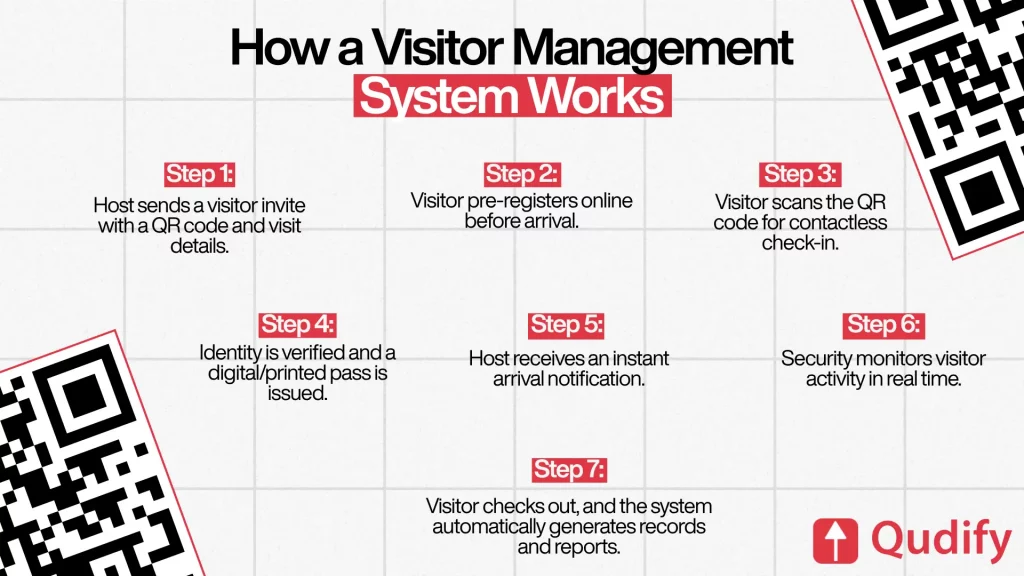
Step 1: Pre-Visit Invitation
The host, an employee inside the organisation, uses the VMS dashboard or mobile app to invite a visitor. The visitor receives a personalised invitation via email or WhatsApp containing a unique QR code, the office address, directions, and any documents they need to bring.
Step 2: Visitor Pre-Registration
Using the link in the invitation, the visitor completes their details: name, organisation, purpose of visit, and government ID information before they arrive. There is no form-filling at the front desk and no queue at the reception counter.
Step 3: Contactless Check-In on Arrival
On arrival, the visitor scans their QR code at the reception kiosk or a designated QR stand. No physical token is required. No security guard needs to manually verify or transcribe their identity.
Step 4: Identity Verification and Pass Issuance
The system cross-references the visitor’s pre-submitted identity against its records, validates the check-in, and instantly generates a digital visitor pass. If a physical badge is required, it can be printed automatically at this point.
Step 5: Instant Host Notification
The moment the visitor checks in, the host receives an automatic alert via app, SMS, or WhatsApp so they can come to reception or send someone to escort the guest. No waiting. No missed arrivals.
Step 6: Real-Time Premises Monitoring
Security and administration staff can view in real time exactly who is currently on the premises, which floor they are visiting, how long they have been present, and which host they are visiting.
Step 7: Check-Out and Automated Log Generation
When the visitor leaves, they check out via QR scan. The system records the exit time automatically. Cloud-based reports are immediately available for security audits, regulatory compliance reviews, and operational analytics.
Traditional Logbooks vs. Digital Visitor Management Systems
The case for switching is not merely about modernisation. It is about closing real security gaps and meeting real compliance obligations.
| Parameter | Traditional Paper Logbook | Digital Visitor Management System |
| Check-In Speed | 3–8 minutes | Under 60 seconds |
| Data Accuracy | High error risk, often illegible | Validated at entry; no manual transcription |
| Host Notification | Manual phone call (often missed) | Instant automated alert via SMS/app/WhatsApp |
| Visitor Pass | None, or shared reusable cards | Unique time-limited digital or printed pass |
| Emergency Headcount | Manual, slow, unreliable | Instant live list on any device |
| Data Security | Physically exposed; anyone in the lobby can read previous entries | Cloud-encrypted with access controls |
| Regulatory Compliance | No consent capture, no audit trail | Automated consent management and audit-ready logs |
| Blacklist Enforcement | Impossible in practice | Automatic real-time flagging |
| Multi-Location Visibility | Siloed and non-transferable | Centralised dashboard across all sites |
| Environmental Impact | Continuous paper consumption | Fully paperless |
The privacy gap in the paper logbook deserves particular emphasis. When the next visitor walks up to the reception desk and glances at the open register, they can read the name, phone number, and company of every person who visited before them. Under India’s Digital Personal Data Protection (DPDP) Act 2023, this constitutes an exposure of personal data, a compliance risk that organisations simply cannot afford to ignore.
Why the Need Is Urgent in India Right Now
India is not a generic market. Its office ecosystem has specific characteristics that make visitor management both uniquely challenging and uniquely consequential.
1. The Scale of India’s Commercial Office Market
India’s commercial real estate sector is one of the fastest-growing in Asia. According to JLL India’s research, the country has seen consistent high-volume Grade A office space absorption across its top six cities Bengaluru, Hyderabad, Mumbai, Delhi-NCR, Pune, and Chennai with each major business park and SEZ receiving hundreds to thousands of visitors on any given working day.
The sheer volume of daily footfall in Indian offices makes manual visitor management not just inefficient, but a genuine security liability.
2. The Rise of Hybrid Work and Multi-Tenant Offices
Post-pandemic, India’s workplaces have become significantly more fluid. Co-working operators and flexible office providers now host dozens of companies under a single roof. On any given day, the same entrance may receive visitors for fifteen or twenty different companies.
Without a centralised VMS, security devolves into a chaos of multiple registers, multiple contact lists, and zero accountability. There is no way to answer a simple question: who is in this building right now?
3. India’s DPDP Act: A Compliance Obligation Every Organisation Must Understand
India’s Digital Personal Data Protection (DPDP) Act 2023 represents the country’s first comprehensive framework governing the collection, processing, storage, and transfer of digital personal data. The DPDP Rules were finalised on 13 November 2025, with full enforcement of the remaining provisions of the Act coming into effect by 13 May 2027.
Every time a visitor’s name, phone number, Aadhaar number, or photograph is collected at your front desk, including in a paper register that is subsequently digitised, it constitutes the collection of personal data under this Act. The DPDPA applies explicitly to digital personal data, including data that originates in non-digital form but is subsequently digitised.
Without a proper digital system that captures free, informed, and explicit consent before data collection, organisations face serious legal exposure. The Data Protection Board of India enforces penalties under Section 33 of the Act, which range from ₹10,000 for minor individual violations to ₹250 crore per violation for organisations in cases of significant non-compliance. Failure to collect valid consent, failure to maintain verifiable consent records, or sharing visitor data without consent can each attract fines of up to ₹50 crore per incident.
A compliant VMS captures digital consent at the point of pre-registration before the visitor even arrives and maintains auditable records of that consent automatically. This is not an optional feature. It is a legal requirement.
4. Workplace Security Threats Are Real and Growing
India has seen a documented rise in workplace security incidents from unauthorised access to sensitive areas and data theft by visitors posing as contractors, to physical threats targeting employees. Manufacturing plants, pharmaceutical companies, IT firms handling sensitive client data, and financial institutions all face genuine perimeter security risks.
A paper logbook provides no real protection against any of these threats. Someone can write a false name and a false company name and walk in unchallenged. A VMS with ID verification, blacklist matching, and real-time monitoring closes this gap in a way that manual processes fundamentally cannot.
5. ESG Commitments and Sustainability Reporting
Indian organisations, particularly those listed on domestic stock exchanges, those working with international clients, and those seeking ESG ratings, are increasingly held to measurable sustainability standards. Eliminating paper-based processes is a straightforward, quantifiable sustainability improvement that feeds directly into ESG disclosures.
A QR-based VMS eliminates paper visitor registers, paper visitor passes, and the administrative overhead associated with manual data entry and physical record storage.
Essential Features of a Modern Visitor Management System
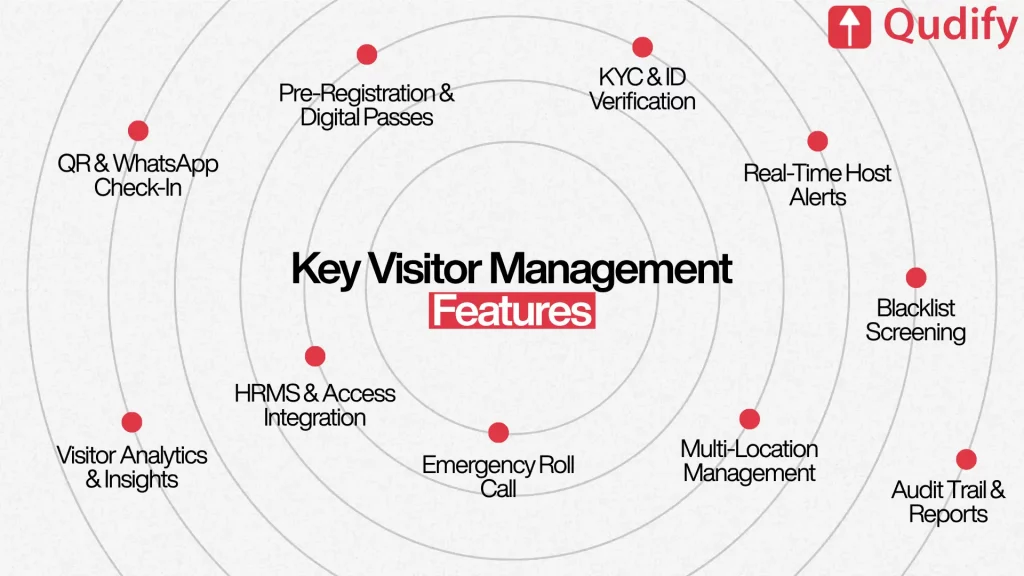
Not all VMS platforms are equal. Here is what to look for when evaluating a solution for an Indian workplace:
QR Code and WhatsApp-Native Check-In: Designed specifically for the Indian market, where smartphone and WhatsApp penetration is high. Visitors scan a QR code on their own device with no app download required, making the experience accessible and friction-free for everyone from a first-time visitor to a regular contractor.
Pre-Registration and Invite Scheduling: Hosts schedule visits in advance. The system sends a digital pass directly to the visitor, eliminating gate-side queues and manual form-filling entirely.
KYC and Government ID Verification: Critical for regulated industries including BFSI, pharmaceuticals, and manufacturing, where only verified, authorised individuals can gain access to certain areas. The system cross-references visitor identity against their submitted government ID documents.
Time-Limited Digital Passes and Badges: Replaces physical reusable visitor cards with secure, time-bound digital passes that cannot be lost, duplicated, shared, or used after the approved visit window.
Real-Time Host Notifications: Eliminates lobby wait times and delayed meetings. Hosts receive an instant alert the moment their guest completes check-in.
Blacklist and Restricted Entry Management: Automatically flags and alerts security when a restricted individual, a terminated employee, a known trespasser, or someone flagged for a previous security incident attempts to register or check in.
Comprehensive, Searchable Audit Trails: Timestamped, cloud-stored, and fully searchable visitor logs available for security audits, internal investigations, regulatory submissions, and legal matters.
Multi-Location and Multi-Tenant Management: A centralised dashboard that allows a head office security or operations team to monitor visitor activity across offices in different cities simultaneously.
Emergency Evacuation Support: In a fire, medical emergency, or security incident, the system generates a live list of every person currently on the premises instantly, on any authorised device.
HRMS and Access Control Integration: Native integrations with HR platforms for employee directory syncing, and with physical access control systems for automated gate management, creating a unified security ecosystem.
Operational Analytics: Transform raw entry data into actionable insights: peak visitor hours, high-traffic departments, contractor dwell times, and occupancy trends to optimise resourcing and space planning.
Which Industries Need a VMS Most?
While virtually every organisation that receives visitors benefits from a VMS, certain sectors have particularly acute requirements:
| Industry | Primary Driver |
| Corporate IT and Tech Parks | Managing high-volume contractor, vendor, and client footfall across large campuses |
| Manufacturing and Industrial | Contractor management, restricted zone access, and compliance with safety induction requirements |
| BFSI (Banking and Financial Services) | Regulatory compliance, rigorous identity verification, and audit trail requirements |
| Healthcare and Pharmaceuticals | Controlled access to GMP-compliant areas, research facilities, and sensitive production zones |
| Co-working and Flexible Office Spaces | Centralised, unified visitor tracking for multiple tenants sharing a single facility |
| Educational Institutions | Enhanced student and staff safety, visitor authorisation, and emergency headcount |
| Government and Public Sector Undertakings | Security-first identity verification and mandatory record-keeping |
| Retail and Hospitality Corporate Offices | Streamlined vendor, delivery, and contractor management |
The Real Cost of Not Having a VMS
Many organisations delay VMS investment because the cost of inaction is not immediately visible. It is, however, very real.
Security Incidents: A single serious security breach an unauthorised visitor accessing a server room, a sensitive client document, or an executive floor can result in data loss, legal liability, regulatory investigation, and reputational damage that dwarfs years of VMS subscription costs. The risk is not hypothetical; it is a documented pattern across industries.
Regulatory Fines Under the DPDP Act: Collecting visitor personal data without a proper consent framework and secure data storage is a compliance violation under India’s DPDP Act 2023. Penalties can reach ₹250 crore for serious organisational non-compliance. Paper logbooks, by their nature, satisfy none of the Act’s requirements.
Wasted Staff Time: Reception staff, security personnel, and administrators spend a disproportionate amount of time on manual visitor processing, calling hosts, verifying identities, writing entries, and managing physical logs. A QR-based VMS eliminates most of this work, freeing staff for higher-value responsibilities.
Brand and Professional Perception: Your reception area is the first physical touchpoint every client, investor, auditor, and partner has with your organisation. A disorganised, paper-based entry process communicates something specific about your standards of professionalism, security, and operational maturity and not something positive.
Inability to Respond to Emergencies: Without real-time occupancy data, emergency evacuations become chaotic. Knowing who is in the building precisely, immediately is not an administrative convenience. In a fire or security incident, it is a life-safety requirement.
Addressing Common Objections
“We’re too small to need a VMS.” This is the most common and most consequential misconception. An organisation with 20 employees receiving 10 visitors per day still has a security obligation, a data protection obligation, and a professional reputation to uphold. Cloud-based, QR-driven VMS platforms are specifically designed to be affordable and operationally simple for small and mid-sized organisations, not just large enterprises.
“Our security guards handle it.” Security personnel are valuable, but they are human. They can be distracted, socially manipulated, or simply unavailable at a busy moment. They cannot simultaneously cross-reference a visitor against a blacklist, notify a host via app, and generate a timestamped audit record. A VMS augments and empowers security personnel; it does not replace them.
“It will be complicated to set up.” Modern cloud-native VMS platforms require no complex IT infrastructure, no dedicated hardware beyond a QR code display, and no lengthy enterprise onboarding. Most single-location organisations go live within a few days.
“Our visitors won’t be comfortable with the technology.” QR code scanning and WhatsApp are daily habits for the overwhelming majority of Indian smartphone users. In practice, visitors consistently find digital check-in faster, less intrusive, and more professional than being asked to fill in a paper form and wait for a phone call.
How to Choose the Right VMS for Your Indian Office
Selecting a VMS is a strategic decision that affects your security posture, your regulatory compliance, and the daily experience of everyone who visits your workplace. In the Indian market, a generic global solution often falls short of what local organisations actually need.
Prioritise these seven criteria when evaluating options:
1. WhatsApp and QR-Native User Experience: India’s smartphone and WhatsApp penetration makes QR-code and WhatsApp-based check-in the most accessible and friction-free option available. Any system that requires visitors to download a third-party app will see low adoption and persistent front-desk bottlenecks.
2. Cloud Architecture with Multi-Location Visibility: Avoid on-premise systems with associated maintenance costs and single-site limitations. A cloud-based VMS gives your security and operations teams centralised, real-time visibility across all office locations from a single dashboard.
3. DPDP Act Compliance Features: Your VMS provider must offer built-in digital consent capture, encrypted storage, and automated data retention and deletion capabilities. These are not optional features; they are legal requirements under the DPDP Act 2023.
4. KYC and Blacklist Management: For any organisation in BFSI, manufacturing, pharmaceuticals, or critical infrastructure, real-time identity verification and automatic blacklist matching are non-negotiable security requirements.
5. Integration with Your Existing Infrastructure: Your VMS should not be a standalone tool. Look for native integration with your HRMS for employee directory management, your physical access control system for automated gate management, and your CCTV infrastructure for visual audit logs.
6. Transparent, India-Appropriate Pricing: Enterprise-grade security capability should not be exclusive to large corporations. Look for tiered cloud pricing that aligns with Indian MSME and mid-market budget structures, with clear pricing and no hidden hardware costs.
7. India-Based Support: Technical issues can halt operations. A provider with an India-based support team will be accessible during Indian business hours and will understand local compliance nuances, regional infrastructure constraints, and the specific operational dynamics of the Indian workplace.
Meet Qudify: A VMS Built Specifically for Indian Organisations
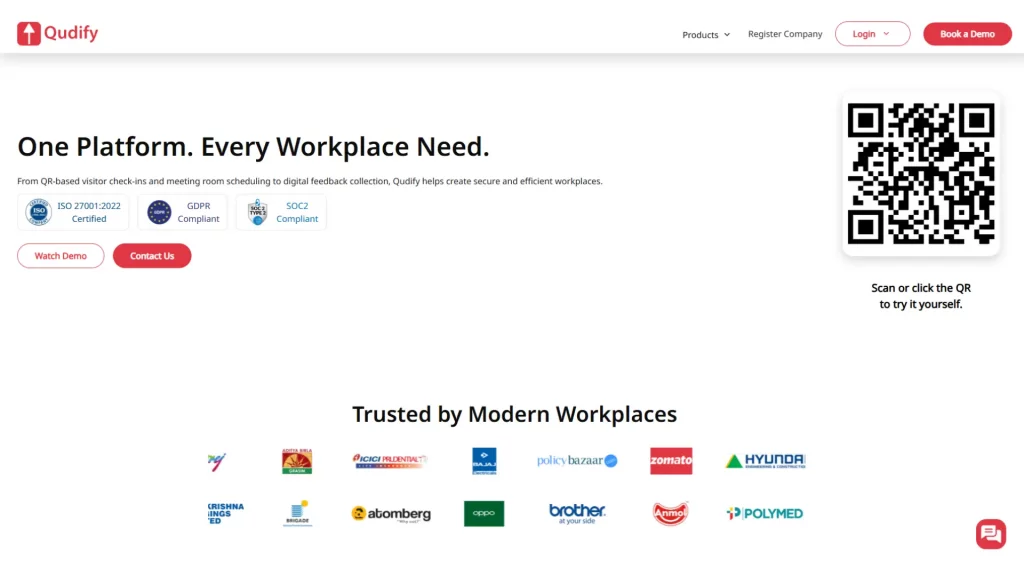
Among the VMS solutions available in the Indian market, Qudify is purpose-built for the specific operational and regulatory context of Indian organisations.
Qudify is a QR-based horizontal SaaS platform headquartered in Gurugram, developed by Qdesq Realtech Pvt Ltd. It was designed from the outset to replace paper-based front-desk processes with a smartphone-native, QR-driven workflow requiring no dedicated kiosks, no proprietary hardware, and no app downloads for visitors. The platform serves both large enterprises and MSMEs, with cloud-based pricing designed to be accessible across organisation sizes.
Qudify currently operates across 500+ live sites, serves 400+ client organisations, supports over 64,000 monthly active users, and has facilitated more than 2 million QR scans.
What Makes Qudify Well-Suited for the Indian Market
No Expensive Hardware Required. Many international VMS providers are built around iPad kiosks, dedicated terminals, and proprietary badge printers. Qudify operates entirely through QR codes and WhatsApp technologies already embedded in daily life for virtually every Indian smartphone user. The cost and complexity of deployment are significantly lower as a result.
WhatsApp-Native Workflow. With over 500 million WhatsApp users in India, Qudify’s decision to route visitor passes and check-in links through WhatsApp rather than a dedicated app is a practical design choice that dramatically reduces friction for visitors and increases adoption rates.
Cloud-Based, Multi-Site Monitoring. Security and operations teams can monitor all office locations from a single centralised dashboard, in real time, without being physically present at each site.
DPDP-Aligned Data Management. Qudify captures visitor consent digitally at the pre-registration stage before data is collected and maintains auditable consent records, supporting organisations’ obligations under the DPDP Act 2023.
Designed for Rapid Deployment. Most single-location deployments go live within days. There is no complex IT infrastructure to provision, no server to configure, and no lengthy enterprise onboarding process.
Qudify’s Core Product Suite
| Product Module | Core Functionality | Primary Business Value |
| QR-Based Visitor Management | Contactless check-in, identity verification, digital passes | Enhances entry security while delivering a professional guest experience |
| Smart Meeting Room Booking | QR-based scheduling, utilisation analytics, no-show detection | Reduces ghost meetings and optimises workspace utilisation |
| Digital Complaint Management | Facility issue logging, tracking, and resolution workflows | Improves operational responsiveness and employee satisfaction |
Implementation: A Practical Roadmap
Rolling out a VMS is a straightforward process with the right provider. Most single-location organisations can complete deployment in under two weeks.
| Phase | Key Actions | Typical Timeline |
| Assessment | Map current visitor flow, identify security gaps, define access categories | Week 1 |
| Selection | Evaluate providers against the seven criteria above | Week 1–2 |
| Configuration | Set up office details, host directories, visitor categories, and branding | Week 2 |
| Pilot Testing | Run a controlled pilot with internal staff and a small group of visitors | Week 2–3 |
| Staff Training | Brief security, reception, and administration teams on the new workflow | Week 3 |
| Go Live | Full deployment at all entry points | Week 3–4 |
| Ongoing Review | Monitor analytics, visitor feedback, and security logs on a continuous basis | Ongoing |
For organisations with a single location and an existing IT environment, this timeline can often be compressed to under two weeks.
Conclusion
The reception area of your office is not just a logistical checkpoint. It is where your security posture meets your brand identity. It is where regulatory compliance either begins or breaks down. It is the first impression every client, investor, auditor, and partner forms about your organisation and it is the boundary between your controlled environment and the outside world.
In 2026, with India’s DPDP Act establishing enforceable data protection obligations, with the country’s commercial real estate market continuing to expand at pace, and with workplace security threats becoming more sophisticated, a Visitor Management System is not an optional upgrade. It is a fundamental operational and compliance investment.
Qudify has been built specifically to make that investment accessible, fast to deploy, and genuinely impactful for Indian organisations of every size. From QR-based contactless check-ins and WhatsApp-native digital passes to real-time multi-site dashboards and DPDP-aligned consent management, it provides everything a modern Indian workplace needs to secure its front door and everything behind it.
Frequently Asked Questions About Visitor Management Systems
What is a Visitor Management System?
A Visitor Management System (VMS) is a digital platform that automates the registration, identity verification, tracking, and management of visitors at a workplace. It replaces paper logbooks with a cloud-based system that captures visitor data with consent, notifies hosts in real time, and maintains a searchable, compliance-ready audit trail of all entries and exits.
How is a VMS different from a paper visitor register?
A paper register records names manually, offers no identity verification, provides no host notifications, and creates no searchable audit trail. A VMS captures verified identity, sends instant host alerts, flags blacklisted individuals, generates real-time occupancy data, and maintains encrypted, compliance-ready records all automatically.
Is a Visitor Management System mandatory under Indian law?
The DPDP Act 2023 does not mandate a VMS specifically, but it requires that any organisation collecting personal data, including visitor names, phone numbers, and identity documents, must do so with free and explicit digital consent, maintain secure records, and provide for data deletion on request. A paper logbook satisfies none of these requirements. A compliant VMS is, in practice, necessary for any organisation collecting visitor data.
What are the penalties for non-compliance with India’s DPDP Act?
The Data Protection Board of India can impose penalties of up to ₹250 crore per violation for significant organisational non-compliance under Section 33 of the DPDP Act. Specific violations such as failure to obtain valid consent can attract fines of up to ₹50 crore per incident.
Can a VMS work for small businesses and MSMEs?
Yes. Cloud-based, QR-native VMS platforms are specifically designed to be affordable and operationally simple for small and mid-sized organisations. There is no expensive hardware to purchase, no server to maintain, and no lengthy IT project to manage. Most small businesses can deploy a VMS within a few days.
Does a VMS require visitors to download an app?
Not if the system is designed well for the Indian market. QR-based platforms allow visitors to check in using their smartphone’s default camera app, with passes and notifications delivered via WhatsApp. No third-party app download is required.
Can a VMS manage multiple office locations?
Yes. Cloud-based VMS platforms provide a centralised dashboard from which security and operations teams can monitor visitor activity, check real-time occupancy, and review audit logs across all office locations simultaneously.
Is visitor data stored securely in a VMS?
In a reputable cloud-based VMS, visitor data is encrypted in transit and at rest, stored with defined retention policies, accessible only to authorised personnel, and subject to deletion workflows that comply with data protection obligations under the DPDP Act. This is materially more secure than a physical logbook sitting open on a reception desk.